

Alexandria National Museum – Good to Know Before You Go
Step into one of Egypt’s most captivating yet underrated cultural destinations.
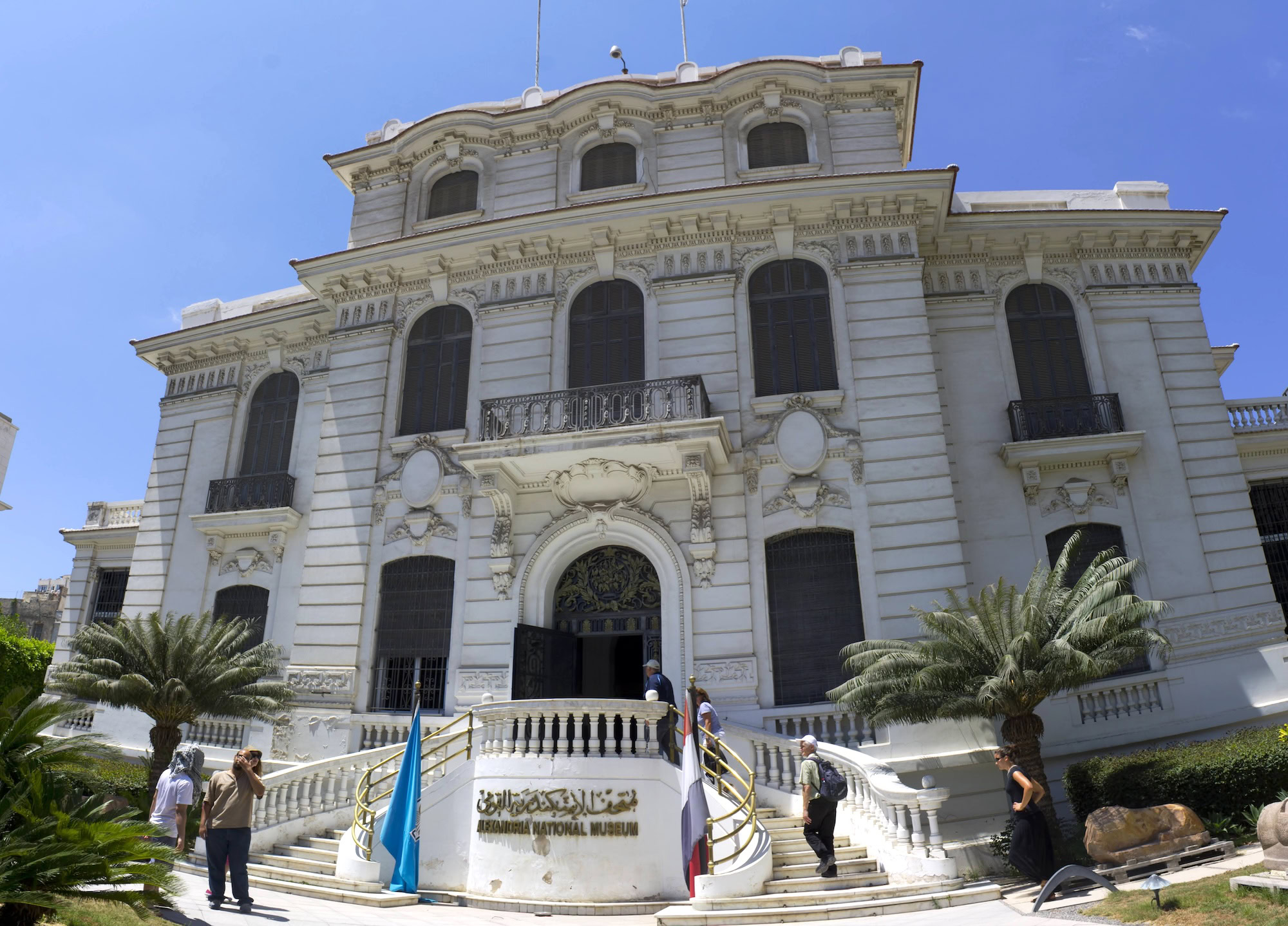
Alexandria National Museum stands as a remarkable testament to Egypt’s layered history, housed within an elegant Italianate mansion that once served as the US consulate. Opened in 2003 under President Hosni Mubarak’s cultural initiatives, this intimate museum offers visitors an extraordinary journey through three millennia of Egyptian civilization. Unlike Cairo’s massive institutions, this Alexandria gem provides a more personal encounter with Egypt’s past, displaying 1,800 carefully curated artifacts across three thoughtfully designed floors.
We believe this museum represents everything that makes Egypt’s cultural heritage so compelling – authentic artifacts, stunning architecture, and stories that bring ancient civilizations to life.
Table of Contents
A Palace Transformed: The Building’s Rich Heritage
The museum’s story begins long before its first artifact was displayed.
Originally constructed in 1926 for Asaad Basili Pasha, a prominent wood merchant, this stunning mansion showcases the finest examples of Italian architectural influence in early 20th-century Alexandria. The building’s elegant facades, ornate interior details, and spacious halls reflect the cosmopolitan character that once defined this Mediterranean city. After serving as the United States consulate for several decades, the structure underwent extensive renovations to accommodate its new role as a cultural institution.
Each exhibition hall has been painted in colors carefully chosen to complement the historical periods displayed within. The pharaonic collections are housed in deep, rich tones that evoke the mysteries of ancient tombs, while the Islamic era artifacts are surrounded by vibrant greens that reflect the period’s artistic traditions.
Modern Facilities Within Historic Walls
Today’s visitors benefit from contemporary amenities seamlessly integrated into the historic structure. The museum features a 1,000-seat theater for lectures and cultural events, a specialized restoration laboratory where artifacts receive ongoing conservation care, and a smaller 150-person lecture hall for educational programs. Accessibility has been prioritized with elevator installation and wheelchair-friendly pathways throughout the building.
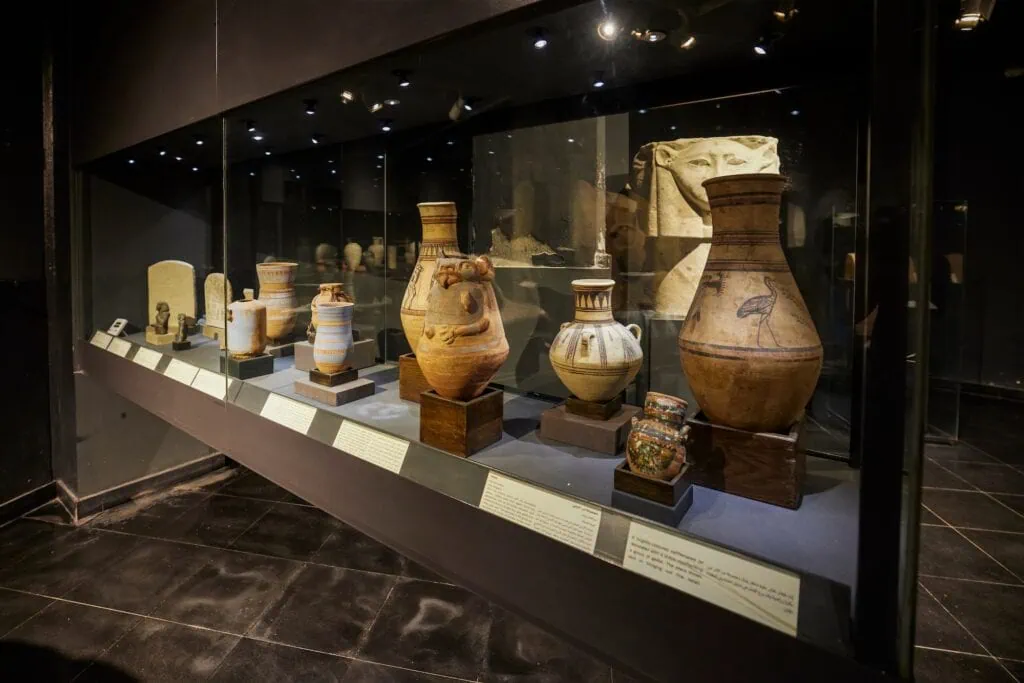
VIP reception areas provide comfortable spaces for special events, while the museum’s parking facilities ensure convenient access for visitors arriving by private vehicle. These modern additions respect the building’s architectural integrity while serving the practical needs of contemporary museum operations.
Three Floors, Three Millennia: The Collections Journey
The museum’s 1,800 artifacts tell Egypt’s story through chronological progression that feels both educational and deeply personal.
Basement Level: Pharaonic Grandeur
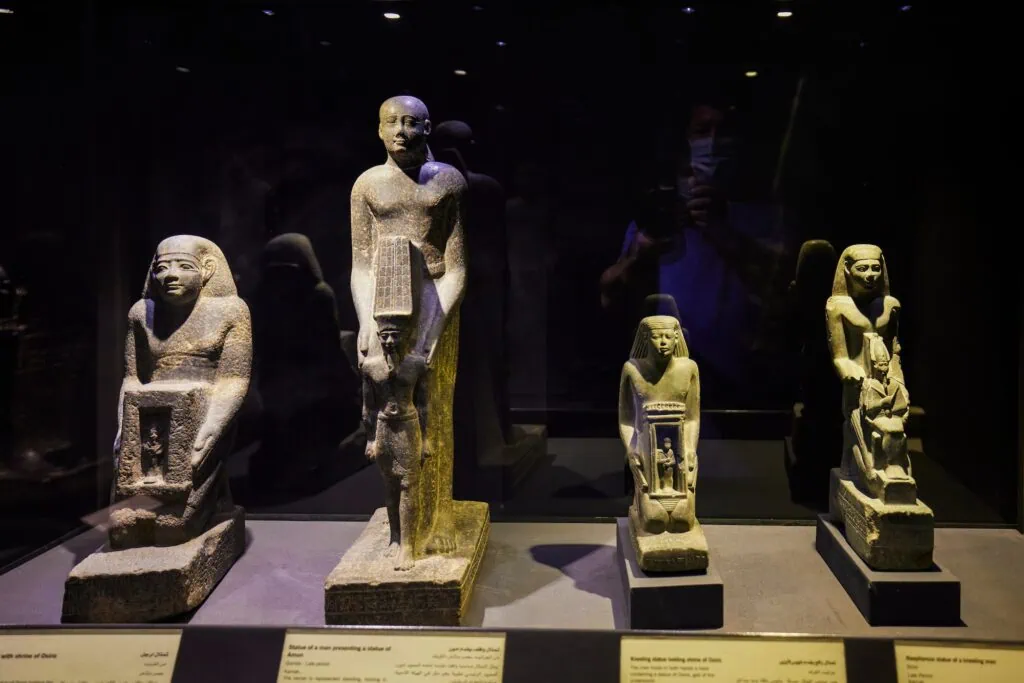
The journey begins in the basement with Egypt’s most ancient treasures. Here, 350 meticulously preserved pieces from the pharaonic period create an atmosphere of reverence and wonder. Visitors encounter stunning heads of Akhnaten and Queen Hatshepsut, their carved features still radiating the power and mystery of Egypt’s golden age. A massive statue of Amun, weighing 1.5 tons, dominates one corner of the gallery, while reconstructed funerary chambers house authentic mummies in settings that mirror their original burial contexts.
These aren’t merely museum pieces behind glass – they’re windows into a civilization that built the pyramids and ruled the ancient world for over three thousand years. The intimate scale of the displays allows visitors to appreciate intricate details often lost in larger institutions.
Ground Floor: Hellenistic and Roman Splendor
The ground level showcases 176 remarkable artifacts from Alexandria’s Hellenistic and Roman periods, many recovered from underwater excavations in the Eastern Harbour and Abu Qir Bay. These submerged treasures offer unique insights into daily life during Alexandria’s peak as the intellectual capital of the ancient world.
A sculpture believed to represent Alexander the Great himself commands attention in the central gallery. Ptolemaic art pieces demonstrate the fascinating cultural fusion that occurred when Greek traditions merged with Egyptian artistic sensibilities. Maritime archaeological finds tell stories of ancient trade routes and the bustling port city that once connected Europe, Africa, and Asia.
Upper Floor: Islamic Heritage and Modern Egypt
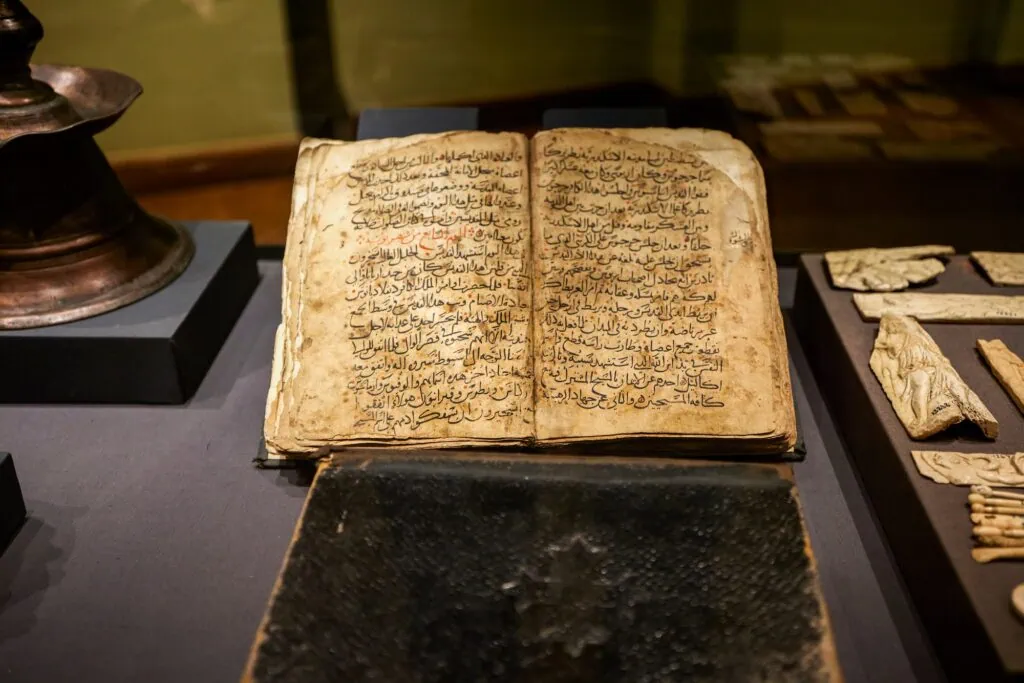
The top floor celebrates Egypt’s Islamic period and more recent history through collections that span from the 7th century to the present day. An impressive currency hall displays coins from various Islamic dynasties that ruled Egypt, while the Islamic weaponry collection showcases the craftsmanship of medieval armorers and weapon makers.
Coptic Christian artifacts bridge the gap between ancient Egyptian traditions and Islamic influences, demonstrating the religious transitions that shaped modern Egypt. Royal jewelry and precious metals from the Muhammad Ali Pasha family provide glimpses into 19th-century Egyptian aristocracy, including gold and silver pieces that reflect the opulence of Egypt’s modern founding dynasty.
Underwater Treasures: Alexandria’s Submerged Heritage
Alexandria’s location along the Mediterranean coast has yielded some of Egypt’s most extraordinary archaeological discoveries.
The museum’s collection of sunken antiquities from Abu Qir Bay represents decades of underwater archaeological work. These pieces spent centuries beneath the waves, preserved in conditions that have maintained their integrity while adding mysterious patinas and textures impossible to achieve on dry land. Visitors can examine artifacts that once adorned palaces and temples now completely submerged beneath Alexandria’s harbor waters.
Each piece tells part of the larger story of ancient Alexandria – a city where Cleopatra walked, where the famous library once stood, and where Greek, Roman, and Egyptian cultures created something entirely new. The underwater finds provide tangible connections to neighborhoods and districts that have been lost to time and rising sea levels.
Maritime archaeological techniques have recovered everything from everyday household items to ceremonial objects, creating a comprehensive picture of life in ancient Alexandria. These discoveries continue to reshape our understanding of how this cosmopolitan city functioned as a bridge between civilizations.
Planning Your Visit: Practical Information
We recommend allowing at least two hours to properly explore all three floors and absorb the museum’s diverse collections.
Operating Hours and Admission
The museum opens daily from 9:00 am (09:00) to 5:00 pm (17:00), providing ample time for thorough exploration. Note that payment is accepted by credit card only – cash transactions are not available. Adult admission provides access to all three floors and the special exhibitions, making it excellent value for the comprehensive experience offered.
Getting There
Located in Alexandria’s historic district, the museum is easily accessible by taxi or private vehicle. The building’s distinctive Italian architecture makes it recognizable from several blocks away. Parking is available on-site, though we recommend arriving earlier in the day during peak tourist seasons for the best parking availability.
What to Expect
The museum’s intimate scale means you’ll never feel rushed or overwhelmed by massive crowds. Small sculptures and detailed artifacts can be viewed up close, allowing for the kind of detailed examination that’s impossible in larger institutions. The chronological organization helps visitors understand Egypt’s historical progression without requiring extensive prior knowledge.
Why Alexandria National Museum Deserves Your Time
This museum offers something increasingly rare in Egypt’s tourism landscape – authenticity without overwhelming scale.
While Cairo’s Egyptian Museum houses more artifacts, Alexandria National Museum provides context and intimacy that create deeper connections with Egypt’s past. The building itself becomes part of the experience, with its diplomatic history and architectural elegance adding layers of meaning to the visit. The carefully curated selection of 1,800 pieces means every artifact has been chosen for its historical significance or artistic merit.
TripAdvisor consistently ranks the museum among Alexandria’s top 10 attractions, with visitors praising both the collection quality and the personal attention possible in this more intimate setting. The museum serves not just tourists but also researchers and students, maintaining active educational programs that bring Egypt’s history to life for new generations.
For travelers seeking to understand Egypt beyond the pyramids and temples, Alexandria National Museum provides essential context about the country’s multicultural heritage and its role as a bridge between ancient and modern worlds.
Trace Egypt’s Story At Alexandria National Museum
The Alexandria National Museum brings Egypt’s rich past to life—guiding you through Pharaonic, Greco-Roman, and modern eras in one elegant setting. With EgyptToursPlus, we seamlessly include this cultural highlight in a private journey that connects Alexandria’s heritage with Egypt’s most iconic and unforgettable experiences.
You choose your travel dates, your pace, and the experiences that shape your route. From immersive museum visits to coastal exploration, ancient landmarks, and refined comfort throughout, we tailor every detail around your preferences—ensuring a smooth, expertly planned, and deeply personal journey.
Frequently Asked Questions
Most visitors should plan 2 to 3 hours for Alexandria National Museum to comfortably explore its three floors covering Pharaonic, Greco-Roman, Coptic, Islamic, and modern Egyptian history. The museum contains more than 1,800 artifacts displayed in chronological order inside a restored Italian-style palace near central Alexandria. Travelers interested in underwater archaeology or royal sculpture may want additional time for detailed viewing. Morning visits generally feel less crowded and provide a quieter experience for reading exhibit descriptions and photographing displays.
No, Alexandria National Museum currently operates as a cashless site for admissions and most museum shop transactions, so visitors should carry a valid credit or debit card. International Visa and Mastercard payments are generally accepted, although travelers should notify their bank before visiting Egypt to avoid transaction blocks. Compared with smaller Egyptian museums that may still accept cash, Alexandria National Museum follows stricter electronic payment procedures. Keeping a backup payment card is also recommended in case of connectivity or banking issues.
Alexandria National Museum is best known for its statue believed to depict Alexander the Great, royal portraits of Akhnaten and Queen Hatshepsut, a massive 1.5-ton statue of Amun, and underwater discoveries recovered from Abu Qir Bay. The museum also displays Greco-Roman mosaics, Coptic icons, Islamic-era objects, and reconstructed burial chambers spanning more than 3,000 years of Egyptian history. Many underwater artifacts came from the submerged royal quarter of ancient Alexandria. The diversity of the collection makes the museum unusually comprehensive for its size.
Yes, Alexandria National Museum is generally very suitable for children because its compact layout, reconstructed tomb displays, and mummy exhibits create a more approachable experience than larger national museums. Families can comfortably explore the collection within 2 to 3 hours without the exhaustion often associated with massive archaeological sites. Interactive presentation styles and varied artifact types also help maintain younger visitors’ attention. Parents visiting during weekday mornings usually encounter quieter galleries and shorter entry lines, making the experience easier for children.
Alexandria National Museum is significantly smaller than Cairo’s Egyptian Museum, but many visitors prefer its quieter atmosphere, clearer organization, and stronger focus on Alexandria’s multicultural history. While Cairo’s museum emphasizes vast Pharaonic collections, Alexandria National Museum presents a more balanced timeline including Greco-Roman, Coptic, Islamic, and modern Egyptian periods within one building. The smaller scale also allows visitors to examine artifacts more comfortably without overwhelming crowds. Travelers with limited time often find the Alexandria museum easier to absorb in a single visit.
Yes, guided tours of Alexandria National Museum are available and can be combined with nearby landmarks such as the Bibliotheca Alexandrina, Pompey’s Pillar, and the Catacombs of Kom el Shoqafa. Professional Egyptologist guides help explain the historical transitions between ancient Egyptian, Greek, Roman, Coptic, and Islamic eras represented throughout the collection. Private guided visits also allow more time at specific exhibits like the underwater archaeology section from Abu Qir Bay. Advance booking is recommended during weekends and Egyptian public holidays.
Alexandria National Museum pairs especially well with the Bibliotheca Alexandrina, Pompey’s Pillar, the Roman Amphitheater, and the Catacombs of Kom el Shoqafa for a full-day cultural itinerary. These sites collectively trace Alexandria’s evolution from the Ptolemaic era through Roman, Coptic, and modern Egyptian history within relatively short driving distances. The museum’s central location also makes it convenient to combine with the Corniche waterfront and historic downtown architecture. Starting early helps visitors comfortably fit several attractions into one day.
Yes, Alexandria National Museum is considered one of Egypt’s more accessible museums, with elevators, ramps, and adapted pathways connecting all three exhibition floors. The building was renovated from a former palace into a modern museum facility, allowing accessibility improvements that are difficult at many ancient archaeological sites. Visitors with mobility limitations can generally navigate the galleries comfortably with assistance if needed. Compared with older historic monuments in Alexandria, the museum offers a far more manageable experience for wheelchair users.
The best time to visit Alexandria National Museum is typically between 9:00 am and 11:00 am, when galleries are quieter and temperatures in Alexandria remain more comfortable for walking between nearby attractions. Morning light also improves interior visibility and exterior photography around the museum’s restored Italian-style façade. Afternoon periods can become busier with tour groups and school visits, particularly on weekends and Egyptian holidays. Travelers planning multiple Alexandria attractions usually benefit from starting their day at the museum first.
Yes, Alexandria National Museum includes a gift shop offering books on Egyptian history, replica statues, educational materials, postcards, and archaeology-themed souvenirs connected to the museum’s collections. Items related to Alexandria’s Greco-Roman heritage and underwater discoveries are particularly popular with international visitors. Most purchases require card payment because the museum operates under cashless transaction policies. Travelers seeking higher-quality educational souvenirs often find museum shops more reliable than street vendors near major tourist areas.
Photography policies inside Alexandria National Museum can vary depending on the exhibition area, conservation concerns, and temporary displays, so visitors should confirm current rules at the entrance desk upon arrival. Flash photography is commonly restricted because repeated light exposure may damage pigments, textiles, and delicate archaeological surfaces over time. Professional cameras, tripods, or commercial filming equipment may require additional permissions from Egyptian authorities. Morning visits usually provide the most comfortable conditions for interior photography without heavy visitor traffic.
Design Your Custom Tour
Explore Egypt your way by selecting only the attractions you want to visit