

Two timeless civilizations, one epic private journey
Egypt and Greece Tours
Our Egypt and Greece Tours bring you a smooth, tailor-made adventure through two of the world’s most iconic destinations. Enjoy fully customizable itineraries, seamless planning, and 24/7 support from specialists who ensure your journey is as inspiring as it is worry-free.
The Alexandria Axis: Where Egypt and Greece Met for 600 Years
The Pyramids and the Acropolis bookend 2,500 years of classical Mediterranean civilisation — and Alexandria is the city that connected them.
Egypt and Greece is the most thematically connected multi-country pairing we offer. The two civilisations didn’t just exist in parallel; they overlapped, traded, conquered each other, and in the case of Egypt’s Ptolemaic period, became one.
Alexander the Great founded Alexandria in 332 BC, and for the next six centuries it was the meeting point of Greek and Egyptian culture, the intellectual capital of the Mediterranean, and the city that produced everything from Euclid’s geometry to Cleopatra’s dynasty. Walking the Avenue of Sphinxes at Karnak and then walking the Sacred Way to the Acropolis a week later traces 2,500 years of the same Mediterranean cultural conversation.
We’ve been crafting Egypt journeys since 1955, with TripAdvisor Travelers’ Choice 2020 through 2026 in our pocket. Our Egypt and Greece itineraries are built as one continuous trip, around your dates, pace, and budget — flights, transfers, hotels, and guides coordinated end-to-end so you don’t notice the country line you’re crossing.
Table of Contents
Why Egypt and Greece Pair So Well
Three reasons this combination works better than most multi-country trips.
Geographic and logistical simplicity
Cairo to Athens is a 2-hour 45-minute direct flight, operated daily by EgyptAir. Both cities have efficient international airports and well-developed inbound tourist infrastructure. Time zones are exactly the same (Cairo and Athens both run EET/EEST), so jet lag between the two countries is non-existent. We coordinate the international flights, the Cairo–Athens connection, and all transfers as one continuous booking.
Same season, no compromise
Both countries run their high seasons in roughly the same windows. Spring (April–early June) and autumn (September–October) are the sweet spots for combining them — Egypt’s heat hasn’t peaked, and Greece’s tourist crush hasn’t started or is winding down. Summer works for Greece but is genuinely difficult in Egypt; winter works for Egypt but closes most Greek islands. Spring and autumn deliver both at their best.
Two civilisations that actually shaped each other
Most multi-country pairings work because of geography or logistics. Egypt and Greece work because of history. The two civilisations overlapped for 600 years — Greek dynasties on Egyptian soil, Egyptian gods worshipped in Greek temples, Greek philosophy taught in Alexandria, Coptic Christianity born from Greek-speaking communities — producing fused art, architecture, and religion. Few other pairings on the planet have this depth of shared cultural DNA, which is what makes the trip more than just two countries on one passport. The full historical case is laid out in the next section.
How We Build an Egypt + Greece Trip
Every Egypt + Greece itinerary we run is built privately, around the travelers booking it. There’s no fixed-departure version. Your party travels with its own Egyptologist guide and personal driver in Egypt, and with a licensed local guide and driver in Greece.
A typical Egypt + Greece trip runs 10 to 14 days. The split that works for most travelers:
- 5 to 7 days in Egypt (Cairo, optionally a 4-day Nile cruise, Abu Simbel)
- 5 to 7 days in Greece (Athens, plus 1–3 islands)
Shorter pairings (10 days) drop the Nile cruise and run Cairo + Athens + 1 island. Longer pairings (14–18+ days) add Alexandria (the natural Greek-Egyptian bridge city), more Greek islands, an Abu Simbel extension via Lake Nasser, or a third country (Turkey being the most popular add-on, with Istanbul and Cappadocia rounding out an Eastern Mediterranean ancient civilisations circuit).
Order of travel
We sequence Egypt first, Greece second, in nearly all cases. Two reasons. The first is intensity: Cairo is dense, Greek islands are restful by comparison, and finishing in Greece gives travelers a softer landing before the long flight home. The second is logistics: Athens International Airport (ATH) has stronger direct connections to Europe and North America than Cairo for return flights.
Cruise or no cruise
The Nile cruise is the strongest single experience on the Egypt side. Itineraries with a cruise spend 4 days / 3 nights between Luxor and Aswan on either a Luxury Nile Cruise (50–150 guests, 5-star, panoramic cabins) or a Dahabiya Nile Cruise (8–16 guests, traditional twin-mast sailing vessel). We also offer 5, 6, 7, and 8-day cruise options on select Luxury Nile Cruise vessels for travelers wanting more time on the river. Itineraries without a cruise still cover Cairo properly and can include Luxor and Aswan via flights and hotel-based touring.
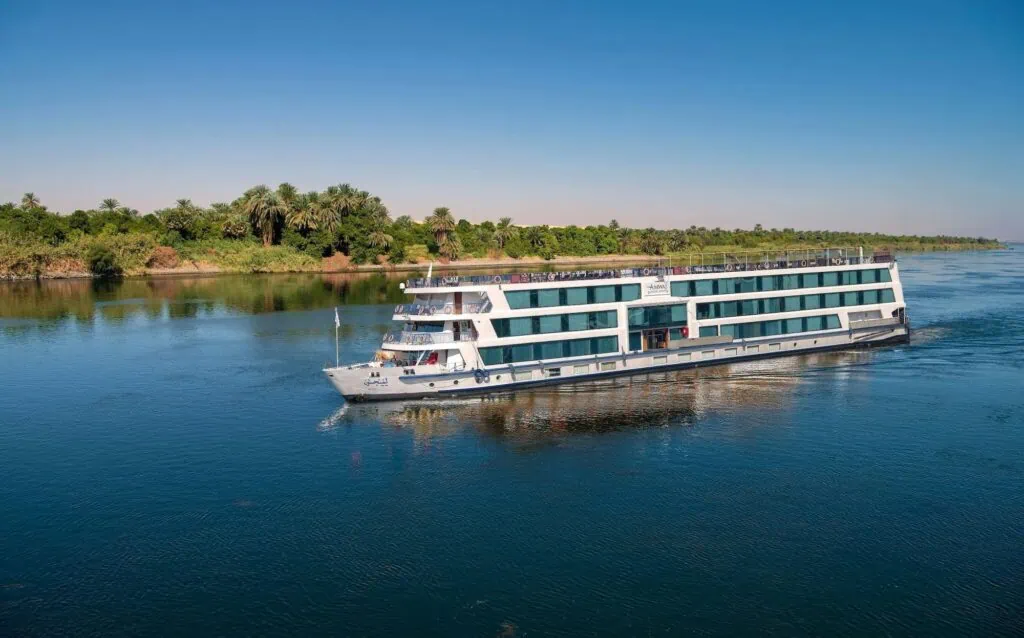
A note on cruise shore excursions. On Luxury Nile Cruises, shore excursions run as small group experiences (around 12 guests per Egyptologist), shared with fellow ship passengers. Fully private excursions can be arranged on request at additional cost. On Dahabiyas, the boat itself is small enough that excursions feel essentially private. All your land-based touring in Cairo, Luxor, Aswan, and across Greece is fully private throughout: just your party plus your guide and driver.
How Egypt and Greece Actually Connected
The opener established Alexandria as the meeting point. This section unpacks how the two civilisations got there — and why the connection runs much deeper than a single city.
Egypt was old when Greece was young. The Pyramids were already 2,000 years old when Greek civilisation began emerging in the Bronze Age. Early Greek philosophers, mathematicians, and architects travelled to Egypt to study — Pythagoras, Solon, Herodotus, and (according to tradition) Plato all spent time there. Greek geometry, astronomy, and even some elements of Greek religion absorbed Egyptian influence during this period. When Herodotus visited the Pyramids in the 5th century BC, he was already a tourist looking at ancient monuments — the same monuments you’ll see.
Then Greece conquered Egypt. Alexander the Great arrived in 332 BC, was welcomed as a liberator from Persian rule, and founded Alexandria on the Mediterranean coast. After his death, his general Ptolemy took Egypt and founded a Greek-speaking dynasty that ruled the country for nearly three centuries. The Ptolemies built temples in pharaonic style (Edfu, Kom Ombo, the temple of Hathor at Dendera, and large parts of Philae are all Ptolemaic), spoke Greek at court, and presided over Alexandria as the intellectual capital of the Mediterranean. The famous Library of Alexandria, the Pharos lighthouse (one of the Seven Wonders of the Ancient World), and much of the Greek mathematical and astronomical tradition came out of this Hellenistic-Egyptian fusion. The dynasty ended in 30 BC with Cleopatra VII — the last pharaoh of Egypt was a Greek queen.
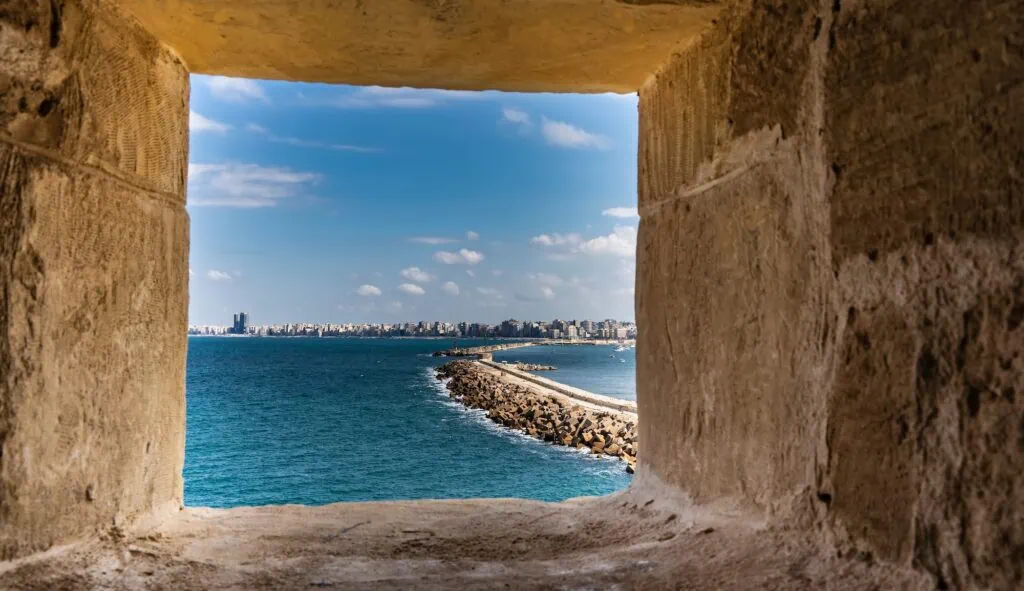
The architectural and artistic conversation runs through both countries, in stone you can actually see. The Ptolemaic temples at Edfu, Kom Ombo, Dendera, and Philae use pharaonic temple layout but Hellenistic decorative vocabulary. The Greco-Egyptian sculpture style produced in Alexandria influenced Roman portraiture for centuries afterwards. Coptic Christianity grew out of the Greek-speaking Christian community in Alexandria. The Acropolis Museum in Athens houses statuary that would look familiar to anyone who’s just spent a week looking at the Greco-Roman period rooms at the Grand Egyptian Museum — and vice versa.
This is why Egypt + Greece rewards travelers more than equivalent-distance pairings. You’re not just stamping two countries on a passport. You’re tracing one continuous Mediterranean cultural thread that runs from the 26th century BC pyramids through 5th century BC Athens through 1st century BC Cleopatra all the way to the modern day.
What Egypt Gives You
Each tour itinerary on the site lists what’s included as standard. Below is the broader picture — what Egypt can deliver across an Egypt + Greece trip.
The Grand Egyptian Museum, now fully open, is the dominant museum draw. It holds the world’s most comprehensive pharaonic collection, including the complete Tutankhamun ensemble — the golden mask, the inner shrines, and the rest of the 5,000+ items displayed together for the first time in history. A half-day visit is the minimum.
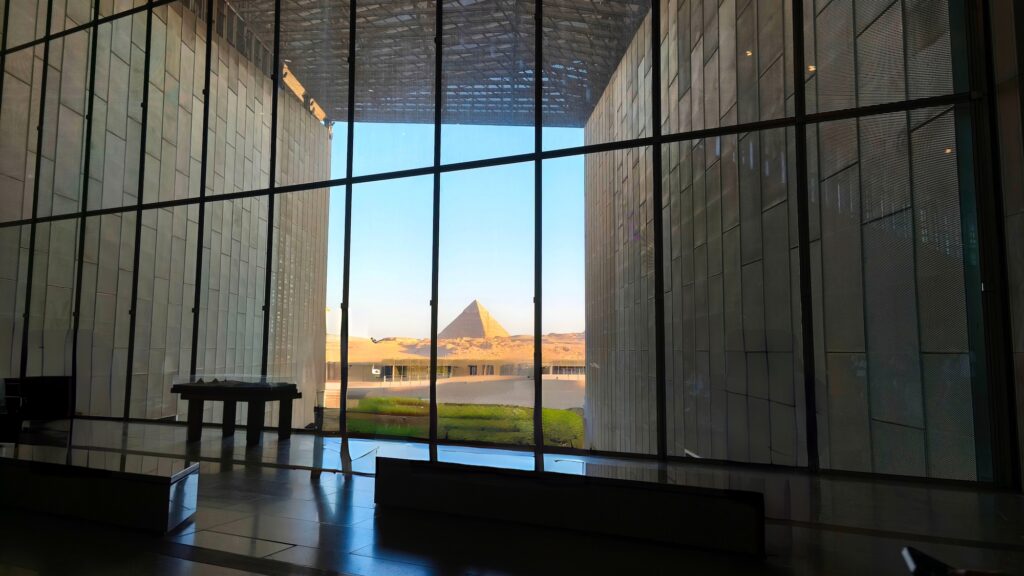
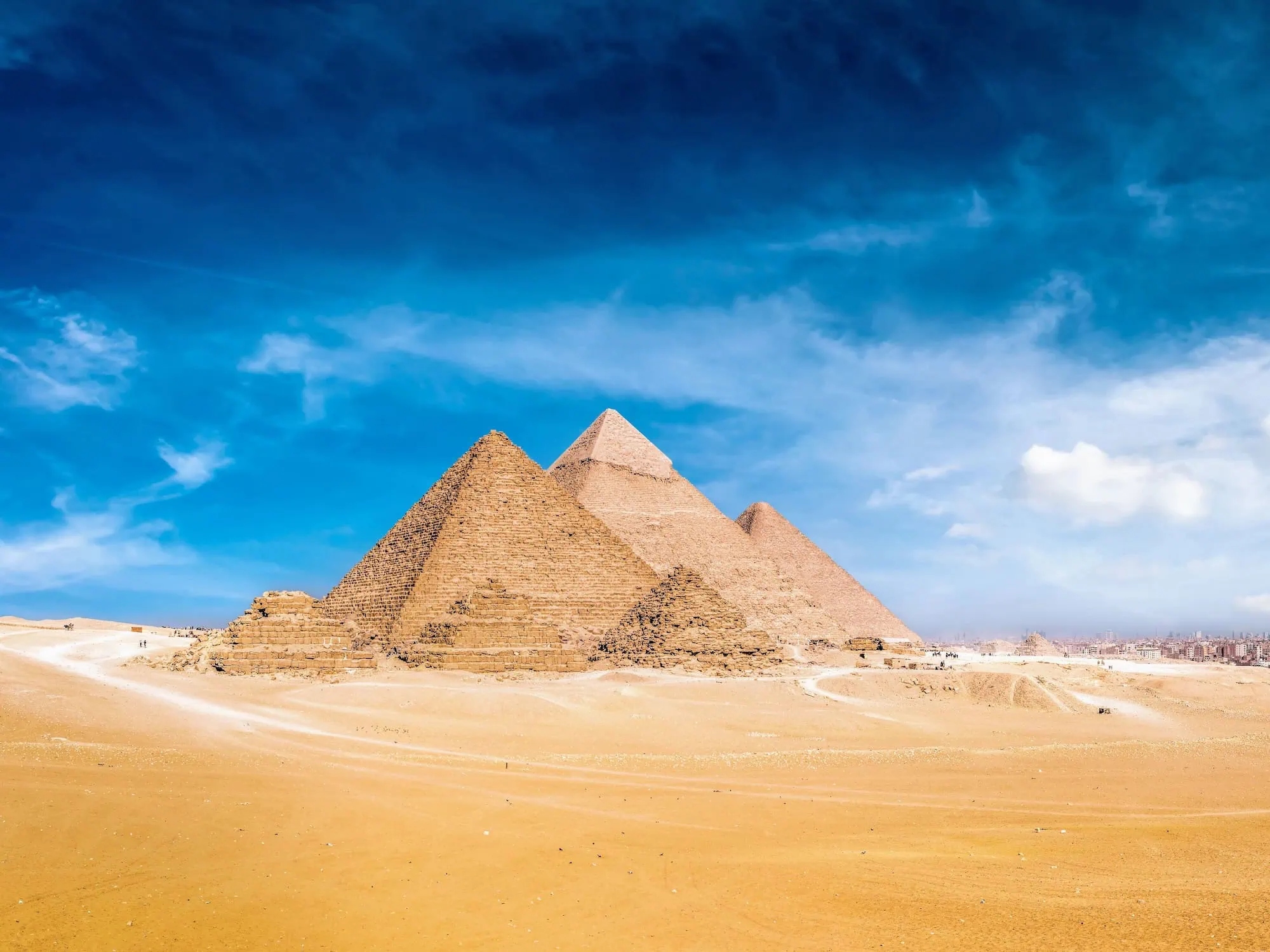
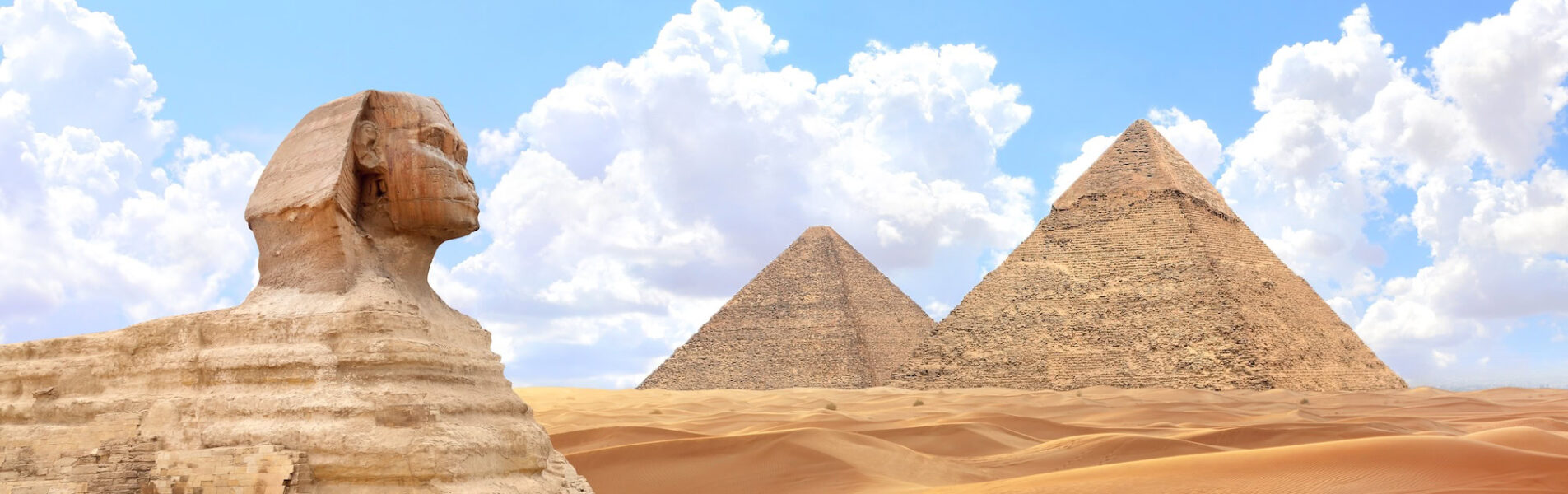
The Pyramids of Giza remain the moment most travelers came for. The Great Pyramid is roughly 4,500 years old and is the only surviving Wonder of the Ancient World. Interior access (a separate ticket with a daily quota) can be added on request if you want to climb into the burial chamber.
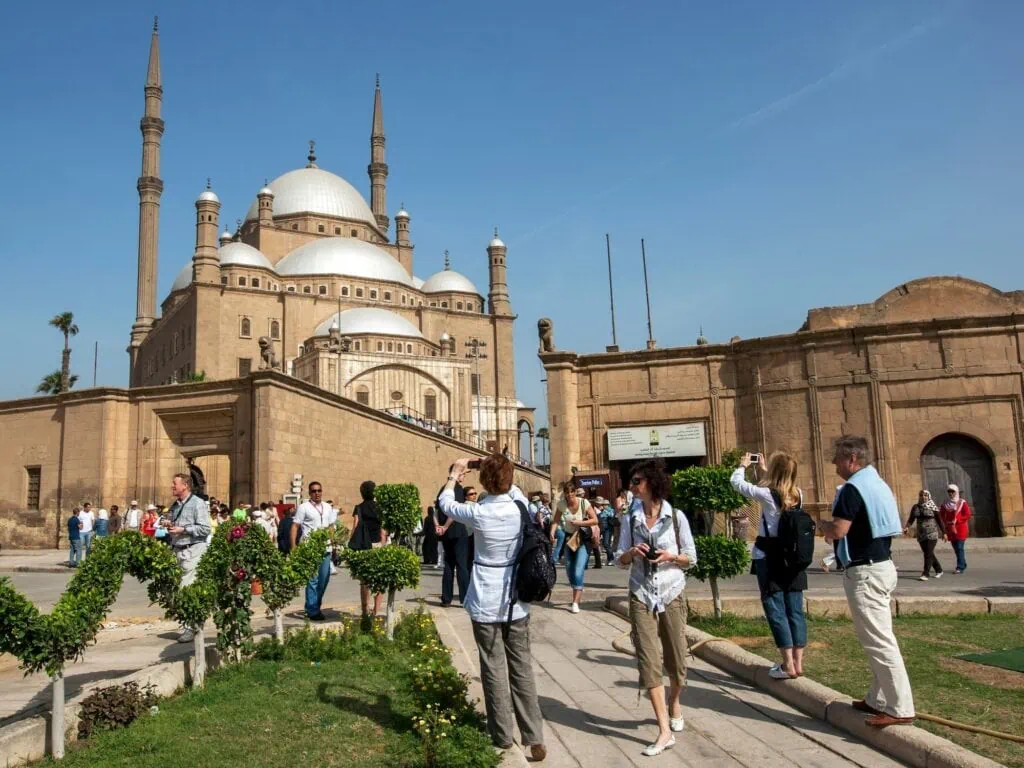
Khan El Khalili is the medieval bazaar quarter, alive since the 14th century. Coptic Cairo anchors the early Christian heritage of the country, with the Hanging Church (Al-Muallaqa) at its centre — and the Coptic tradition is one of the most direct lineages from the Hellenistic-Egyptian period. The Citadel of Saladin offers the best panoramic view of Cairo and houses the Mosque of Muhammad Ali.
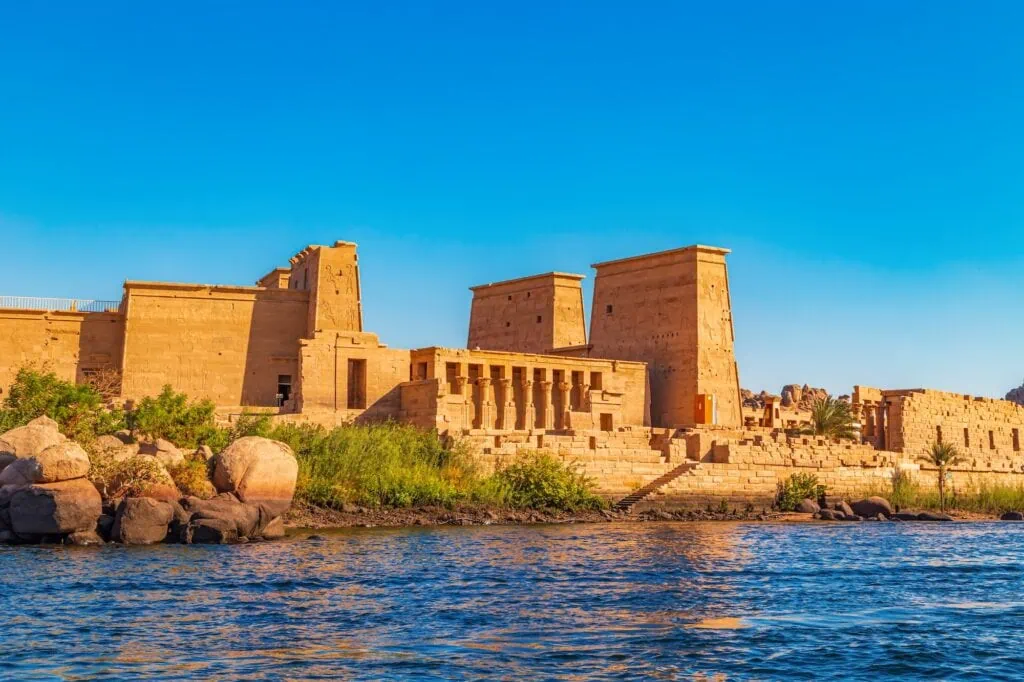
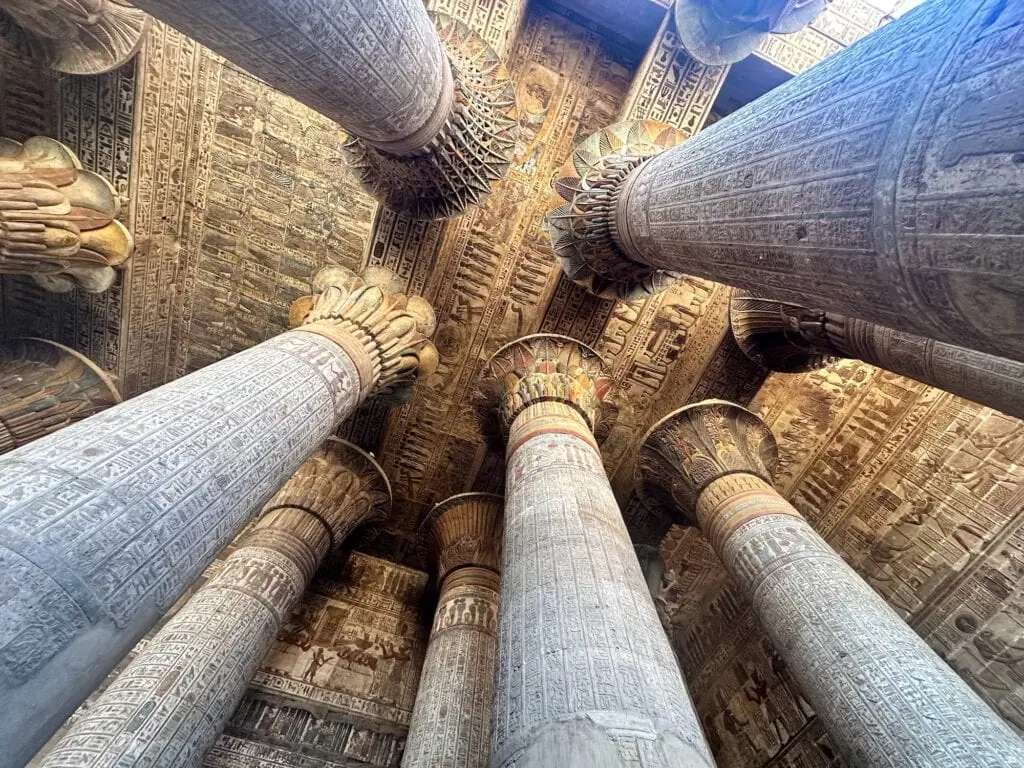
If your itinerary includes Luxor and Aswan, the highlights are Karnak Temple (with its Hypostyle Hall of 134 columns, and the 2.7 km Avenue of Sphinxes connecting to Luxor Temple), the Valley of the Kings, Hatshepsut’s Mortuary Temple at Deir el-Bahari, and Philae Temple in Aswan (largely Ptolemaic in its current form — direct Greek-Egyptian fusion architecture you’ll see).
For travelers specifically interested in the Greek-Egyptian connection, Alexandria is the natural addition: the catacombs of Kom el-Shoqafa, the Roman amphitheatre, the Citadel of Qaitbay (built on the site of the ancient Pharos lighthouse), and the modern Bibliotheca Alexandrina. We can build Alexandria into the itinerary as a day trip from Cairo or as an overnight.
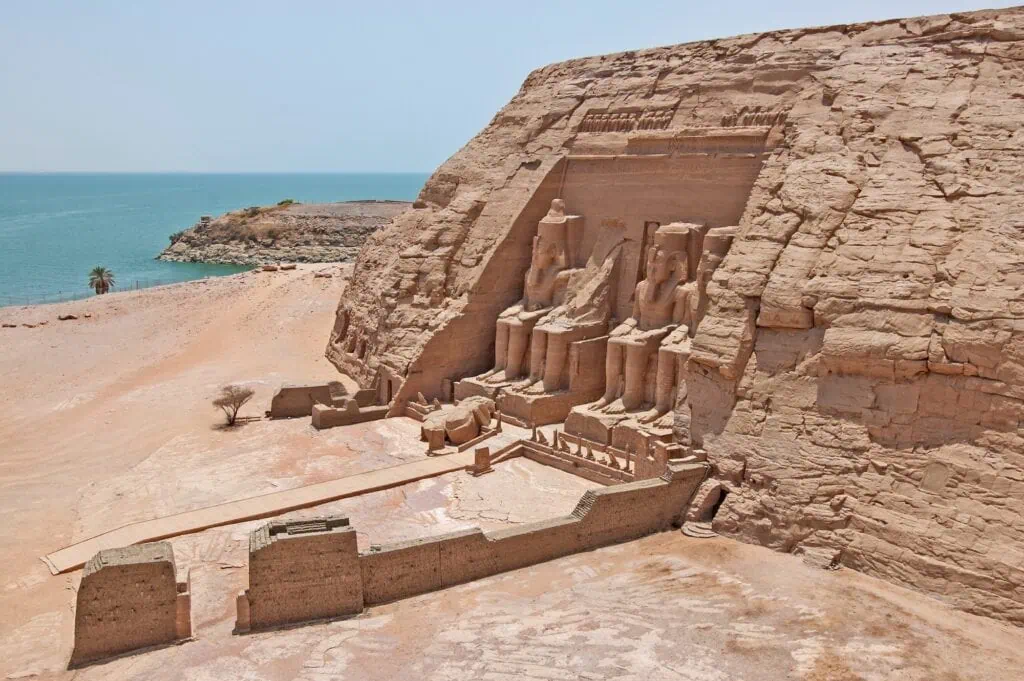
Abu Simbel as an extension — the colossal twin temples of Ramesses II and Nefertari, relocated stone by stone in the 1960s to escape the rising waters of Lake Nasser. Abu Simbel sits 280 km south of Aswan and is added in one of three ways:
- Flight from Aswan (45 minutes each way) — fastest, ideal if your time is tight. Adds 1 day.
- Small-group road convoy from Aswan (3-hour drive each way through the Western Desert, departing pre-dawn, runs as a small-group format rather than private) — the cost-effective option. Adds 1 day.
- Lake Nasser cruise extension (3 or 4 nights from Aswan to Abu Simbel and back, taking in the relocated Nubian temples along the way) — the most immersive. Adds 3 to 4 days.
What Greece Gives You
Greece delivers on a more spread-out, island-based scale than Egypt. Five to seven days covers the headlines properly: Athens for the classical heritage, plus one to three islands for the Aegean experience.
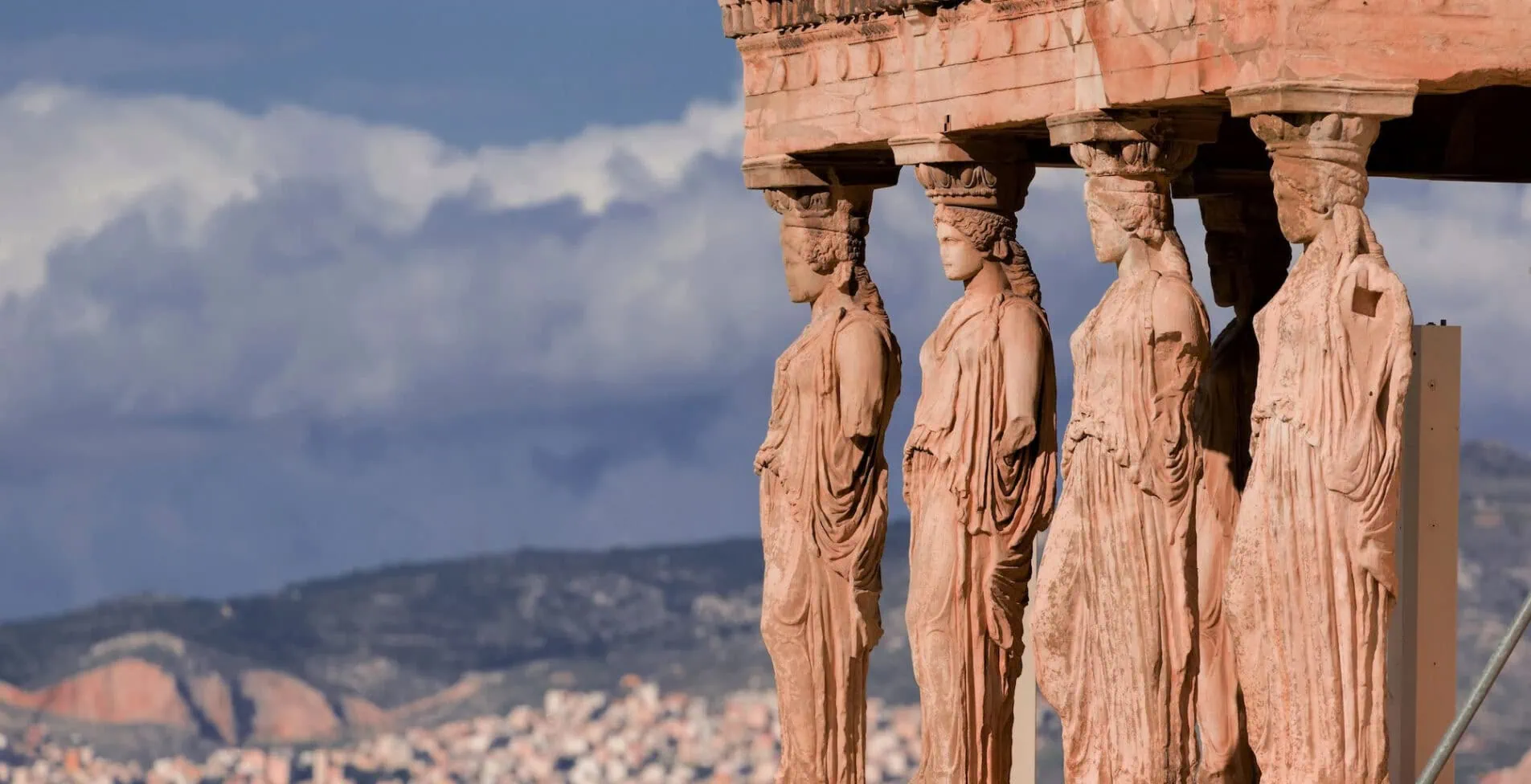
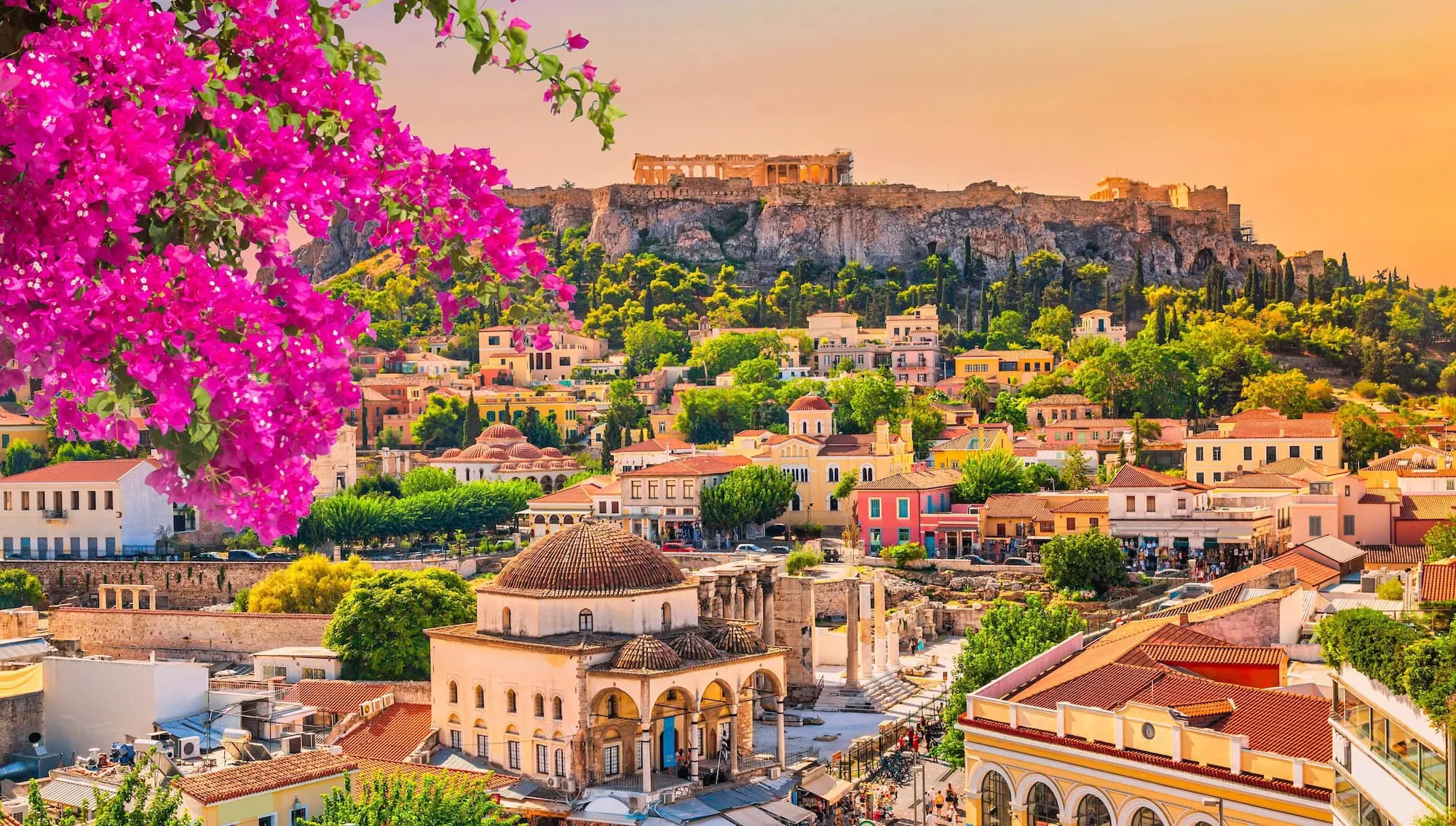
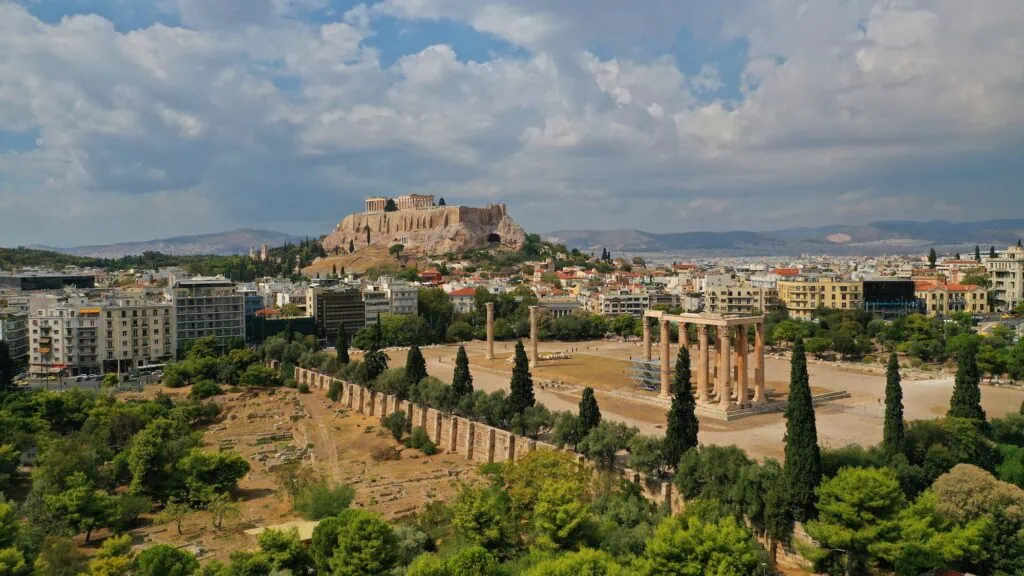
Athens is where every Greece itinerary anchors. The Acropolis with the Parthenon (5th century BC, the architectural high-point of classical Greek civilisation), the Acropolis Museum (one of the best archaeology museums in the world, designed specifically to display the Acropolis collection), the Ancient Agora (the heart of classical Athenian democracy), the Roman Agora and the Tower of the Winds, the Temple of Olympian Zeus, the National Archaeological Museum, and the Plaka old town for evening dining and rooftop bars with Acropolis views. Two to three days covers Athens properly.
The Greek islands are the second half of the experience. The four most popular for Egypt + Greece itineraries:
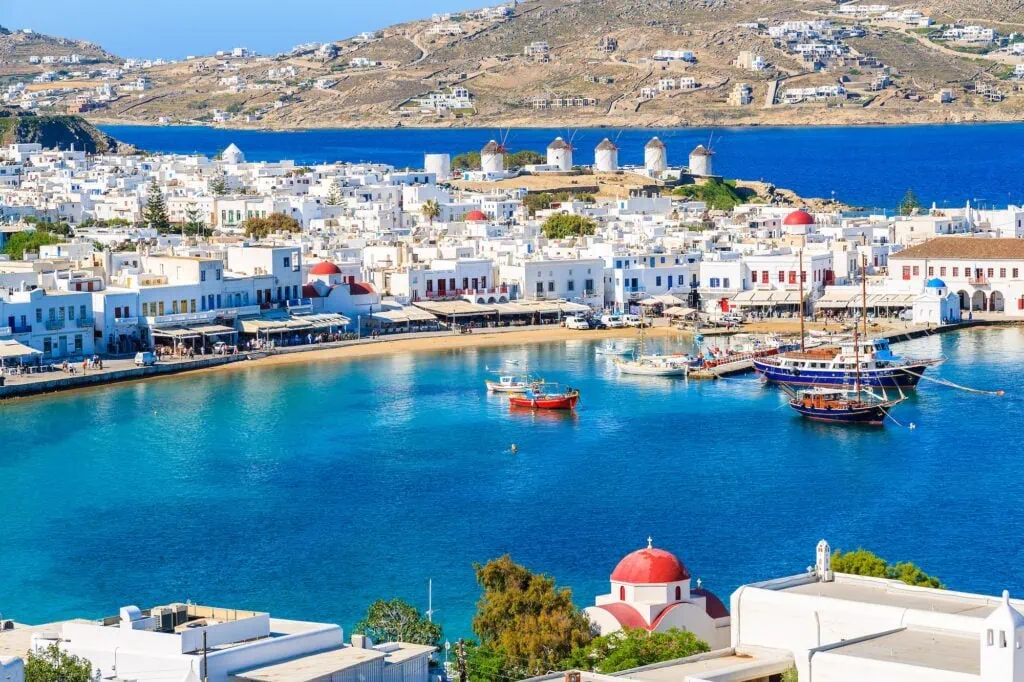
- Santorini — the volcanic caldera, the white-washed cliffside villages of Oia and Fira, sunset at Oia (the most photographed sunset in Europe), wineries on the volcanic soil, and beach time. The most romantic of the major islands. Open roughly April through October — closed in winter.
- Mykonos — Cycladic architecture, the windmills, beach clubs, and the most active nightlife of the Greek islands. Open roughly April through October.
- Crete — the largest Greek island, with the Minoan palace at Knossos (the foundational Bronze Age civilisation that preceded classical Greece), Heraklion’s archaeological museum, mountain villages, and beaches. Open year-round, with milder winter weather than the Cyclades.
- Hydra, Aegina, Spetses (the Saronic Gulf islands) — closest to Athens (1–2 hour ferries from Piraeus), open year-round, much quieter than Santorini and Mykonos. Ideal for shoulder-season trips and for travelers wanting Greek island feel without the summer crowds.
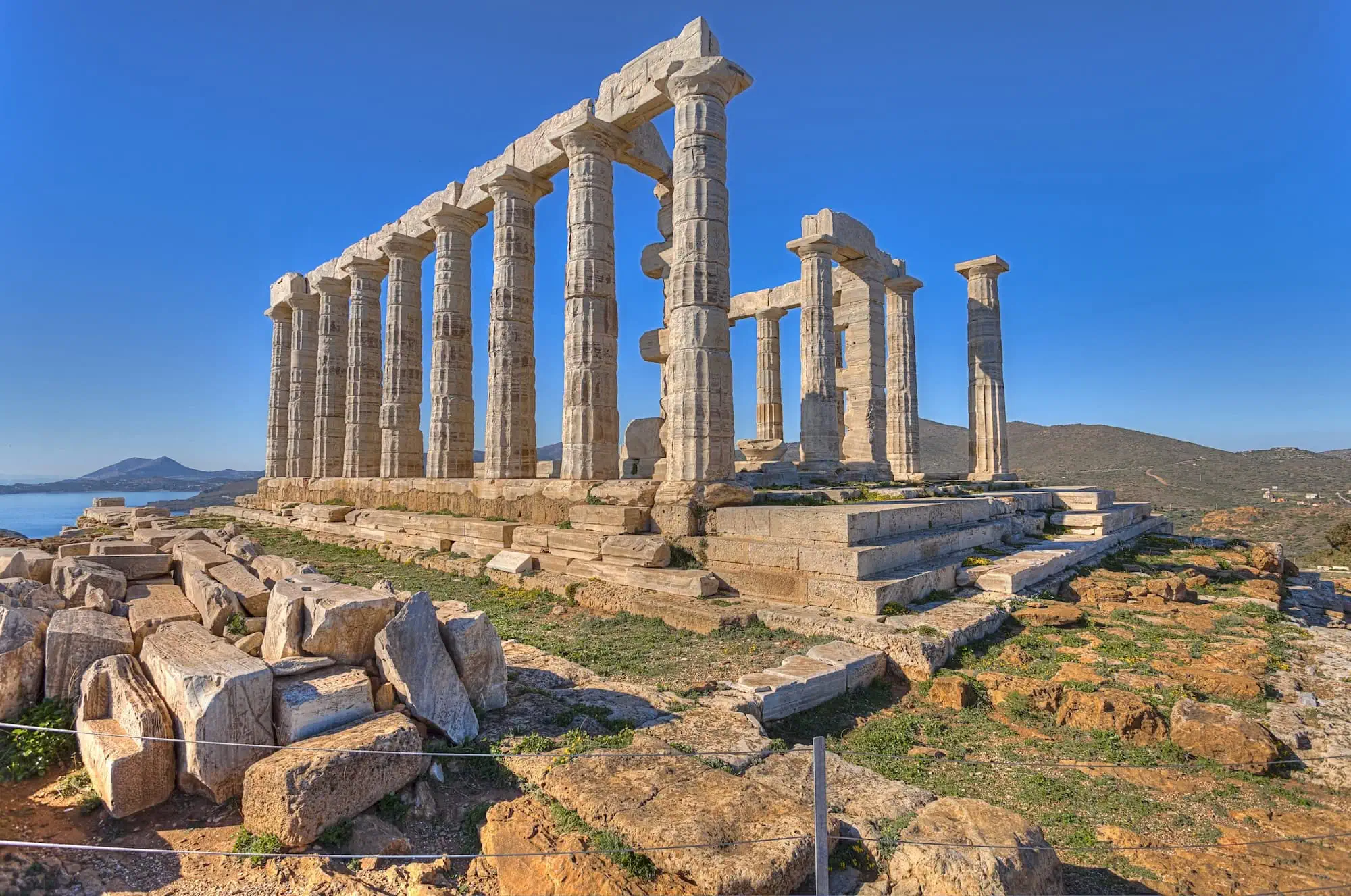
Day trips from Athens worth considering: Cape Sounion (the Temple of Poseidon at sunset, 70 km / 43 miles south of Athens), Delphi (the ancient oracle site, 2.5 hours west), and Mycenae and Epidaurus (Bronze Age fortress and the best-preserved ancient theatre in Greece, both in the Peloponnese, makeable as a long day or split across two days with a Nafplio overnight).
Alexandria: The Bridge Between the Two Trips
Alexandria deserves a section of its own because it’s the place where Egypt + Greece becomes geographically and historically literal. Founded by Alexander the Great in 332 BC, Alexandria was the intellectual capital of the ancient Mediterranean for 600 years and the meeting point of Greek, Egyptian, Jewish, and later Christian and Islamic traditions.
The headline sites: the Catacombs of Kom el-Shoqafa (a 2nd-century AD necropolis with extraordinary Greek-Egyptian-Roman fused funerary art), the Roman Amphitheatre at Kom el-Dikka (the only Roman amphitheatre in Egypt), the Citadel of Qaitbay (a 15th-century fortress built directly on the foundation stones of the ancient Pharos lighthouse, one of the Seven Wonders of the Ancient World), the Bibliotheca Alexandrina (the modern library completed in 2002, designed as a tribute to the original Library of Alexandria that burned in antiquity), and Pompey’s Pillar.
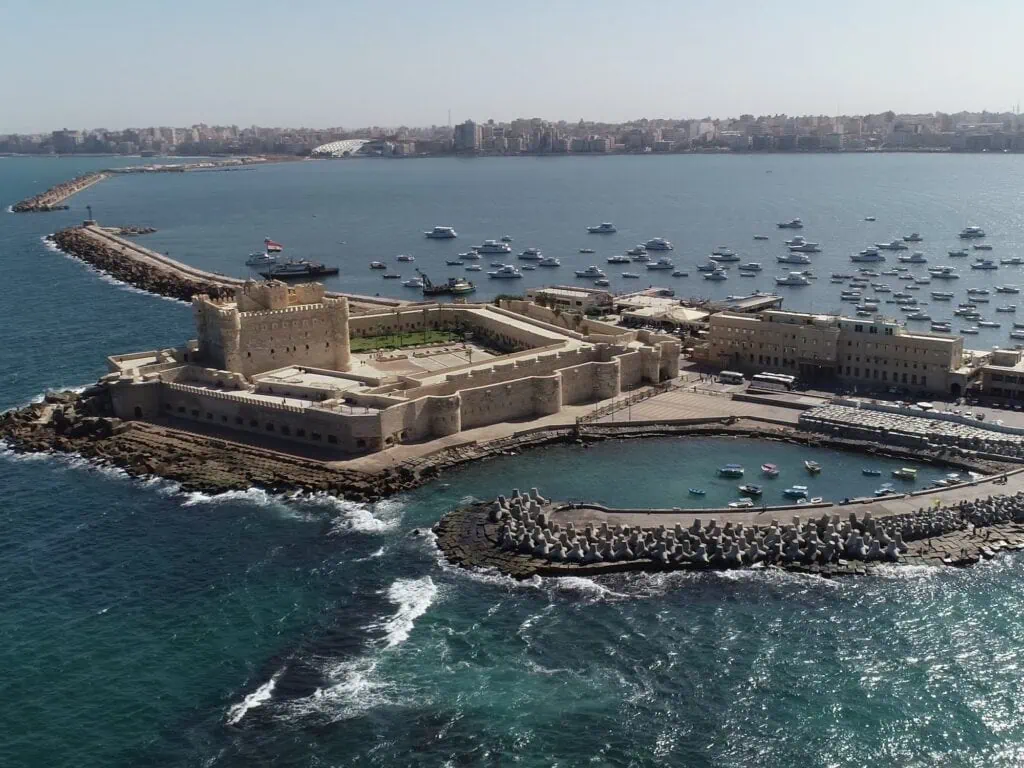
Alexandria sits about 220 km northwest of Cairo on the Mediterranean coast, reachable by a 2.5-hour drive or a 2-hour train ride. We typically build it as either a long day trip from Cairo or as a one-night overnight extension. For travelers specifically interested in the Hellenistic-Egyptian theme, Alexandria is the single most important add-on you can make to an Egypt + Greece trip.
Hotels Across Both Countries
Each tour itinerary on the site lists the specific hotels included in that package. Those are our recommended starting points, picked for location, comfort, and consistency of service. Anything below is alternatives or upgrades you can request when you’re tuning the trip with your Travel Concierge.
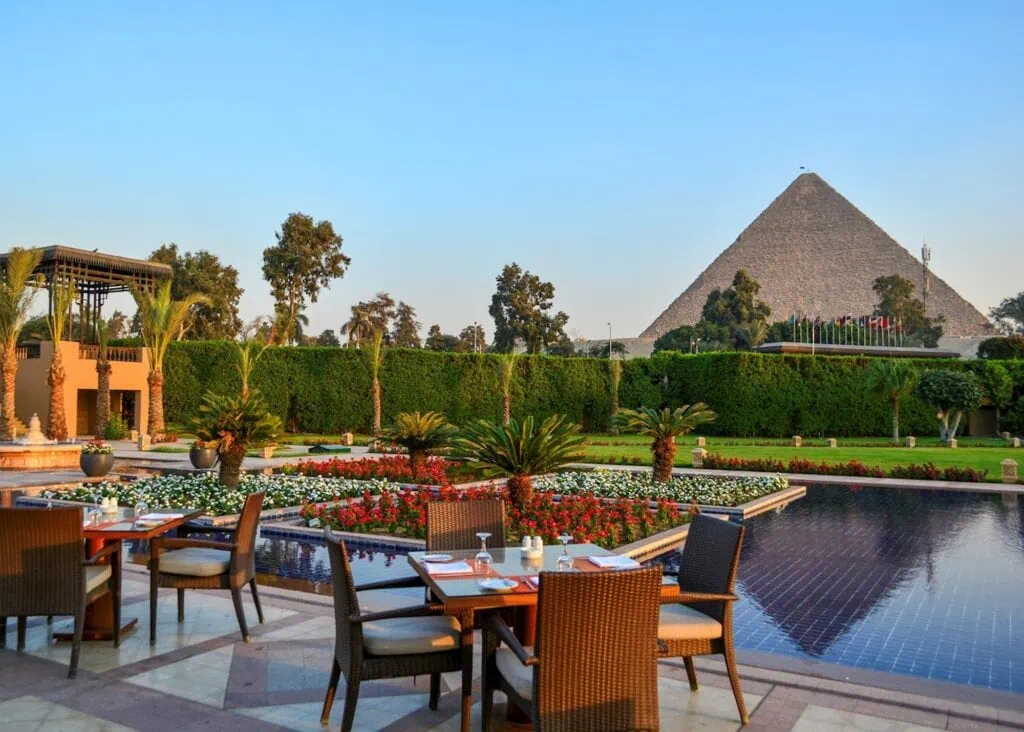
In Egypt, the historic anchor properties are worth knowing about even if you end up choosing something else: Marriott Mena House in Giza (pyramid views from the room balcony), Sofitel Winter Palace in Luxor (late-19th-century landmark, walking distance to Luxor Temple), and Sofitel Legend Old Cataract in Aswan (colonial-era property overlooking the Nile and Elephantine Island; this is the hotel where Agatha Christie stayed and which is widely associated with the inspiration for Death on the Nile). For modern Cairo luxury, Four Seasons-tier downtown and Nile-side hotels are the alternative.
In Greece, the categories run from luxury Athens hotels with Acropolis views (Hotel Grande Bretagne, Electra Palace, AthensWas) to boutique downtown options in Plaka and Monastiraki, to Santorini’s cliffside luxury (Canaves Oia, Mystique, Grace Hotel) and cave-suite boutiques, to Mykonos beachfront resorts (Belvedere, Cavo Tagoo, Bill & Coo), to Crete’s mix of beach resorts and historic Heraklion options. Cabin upgrades on the Nile cruise from standard to suite are also worth flagging if you want extra space.
Visas, Practicalities, and Money
Most travelers, including U.S., U.K., E.U., Canadian, Australian, and many Latin American nationalities, can obtain a 30-day Egypt tourist visa on arrival at Cairo Airport for $25 USD, or apply for an e-visa online before departure.
Greece, as an EU and Schengen Area member, allows visa-free entry for U.S., U.K., Canadian, Australian, and most Latin American passport holders for up to 90 days within any 180-day period. EU citizens enjoy unrestricted entry. Always verify current regulations for your specific nationality before travel, and our Travel Concierge can provide complete documentation guidance for both countries.
A dedicated representative meets you in the arrivals area at Cairo International Airport and Athens International Airport, and guides you through the airport process at both ends.
Whatever your language, you’ll be matched with an Egyptologist guide who speaks it — English, Italian, Spanish, Portuguese, German, French, and others available on request. Greek guides are typically fluent in English and Greek, with other languages available on request.
Money
Egypt uses the Egyptian Pound (EGP); Greece uses the Euro (EUR). Major cards are accepted across hotels, restaurants, and most shops in both countries. Cash is useful for tips, taxis, and souk shopping in Khan El Khalili and at Greek island tavernas and markets.
Best Time to Travel
October through April offers ideal weather conditions in Egypt, with daytime temperatures of 20–25°C (68–77°F) and cool, comfortable evenings. Summer months can exceed 35°C (95°F), making outdoor sightseeing genuinely difficult, though our private tours adjust pacing where needed.
Greece runs the opposite calendar in many ways. Athens is comfortable year-round but at its best from April through October. The Greek islands are seasonal: Santorini, Mykonos, and most Cycladic islands operate roughly April through October, with most hotels, restaurants, and ferry services closed during winter. Crete and the Saronic Gulf islands (Hydra, Aegina, Spetses) operate year-round.
The sweet spot for combining Egypt and Greece is therefore April through early June and September through October — both countries at their best, both shoulder-season for crowds and pricing, both with full island infrastructure operational.
A timing note on Easter: Greek Easter (Orthodox) typically falls one week after Western Easter, often coinciding with Coptic Easter in Egypt (also Orthodox). For travelers interested in Orthodox Christian traditions on both sides of the Mediterranean, an early-to-mid-April Egypt + Greece trip can land you in Coptic Holy Week in Old Cairo and then Greek Easter Sunday in Athens or on an island — one of the most distinctive cultural experiences this pairing offers.
Pairing With a Third Country
Two weeks or more is what you need to comfortably add a third country. The most popular pairings:
- Egypt + Greece + Turkey. The natural Eastern Mediterranean ancient civilisations circuit. Cairo and the Pyramids, Athens and the Acropolis, then Istanbul (Hagia Sophia, Topkapi, the Bosphorus) and optionally Cappadocia. The three cities together cover the pharaonic, classical Greek, Byzantine, and Ottoman peaks of the Eastern Mediterranean. 15–18 days does this comfortably.
- Egypt + Greece + Jordan. Adds the Nabataean piece — Petra and Wadi Rum — to the classical Mediterranean axis. The Treasury at Petra is Hellenistic-Egyptian-Roman in its architectural vocabulary, which makes this a thematically tight three-country trip.
- Egypt + Greece + Saudi Arabia. AlUla and Hegra (the Nabataean sister city to Petra) added to the Egypt-Greece classical axis. Less conventional but historically deepest.
Mention which countries interest you and your Travel Concierge will model durations and pricing across the options. Or skip ahead and build your own multi-country itinerary — choose your countries, dates, and pace, and we’ll send back a tailor-made quote within 1 to 12 hours.

How the Planning Process Actually Works
Egypt + Greece trips have specific friction-points worth knowing about. Greek island ferry schedules (or domestic flights to islands) need to align with your Cairo–Athens flight day. Santorini and Mykonos hotel inventory tightens dramatically in peak months — six months out is realistic for July/August. Easter timing matters if you want Coptic and Greek Easter both in scope. And the cruise-or-no-cruise question genuinely changes the Egypt portion’s character.
Your Travel Concierge builds a first-draft itinerary based on one conversation: your dates, who’s travelling, what you want included, pace preferences, hotel category, and how the time should split between Egypt, Athens, and the islands. The first draft typically lands in your inbox within 1 to 12 hours.
What follows is the back-and-forth, and it’s the part that matters most. We swap hotels, change cabin categories on the cruise, adjust the Egypt-Greece split, layer in or pull out Alexandria, model island combinations and ferry vs flight options, model multi-country extensions, and rework the trip until every piece sits right. Most travelers go through two to four rounds of revisions before booking, though some take significantly more until every detail is locked. There’s no pressure to commit at any stage. The itinerary is finalised only when you’re 100% satisfied and ready to confirm.
Ready to Plan Your Egypt and Greece Tour?
Cairo and the Pyramids, the Nile, Alexandria, Athens and the Acropolis, the Aegean islands at sunset — the Alexandria Axis that traces 2,500 years of one continuous cultural conversation, mapped from start to finish around your dates and pace.
Tell us your dates, who’s travelling, and what matters most, and your dedicated Travel Concierge will have a tailor-made Egypt and Greece itinerary back in your inbox within 1 to 12 hours. We’ve been crafting Egypt journeys since 1955, with TripAdvisor Travelers’ Choice 2020 through 2026 in our pocket, with one Travel Concierge coordinating the entire trip from first email to return home.
Frequently Asked Questions
Ten days is the realistic minimum to cover Cairo, Athens, and one Greek island without rushing. Twelve to fourteen days lets you add a 4-day Nile cruise and a second island. Fifteen days or more opens up Abu Simbel, Alexandria, additional islands, or a third country (most commonly Turkey).
Egypt first, Greece second, in nearly all cases. Cairo is dense and Greece’s island pacing is more relaxed, so finishing in Greece gives a softer landing before the long flight home. Athens International Airport also has stronger direct connections to Europe and North America for return flights.
By direct flight between Cairo (CAI) and Athens (ATH), operated daily by EgyptAir. Flight time is approximately 2 hours 45 minutes. We coordinate the connection as part of one continuous booking, with airport meet-and-greet at both ends.
Standard inclusions: domestic and accommodations across both countries, a 4-day Nile cruise (full board on the cruise) where included, entrance fees to standard sites, your private Egyptologist guide and driver throughout Egypt, your private guide and driver throughout Greece, airport meet-and-greet at Cairo and Athens, and 24/7 support throughout.
Not included: international flights to/from your home country and inter-country flights (Cairo–Athens), tipping, and optional add-ons (interior pyramid access, Abu Simbel options, Alexandria extension, additional Greek islands beyond what your package specifies, day trips from Athens like Delphi or Cape Sounion, Greek island ferry upgrades).
Some meals (typically lunches and some dinners outside the cruise) are quoted separately.
Each tour itinerary on the site lists the precise inclusions and exclusions for that specific package — those are the authoritative reference, and your Travel Concierge will confirm everything in your final itinerary.
Private. Every Egypt + Greece itinerary we run is built around the travelers booking it, with a private guide and driver in each country.
The exception is Nile cruise shore excursions, which run as small group experiences (around 12 guests per Egyptologist) on Luxury Nile Cruises, shared with fellow ship passengers. Fully private cruise excursions and Dahabiya cruises (where the whole vessel is essentially private) are available on request.
Yes, and most travelers do. Twelve days is the comfortable minimum for Cairo + 4-day Nile cruise + Greece. The Nile cruise is the strongest single experience in Egypt and is well worth the extra days if your trip allows it.
Yes. There are three options.
Flight from Aswan (45 minutes each way) is the fastest, ideal if your time is tight. Adds 1 day.
Small-group road convoy from Aswan (3-hour drive each way through the Western Desert, departing pre-dawn, runs as a small-group format rather than private) is the cost-effective option. Adds 1 day.
Lake Nasser cruise extension (3 or 4 nights from Aswan to Abu Simbel and back, taking in the relocated Nubian temples along the way) is the most immersive. Adds 3 to 4 days.
If the Greek-Egyptian connection interests you, yes. Alexandria was founded by Alexander the Great in 332 BC and was the intellectual capital of the Mediterranean for centuries — the meeting point of Greek and Egyptian cultures.
It sits about 220 km northwest of Cairo, reachable by a 2.5-hour drive or 2-hour train ride. We typically build it as either a long day trip from Cairo or as a one-night overnight extension. The headline sites are the Catacombs of Kom el-Shoqafa (Greek-Egyptian-Roman fused funerary art), the Roman Amphitheatre at Kom el-Dikka, the Citadel of Qaitbay (built on the foundation stones of the ancient Pharos lighthouse), and the Bibliotheca Alexandrina.
For travelers specifically interested in the Hellenistic-Egyptian theme, Alexandria is the single most thematically valuable add-on you can make.
Athens is open year-round, as are Crete and the Saronic Gulf islands (Hydra, Aegina, Spetses).
The Cycladic islands — including Santorini and Mykonos — operate roughly April through October. Most hotels, restaurants, and inter-island ferry services close down during winter (November through March).
For winter Egypt + Greece trips, focus on Athens plus Crete or the Saronic Gulf islands. For April–October trips, the full Greek island catalog is available.
Yes, often. Greek Easter (Greek Orthodox) and Coptic Easter (Coptic Orthodox) both follow the Orthodox calendar and typically fall on the same Sunday. Western (Catholic/Protestant) Easter typically falls one week earlier.
For travelers interested in Orthodox Christian traditions, an early-to-mid-April Egypt + Greece trip can place you in Coptic Holy Week services in Old Cairo and then Greek Easter Sunday in Athens or on an island. It’s one of the most distinctive cultural experiences this pairing offers.
Yes. Turkey (Istanbul, Cappadocia) is the most popular three-country pairing, completing the Eastern Mediterranean ancient civilisations circuit. Jordan (Petra, Wadi Rum) adds the Nabataean piece. Saudi Arabia (AlUla, Hegra) is the emerging option for the historically deepest extension.
Two weeks or more is the realistic window for any of these.
October through April: ideal in Egypt (20–25°C / 68–77°F days). Greece in this window is cool to mild — Athens is comfortable, but most Greek islands are closed.
May through September: Greek islands are at their best. Egypt is hot, with summer months exceeding 35°C / 95°F and outdoor sightseeing requiring early morning starts.
The sweet spot for combining both is April through early June and September through October — both countries at their best simultaneously.
For trips in April–May or September–October, three to four months in advance is the comfortable window.
For peak summer (June–August) trips, six months is more realistic — Santorini and Mykonos hotel inventory tightens dramatically, and the most popular cliffside properties on Santorini book up earliest.
For Christmas/New Year and Easter weeks, six months is also realistic on the Egypt side, with the historic anchor properties selling out first.
Whatever your language, you’ll be matched with an Egyptologist guide who speaks it — English, Italian, Spanish, Portuguese, German, French, and others available on request. Greek guides are typically fluent in English and Greek, with other languages available on request.
Egypt requires a $25 tourist visa for most nationalities (visa-on-arrival or e-visa, 30 days). Greece, as an EU and Schengen Area member, allows visa-free entry for U.S., U.K., Canadian, Australian, and most Latin American passport holders for up to 90 days within any 180-day period. EU citizens enjoy unrestricted entry to both Greece and most of Europe.
Your Travel Concierge will confirm what specifically applies to your passport.
Yes. Tourist areas in both countries are well-policed and have strong safety records. Greece is one of the safest destinations in Europe for international travelers, and Egypt’s tourist routes (Cairo, Luxor, Aswan, the Nile cruise corridor) are well-policed.
Our 24/7 worldwide customer service is on call throughout your trip, and your dedicated Travel Concierge stays your point of contact from booking through return home.
Yes, across both countries. Egyptian cuisine has strong vegetarian roots (foul, koshari, vine leaves, baba ghanoush, dozens of vegetable dishes), and Greek cuisine is similarly accommodating (the Greek Orthodox fasting calendar means most tavernas have substantial vegan and vegetarian options as standard year-round). Hotels and restaurants in both countries handle vegetarian, vegan, gluten-free, halal, kosher, and most other dietary needs with advance notice.
Three things. First, depth on the Egypt side: 70+ years of operational experience, our own fleet of vehicles, private Egyptologist guides, and the relationships that come with running Egypt as our home market since 1955.
Second, the Egypt + Greece side is built as one trip, not two trips taped together — coordinated flights, coordinated transfers, one Travel Concierge, one point of contact across both countries.
Third, the trip is genuinely customisable: dates, pace, hotels, inclusions, the cruise question, the Alexandria question, the islands question, the third-country question — all designed around you.
Design Your Custom Tour
Explore Egypt and Greece your way by selecting only the attractions you want to visit