

Catacombs of Kom El Shoqafa – A Site You Must Visit in Alexandria
Step beneath Alexandria’s bustling streets into a world frozen in time.
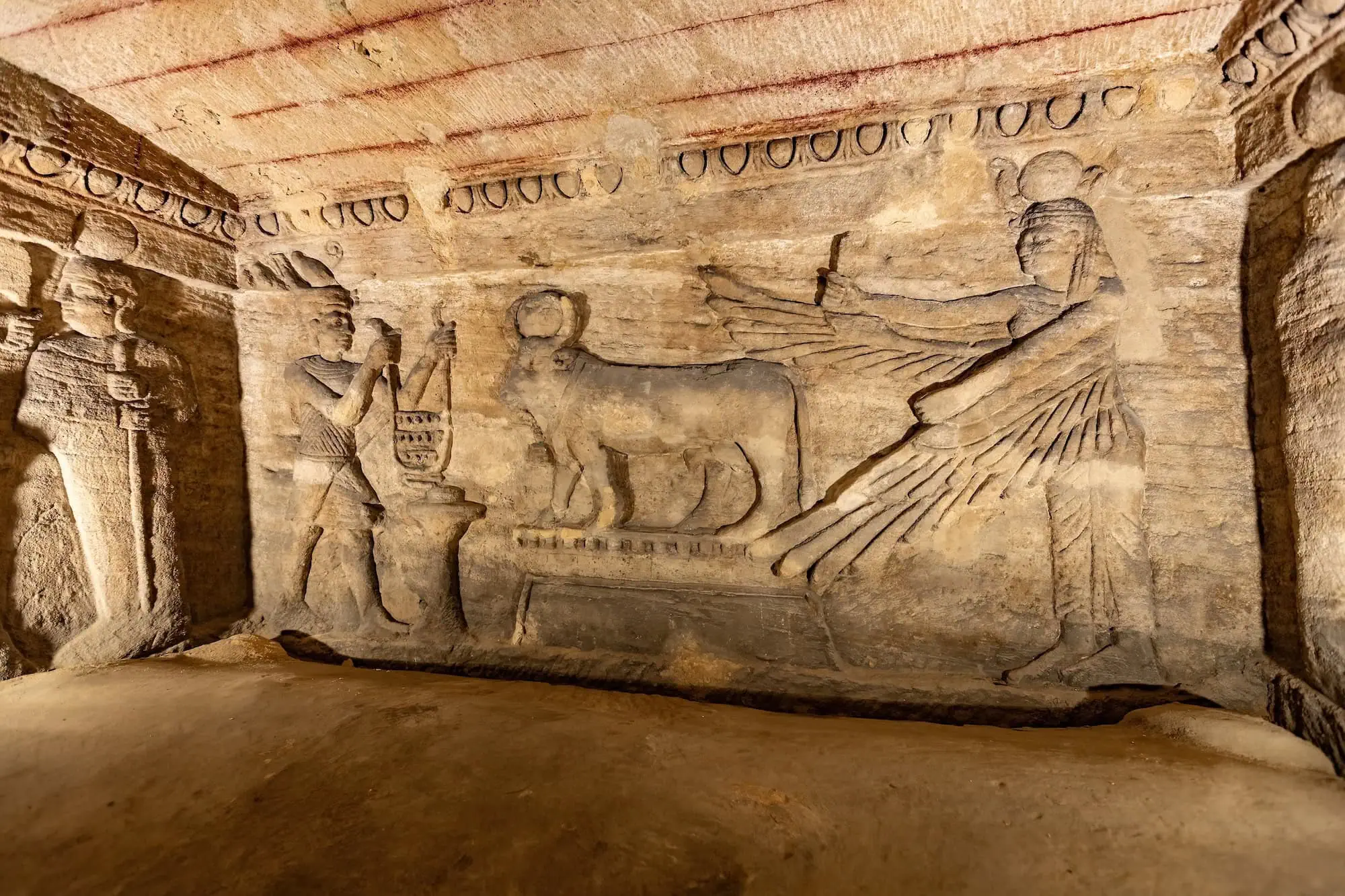
The Catacombs of Kom El Shoqafa represent one of Egypt’s most fascinating archaeological discoveries, where three civilizations merged their burial traditions into something entirely unique. Carved deep into the bedrock during the 2nd century AD, this remarkable necropolis showcases the cultural crossroads that defined ancient Alexandria. What began as private family tombs for the wealthy evolved into a sprawling public burial ground that welcomed people from diverse backgrounds.
We’ve witnessed countless travelers emerge from these underground chambers with a profound appreciation for how ancient cultures adapted and blended their most sacred traditions.
Table of Contents
A Remarkable Archaeological Discovery in Modern Times
Construction workers stumbled upon this underground treasure purely by accident in 1900. A donkey fell through a shaft opening, revealing what archaeologists now consider one of the Seven Wonders of the Medieval World.
The Accidental Revelation
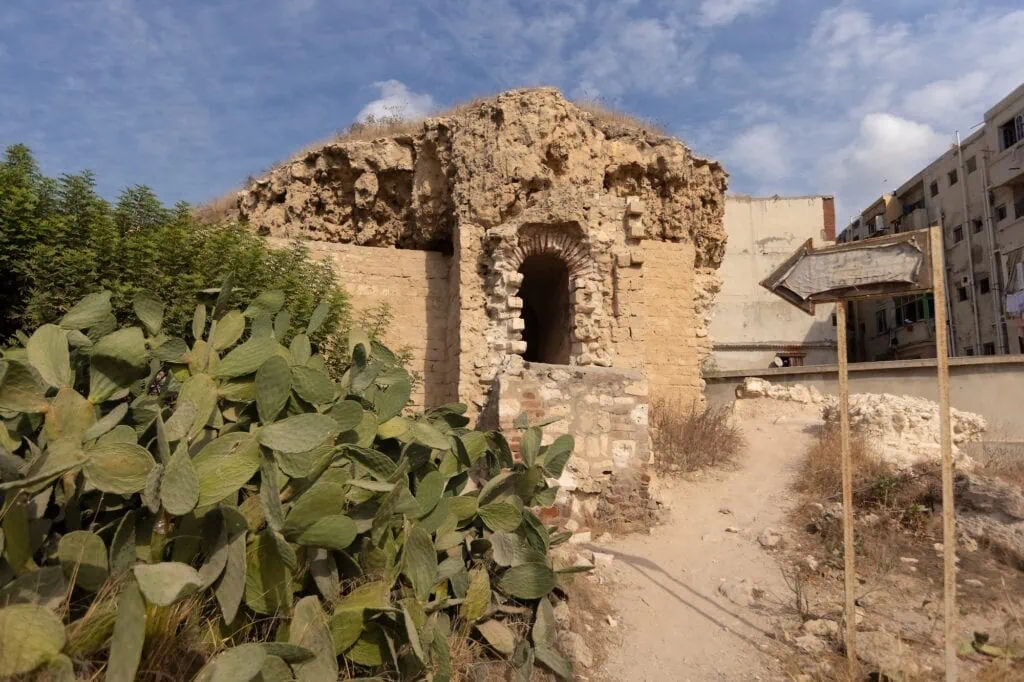
The discovery happened during routine construction work in Alexandria’s Karmouz district. Workers were expanding a cistern when the ground gave way, exposing a circular staircase spiraling into darkness. Local authorities quickly recognized the significance of the find and called in archaeologists to investigate what lay beneath.
Initial Excavation Challenges
Early excavators faced numerous obstacles as they descended the 100-step spiral staircase. The catacombs had been partially flooded for centuries, requiring extensive pumping operations before proper exploration could begin. Ancient debris and collapsed sections complicated the initial mapping efforts, but determined archaeologists gradually revealed the true scope of this underground complex.
Recognition and Preservation
Archaeological teams from multiple institutions collaborated to document and preserve the site. The Egyptian government designated the catacombs as a protected monument within just a few years of discovery, recognizing their international significance as a unique example of cultural fusion in ancient burial practices.
Cultural Fusion in Stone and Symbol
The catacombs demonstrate how Roman, Greek, and Egyptian traditions merged during the Antonine period to create something unprecedented in ancient architecture.
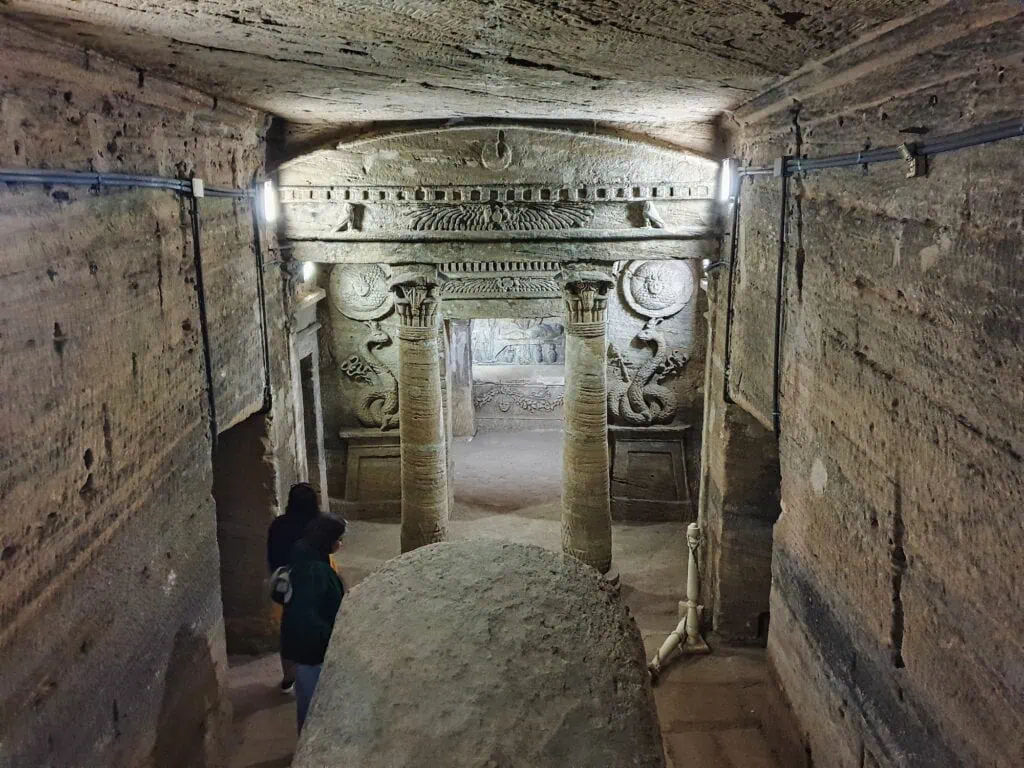
Egyptian pharaonic motifs appear alongside Roman eagles and Greek mythological figures throughout the burial chambers. The main tomb features stunning reliefs where Anubis, the Egyptian god of the dead, stands guard wearing Roman military dress. Serpent guardians carved in traditional Egyptian style frame doorways designed with classical Roman proportions.
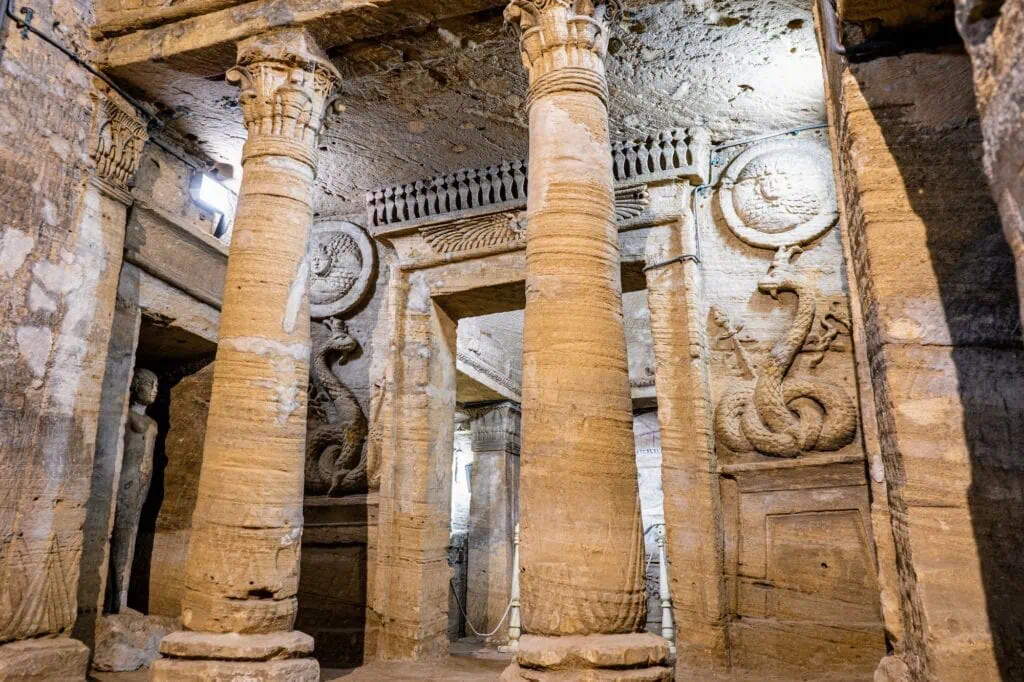
This artistic blending reflected Alexandria’s cosmopolitan character during the 2nd century AD. Wealthy families commissioned tombs that honored their diverse heritage while conforming to local burial customs. The result was an underground art gallery that tells the story of cultural adaptation and mutual respect among different communities.
Roman Architectural Elements
The structural design follows Roman engineering principles with its systematic layout and durable construction methods. Builders used precise mathematical calculations to ensure the stability of chambers carved 35 meters (115 feet) below street level. The main rotunda features classical columns and decorative moldings that would have been familiar to any Roman citizen.
Egyptian Religious Symbolism
Traditional pharaonic imagery dominates the religious aspects of the decoration. Falcon-headed gods, sacred scarabs, and hieroglyphic inscriptions maintain continuity with thousands of years of Egyptian burial traditions. The positioning of these symbols follows ancient Egyptian guidelines for ensuring safe passage to the afterlife.
Architectural Marvel Beneath Alexandria
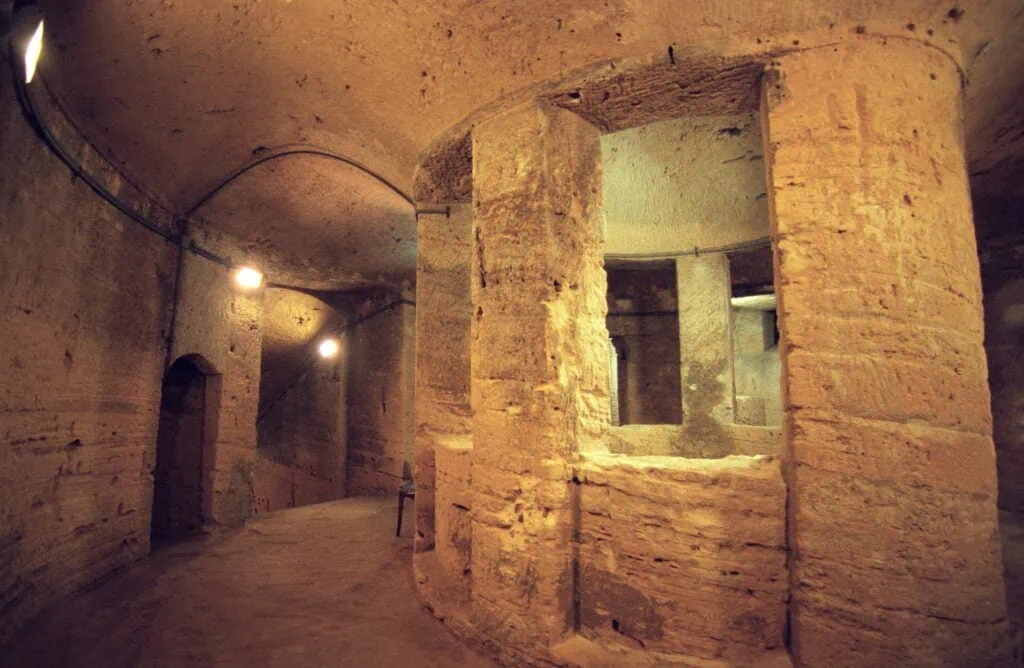
Descending the ancient circular staircase feels like traveling back through time itself. The spiral design serves both practical and symbolic purposes, allowing mourners to process solemnly while representing the journey between the world of the living and the dead.
The main level opens into a rotunda with six massive columns supporting the ceiling. From here, corridors branch off toward family burial chambers, each designed according to the specific wishes and cultural backgrounds of the deceased. The largest chamber, known as the Caracalla Hall, could accommodate communal burial ceremonies for up to 300 people.
Water played a crucial role in both the practical and spiritual aspects of the complex. An intricate drainage system prevented flooding while ceremonial wells provided water for purification rituals. Storage areas held the oils, perfumes, and food offerings essential for ancient burial practices.
Three distinct levels comprise the full complex, though only the upper two remain accessible to modern visitors. Each level served different functions, from preparation of the deceased to final interment and ongoing commemoration ceremonies.
Advanced ventilation systems ensured fresh air circulation throughout the underground chambers. Ancient engineers calculated precise angles for air shafts that remain functional today, nearly 2,000 years after their construction. The sophisticated planning required to create such an ambitious underground project demonstrates the high level of technical expertise available in Roman Alexandria.
Visiting the Catacombs Today
Our expert guides help visitors understand the historical significance and artistic details that might otherwise go unnoticed during a self-guided visit.
Planning Your Visit
The site opens daily from 9:00 am (09:00) to 5:00 pm (17:00), with last entry at 4:30 pm (16:30). We recommend visiting during morning hours when lighting conditions inside the chambers are optimal for photography and detailed viewing. The temperature underground remains constant at approximately 20°C (68°F) year-round, providing relief from Alexandria’s summer heat.
Entry tickets are available at the site entrance, though advance booking through our service ensures skip-the-line access during busy tourist seasons. Photography inside the main chambers requires an additional permit, which we can arrange as part of our comprehensive tour packages.
What to Expect Underground
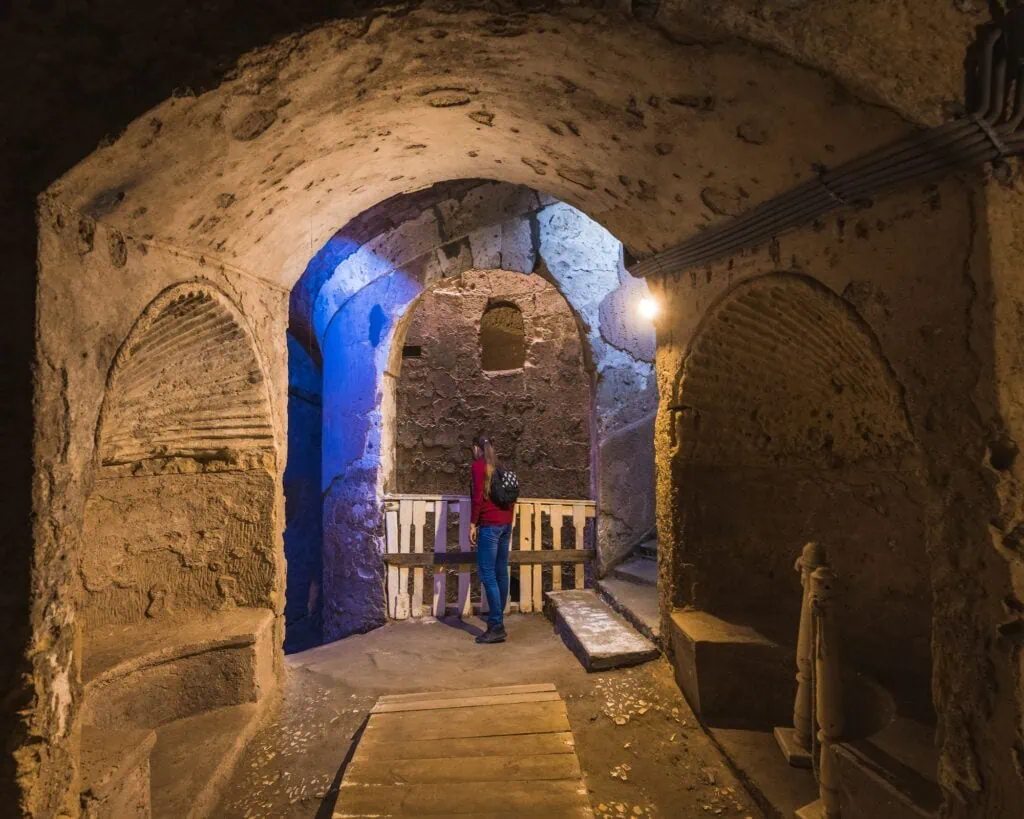
The descent takes visitors down 99 steps along the same spiral staircase used by ancient mourners. Handrails and improved lighting enhance safety while preserving the authentic atmosphere of discovery. The main chambers showcase the finest examples of Greco-Roman-Egyptian artistic fusion, with detailed explanations provided by our qualified Egyptologist guides.
Wheelchair accessibility remains limited due to the historical nature of the site and the steep staircase entrance. Visitors with mobility concerns should contact us in advance to discuss alternative arrangements for experiencing this remarkable location.
Combining with Other Alexandria Attractions
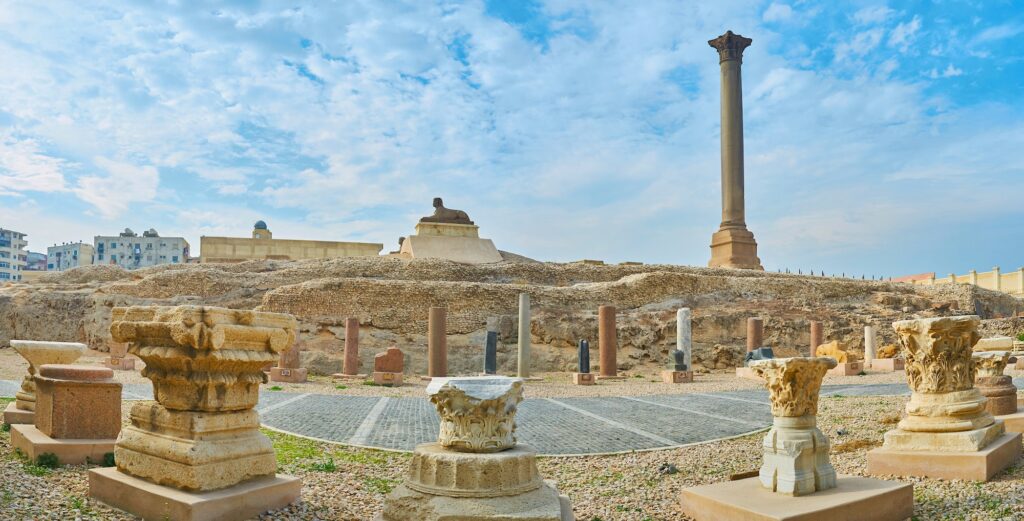
The catacombs location in Alexandria’s archaeological district makes them an ideal starting point for exploring the city’s ancient heritage. The nearby Pompey’s Pillar stands just 500 meters (0.3 miles) away, while the Alexandria National Museum offers additional context about the city’s multicultural past. We design our Alexandria day tours to include multiple historical sites with comfortable transportation between locations.
Preservation Efforts and Modern Challenges
Archaeological teams continue working to protect and study this invaluable cultural treasure. Rising groundwater levels pose ongoing challenges, requiring sophisticated drainage systems and constant monitoring of structural stability.
Modern conservation techniques help preserve the delicate reliefs and inscriptions that make these tombs so extraordinary. Specialists use non-invasive imaging technology to document areas too fragile for regular public access. Climate control systems maintain optimal humidity levels to prevent further deterioration of the ancient artwork.
International cooperation supports ongoing research and preservation projects. Egyptian authorities work closely with archaeological institutions from around the world to ensure the catacombs remain accessible for future generations while protecting their irreplaceable historical value.
Descend Into The Mystery Of Kom El Shoqafa
The Catacombs of Kom El Shoqafa offer one of Egypt’s most unique historical experiences—where Roman, Greek, and Egyptian influences merge in an underground world unlike anything else. With EgyptToursPlus, we seamlessly include this extraordinary site in a private journey that connects Alexandria’s layered heritage with Egypt’s most iconic destinations.
You choose your travel dates, your pace, and the experiences that shape your route. From immersive cultural exploration to coastal highlights and refined comfort throughout, we tailor every detail around your preferences—ensuring a smooth, expertly planned, and deeply personal travel experience.
Frequently Asked Questions
Most visitors spend 45 minutes to 1 hour exploring the Catacombs of Kom El Shoqafa, although history enthusiasts often stay longer to study the carvings and burial chambers in detail. The site descends roughly 35 meters (115 feet) underground through a spiral staircase and includes Roman banquet halls, tomb niches, and hybrid Egyptian-Greco-Roman artwork dating to the 2nd century CE. Guided visits help explain symbolism that many travelers would otherwise overlook. Early morning visits usually provide cooler temperatures and fewer tour groups.
Yes, the Catacombs of Kom El Shoqafa are generally suitable for children over 8 years old, especially those interested in archaeology, tunnels, and ancient history. The underground chambers, spiral staircase, and carved burial halls often feel adventurous for families visiting Alexandria. Parents should supervise carefully because the stairs can become slippery and some passages are narrow or dimly lit. Children uncomfortable with enclosed underground spaces may find portions of the visit challenging, particularly during busier periods with larger crowds.
Photography inside the Catacombs of Kom El Shoqafa is permitted only with a separate photography ticket purchased at the entrance, and flash photography is strictly prohibited to protect ancient pigments and stone surfaces. Rules may occasionally change depending on conservation work or temporary restrictions imposed by Egyptian authorities. Visitors using professional cameras, tripods, or commercial filming equipment may require additional permits beyond standard tourist access. Morning visits generally offer the clearest conditions for photography before the chambers become crowded.
Visitors should wear comfortable walking shoes with strong grip because the Catacombs of Kom El Shoqafa include steep stairs, worn stone surfaces, and underground passages approximately 35 meters below street level. Lightweight clothing works well during Alexandria’s warmer months, but many travelers appreciate carrying a light jacket because the underground chambers feel noticeably cooler than the surface. Modest, breathable clothing is also practical for extended sightseeing around Alexandria. Avoid sandals or smooth-soled shoes, especially during humid weather conditions.
The Catacombs of Kom El Shoqafa are located about 4 km (2.5 miles) southwest of central Alexandria, with travel times ranging from 10 to 25 minutes depending on traffic conditions. The site sits in the Kom El Shoqafa district near Pompey’s Pillar, making it easy to combine both attractions in one itinerary. Taxis, rideshare services, and organized tours regularly serve the area from the Corniche and downtown Alexandria. Morning departures generally avoid the city’s heaviest traffic congestion.
While visitors can explore the Catacombs of Kom El Shoqafa independently, expert guides greatly improve the experience by explaining the rare fusion of Egyptian, Greek, and Roman symbolism found throughout the tomb complex. Many carvings combine traditional Egyptian funerary imagery with Roman hairstyles, Greek architectural motifs, and classical burial customs dating to the 2nd century CE. Without interpretation, important details are easy to miss inside the dim underground chambers. Guided visits also help visitors navigate the historical sequence of the site more efficiently.
Yes, touching any carvings, reliefs, inscriptions, or stone surfaces inside the Catacombs of Kom El Shoqafa is strictly prohibited under Egyptian antiquities protection regulations. Oils and moisture from human hands gradually damage fragile limestone and accelerate erosion on artwork that has survived nearly 2,000 years underground. Security staff and conservation teams closely monitor visitor behavior to preserve the chambers for future generations. Travelers should maintain respectful distance from walls and avoid leaning on decorated surfaces while taking photographs.
The Catacombs of Kom El Shoqafa are unique because they combine Egyptian funerary traditions with Greek and Roman artistic styles in a way found nowhere else in the ancient world. Built during the Roman period around the 2nd century CE, the site features Egyptian gods wearing Roman armor, classical architectural details, and multi-level underground tomb chambers carved into bedrock. Most Egyptian burial sites are purely Pharaonic in style, while Kom El Shoqafa reflects Alexandria’s multicultural identity under Roman rule.
Yes, the Catacombs of Kom El Shoqafa can generally be visited year-round because the underground chambers maintain relatively stable temperatures regardless of Alexandria’s seasonal weather conditions. Unlike exposed desert monuments that become difficult in extreme heat, the subterranean structure remains comparatively cool even during summer months. Temporary closures may occasionally occur for conservation work, drainage maintenance, or safety inspections after heavy rainfall. Checking operating status in advance is recommended, particularly during Egyptian public holidays and peak tourism periods.
The accessible chambers of the Catacombs of Kom El Shoqafa extend approximately 35 meters (115 feet) below street level and are reached through a spiral staircase containing roughly 99 steps. The underground complex includes burial halls, banquet rooms, tunnels, and carved chambers spread across multiple levels dating to the Roman era. The depth helped preserve the site from surface damage for centuries while creating the cool subterranean atmosphere visitors experience today. Travelers with mobility concerns should prepare for extended stair navigation.
Most human remains originally buried in the Catacombs of Kom El Shoqafa were removed during archaeological excavations conducted in the late 19th and early 20th centuries, although some sarcophagi and burial features remain in their original locations. The catacombs served wealthy Alexandrian families during the Roman period and included chambers for both burial and commemorative funeral banquets. Archaeologists recovered artifacts, skeletal remains, and decorative objects that helped document Alexandria’s multicultural society under Roman rule. Some discoveries are now housed in Egyptian museums.
Limited parking is available near the entrance to the Catacombs of Kom El Shoqafa, although spaces can fill quickly during weekends, holidays, and peak tourism periods in Alexandria. The surrounding streets are often congested, especially during late morning and afternoon traffic hours. Many travelers prefer arriving by taxi or organized transportation to avoid parking difficulties and navigation challenges in the Kom El Shoqafa district. Visitors combining the catacombs with Pompey’s Pillar often benefit from using one coordinated transport arrangement for both sites.
Design Your Custom Tour
Explore Egypt your way by selecting only the attractions you want to visit