

The Ramesseum Temple in Luxor – Mortuary Temple of Ramses II
The colossal statue lies in fragments now, but its story endures.
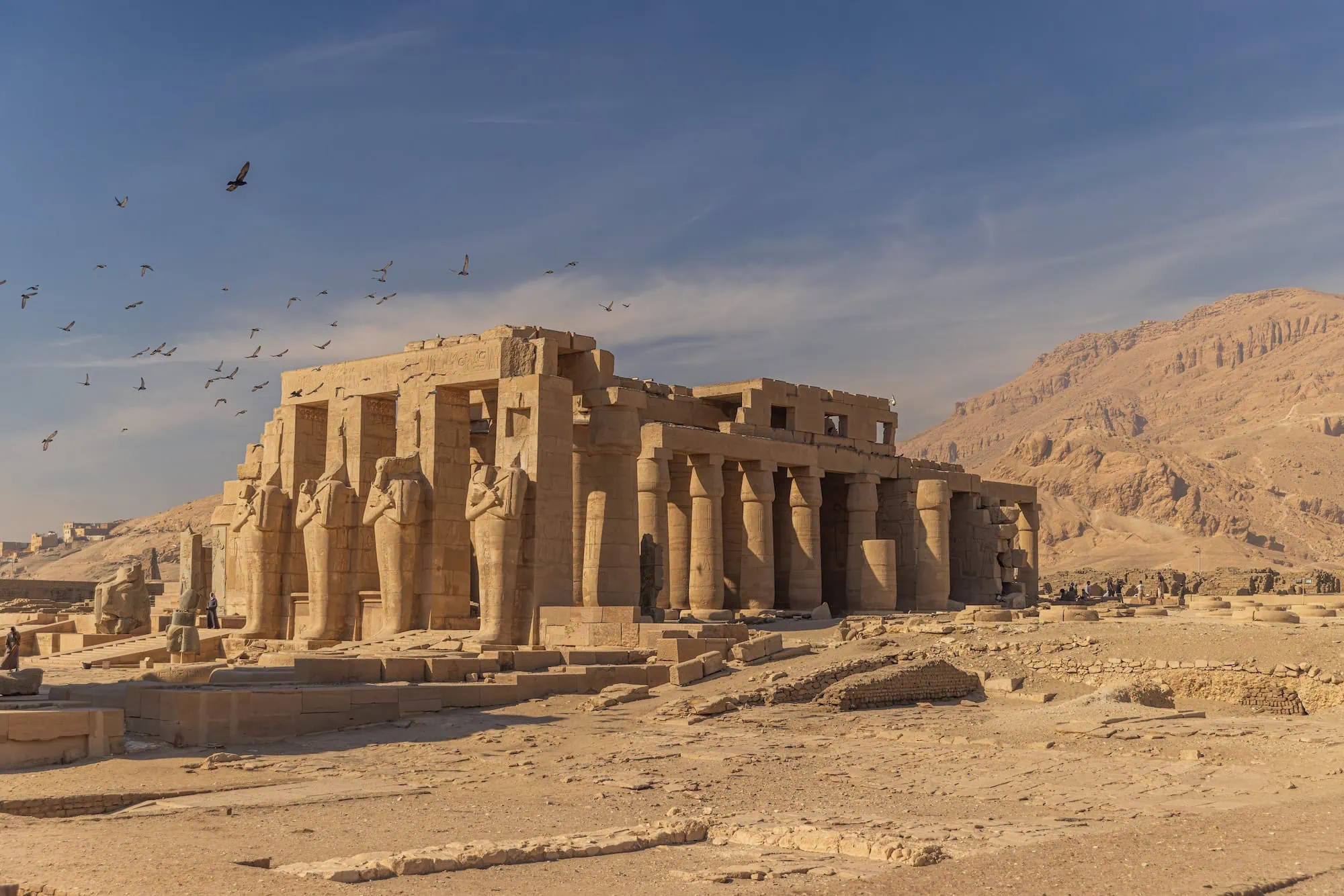
Built during the reign of one of ancient Egypt’s most powerful pharaohs, the Ramesseum stands as a testament to both divine kingship and architectural mastery. This mortuary temple, constructed over two decades in the 13th century BC, served as Ramesses II’s gateway to the afterlife while proclaiming his earthly achievements to future generations. Located on the west bank of the Nile near Luxor, the temple complex reveals layers of Egyptian civilization through its towering pylons, intricate reliefs, and innovative design.
The monument that inspired Percy Shelley’s famous poem “Ozymandias” continues to captivate visitors with its blend of spiritual purpose and political propaganda, offering unique insights into New Kingdom Egypt’s golden age.
Table of Contents
The Great Builder: Ramesses II’s Legacy
Ramesses II ruled Egypt for 66 years, from 1279 to 1213 BCE, establishing himself as one of history’s most prolific monument builders. His reign marked the pinnacle of Egyptian imperial power, with military campaigns extending from Nubia to the Levant. The pharaoh’s ambitious building projects transformed the architectural landscape of ancient Egypt, creating structures that would outlast empires.
The Vision Behind the Memorial
The Ramesseum represented more than royal vanity. Ancient Egyptians viewed mortuary temples as essential for the pharaoh’s journey into the afterlife, where he would join the gods and continue protecting Egypt. Ramesses II conceived his temple as both a functional religious center and a permanent record of his achievements, particularly his military victories against the Hittites.
Construction Timeline and Workforce
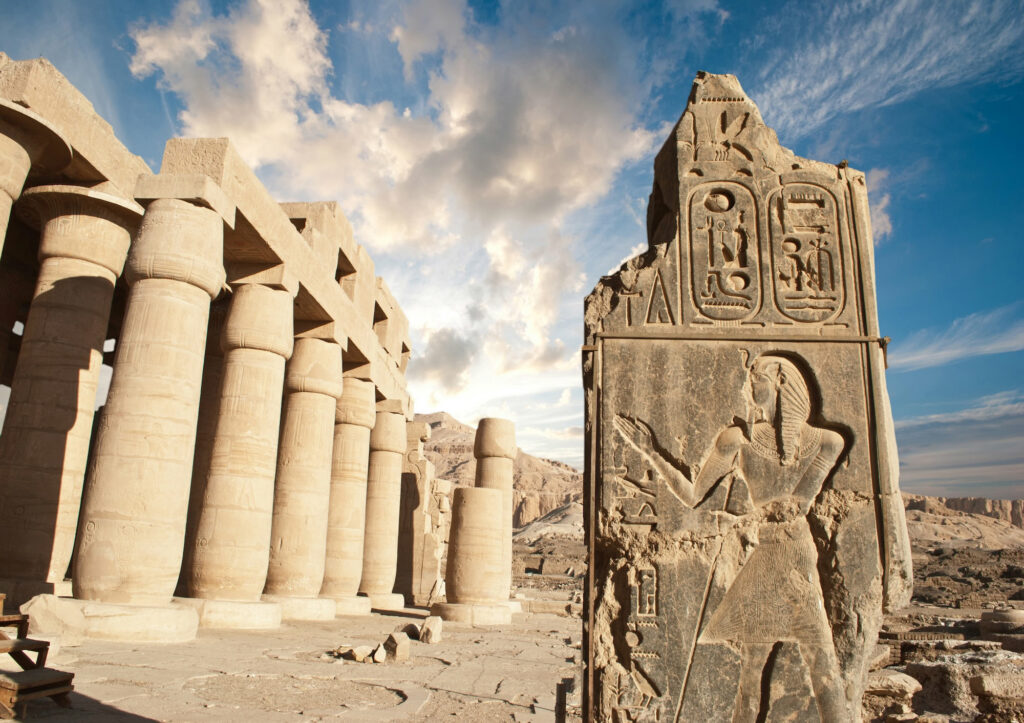
Archaeological evidence suggests construction began early in Ramesses II’s reign and continued for approximately 20 years. Thousands of skilled craftsmen, architects, and laborers contributed to the project, utilizing advanced engineering techniques to transport massive granite blocks from Aswan, over 200 kilometers (124 miles) south. The temple’s orientation aligned precisely with astronomical events, demonstrating the sophisticated mathematical knowledge of its builders.
Architectural Innovation
The temple’s design incorporated several architectural innovations that influenced later Egyptian construction. The builders created a sophisticated drainage system to protect the structure from Nile floods, while the foundation design distributed the enormous weight of the colossal statues and pylons across the underlying bedrock.
Architectural Marvel of Ancient World
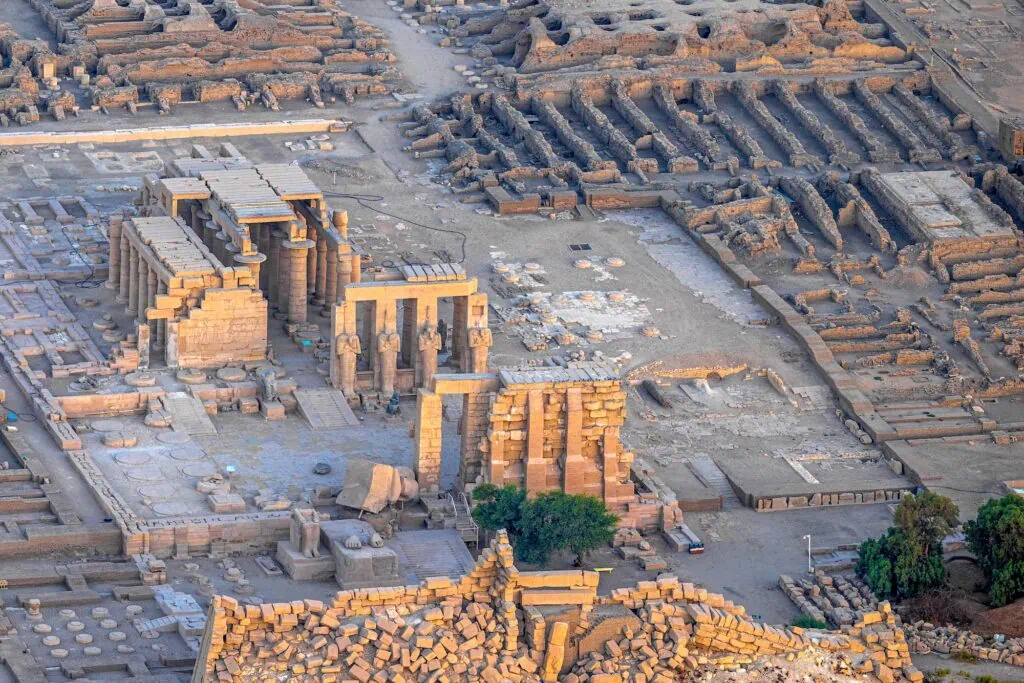
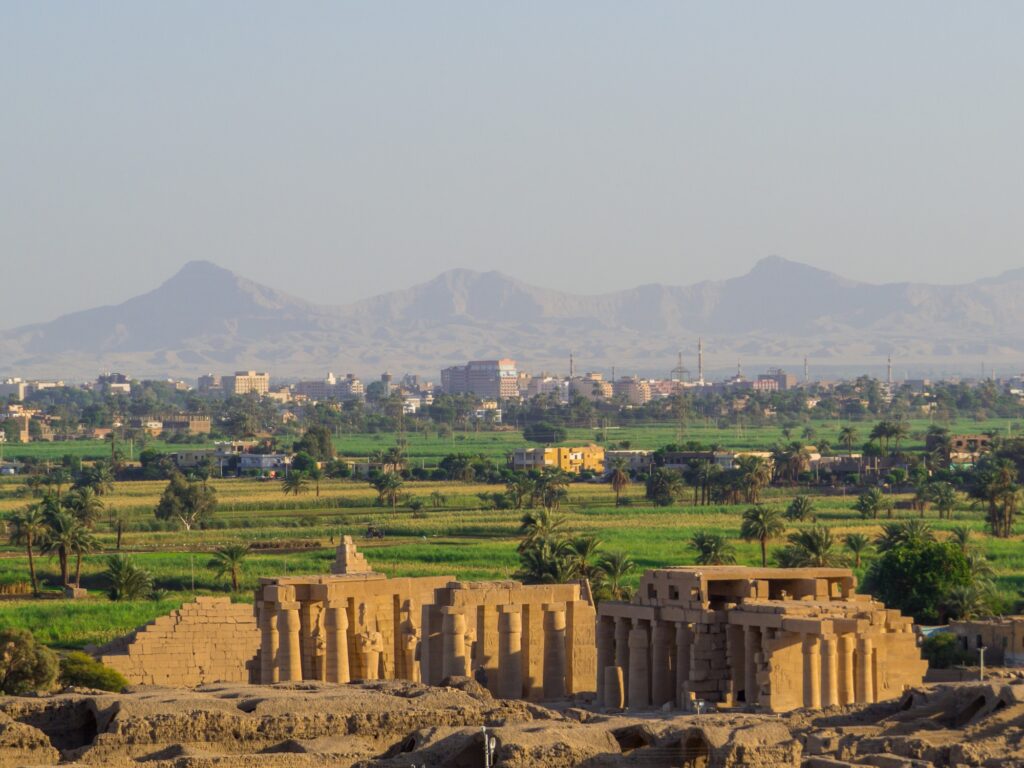
Walking through the Ramesseum today reveals the sophisticated planning that went into its construction. The temple follows traditional Egyptian mortuary temple design while incorporating unique elements that reflect Ramesses II’s personality and achievements.
The first pylon, standing 65 meters (213 feet) wide and originally reaching 38 meters (125 feet) in height, welcomed visitors with scenes of the pharaoh’s military triumphs. Beyond the pylon, two successive courtyards led visitors deeper into the sacred space, each decorated with colossal statues and detailed reliefs depicting religious ceremonies and royal achievements.
The Hypostyle Hall’s Engineering
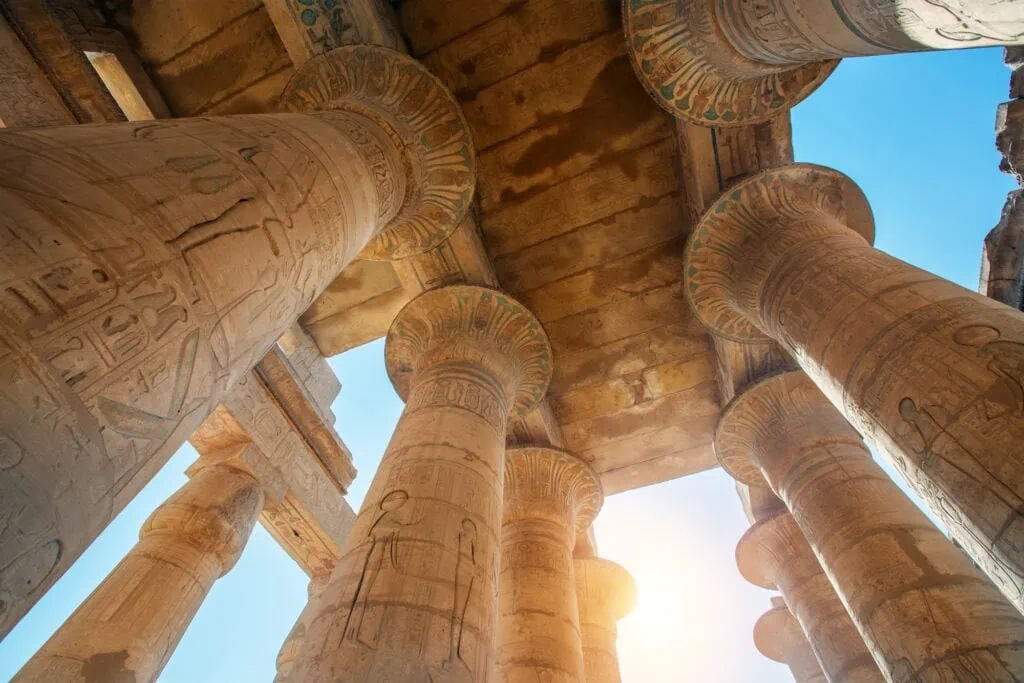
The temple’s hypostyle hall demonstrates remarkable engineering prowess. Forty-eight columns, each carved to resemble papyrus plants, supported the massive roof structure. The columns varied in height, creating a sophisticated lighting system that illuminated specific reliefs at different times of day. This architectural feature served both practical and symbolic purposes, representing the primordial marsh from which all life emerged in Egyptian mythology.
Symbols of Power: Colossal Statues
The most famous element of the Ramesseum was undoubtedly the massive seated statue of Ramesses II, carved from a single piece of granite. Standing over 17 meters (56 feet) tall and weighing an estimated 1,000 tons, this colossus ranked among the largest statues ever carved in ancient Egypt.
Giovanni Belzoni’s expedition in 1816 discovered fragments of this remarkable sculpture, with the head and torso section—known as the “Younger Memnon”—eventually finding its way to the British Museum in London. The statue’s inscriptions proclaimed Ramesses II as “King of Kings,” a title that echoed through Shelley’s romantic imagination when he penned “Ozymandias.”
The temple complex originally housed multiple colossal statues, creating an overwhelming display of royal power. These monuments served a dual purpose: impressing visitors with the pharaoh’s divine status while providing focal points for religious rituals conducted within the temple grounds.
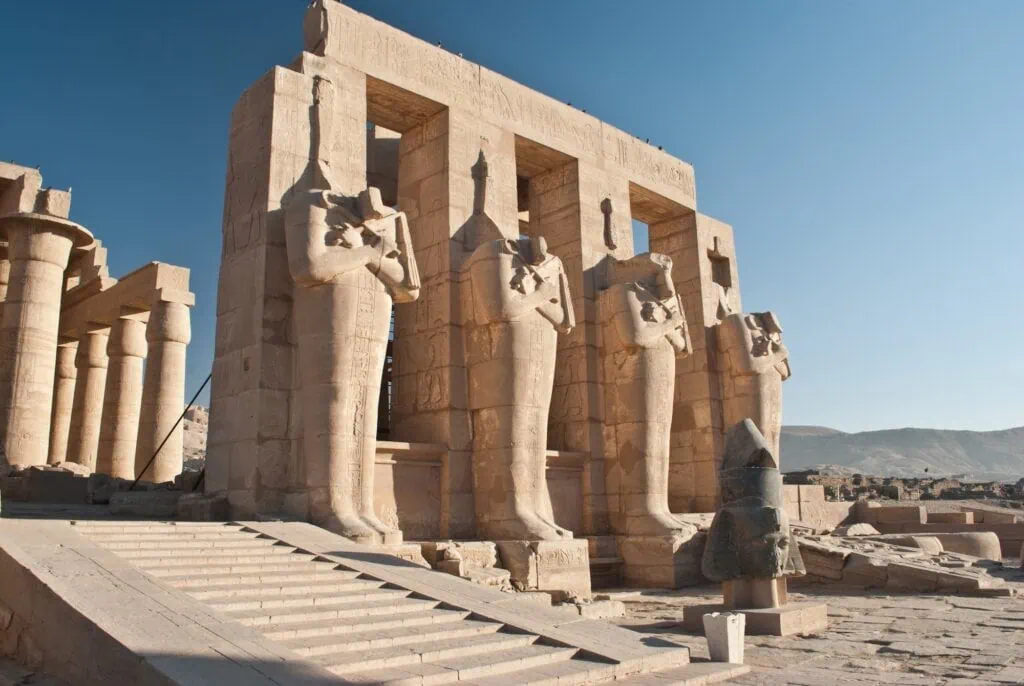
Smaller statues throughout the complex depicted Ramesses II in various religious poses, often shown making offerings to different Egyptian deities. These sculptures reinforced the pharaoh’s role as intermediary between the gods and humanity, a central concept in ancient Egyptian religious thought.
Artistic Techniques and Symbolism
Master craftsmen employed sophisticated carving techniques to create these monumental works. The granite’s hardness required specialized tools and methods, including copper chisels, wooden wedges, and sand abrasives. Each statue incorporated symbolic elements that communicated specific messages about royal power and divine authority.
The fallen colossus continues to inspire awe among modern visitors, its broken condition paradoxically enhancing rather than diminishing its impact. This transformation from symbol of eternal power to romantic ruin reflects broader changes in how we understand and appreciate ancient monuments.
Military Glory Carved in Stone
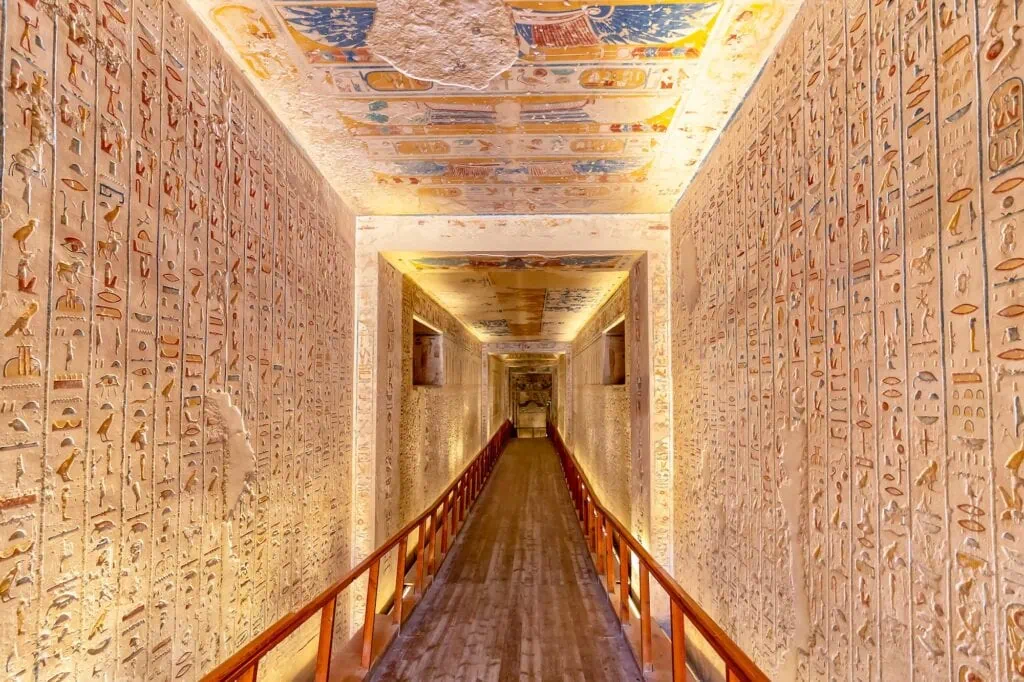
The Battle of Kadesh decorates the temple walls in spectacular detail, transforming military propaganda into high art. This conflict, fought around 1274 BCE against the Hittite Empire, marked a crucial moment in ancient Near Eastern history and became the centerpiece of Ramesses II’s public relations campaign.
The Kadesh Campaign Depicted
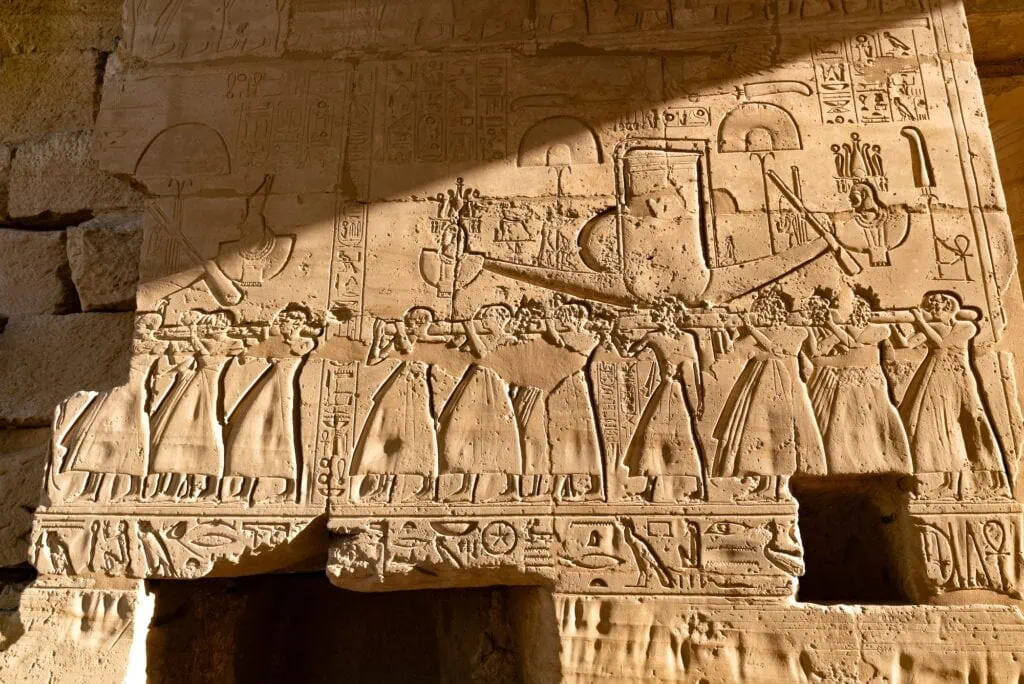
Relief carvings throughout the temple complex narrate the battle’s unfolding drama. The pharaoh appears larger than life, driving his war chariot through enemy ranks while his horses rear dramatically above fallen foes. These scenes deliberately emphasized individual heroism over tactical complexity, presenting Ramesses II as Egypt’s invincible protector.
The reliefs include detailed depictions of Egyptian military equipment, from composite bows to bronze-tipped spears, providing modern historians with valuable insights into New Kingdom warfare. Hieroglyphic inscriptions accompanying the visual narrative describe specific moments of the campaign, including the pharaoh’s supposed single-handed rescue of his army from a Hittite ambush.
Propaganda and Historical Reality
Modern scholarship reveals significant discrepancies between the temple’s version of events and probable historical reality. The Battle of Kadesh likely ended in a stalemate, leading eventually to the world’s first recorded peace treaty. However, the Ramesseum’s reliefs present unqualified Egyptian victory, demonstrating how ancient rulers used art and architecture to shape public perception of their achievements.
Additional military scenes throughout the temple celebrate campaigns in Syria, Nubia, and Libya, creating a comprehensive catalog of Egyptian imperial expansion. These decorative programs served educational purposes, teaching visitors about Egypt’s enemies and the pharaoh’s role in protecting civilization from foreign threats.
Religious Functions and Daily Operations
Beyond its role as a royal monument, the Ramesseum functioned as an active religious center with complex daily operations. The temple employed hundreds of priests, scribes, craftsmen, and support staff, creating a bustling economic hub within the broader Theban religious community.
Temple Administration
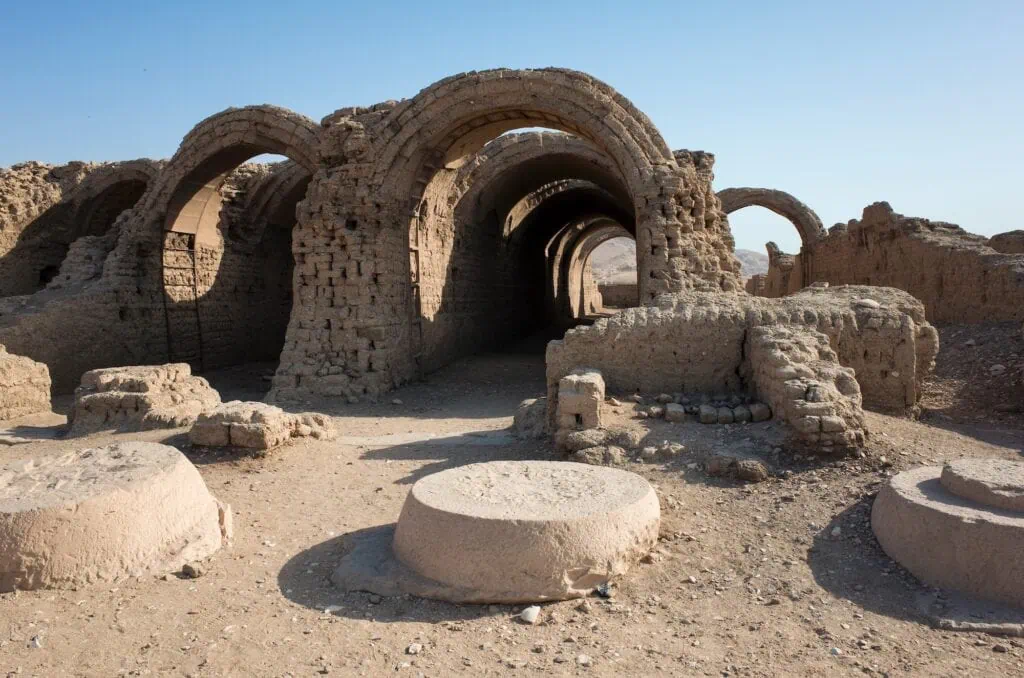
Recent archaeological discoveries have revealed extensive administrative areas within the temple complex, including workshops, kitchens, bakeries, and storage facilities. These spaces supported the temple’s religious functions while generating income through various craft industries. The famous “House of Life,” an ancient Egyptian institution combining library, scriptorium, and medical center, operated within the Ramesseum complex.
Papyrus documents recovered from the site detail the temple’s economic activities, from cattle breeding to textile production. These records illuminate the sophisticated management systems required to operate large Egyptian temples, revealing them as multifaceted institutions that combined religious, educational, and economic functions.
Religious Ceremonies
Daily rituals at the Ramesseum followed patterns established throughout Egyptian temple tradition. Priests performed morning awakening ceremonies for the cult statue, offered meals and incense, and conducted evening closing rituals. Special festivals, including the Beautiful Festival of the Valley, brought thousands of visitors to the site annually.
The Festival of Min, an important fertility celebration, received particular emphasis in the temple’s decorative program. Reliefs depicting this festival provide detailed information about ancient Egyptian religious practices, from musical performances to ritual offerings.
Modern Discovery and Archaeological Legacy
European rediscovery of the Ramesseum began during Napoleon’s Egyptian expedition of 1798-1801, when French scholars first documented the site’s monuments and inscriptions. This initial survey sparked broader European interest in Egyptian antiquities, contributing to the birth of modern Egyptology.
Jean-François Champollion visited the site in 1829, shortly after his breakthrough in deciphering hieroglyphs. His work at the Ramesseum provided crucial insights into the temple’s historical and religious significance, establishing many interpretations that remain influential today.
Archaeological Challenges and Discoveries
Modern excavations continue revealing new aspects of the temple complex. Ground-penetrating radar has identified buried structures, while careful analysis of architectural fragments helps reconstruct the original appearance of damaged areas. International archaeological missions work collaboratively to preserve and study the site, employing both traditional excavation methods and cutting-edge technology.
Climate change and tourism pressure present ongoing challenges for conservation efforts. Rising groundwater levels threaten foundation stability, while increased visitor numbers create wear patterns on ancient surfaces. These concerns require careful balance between public access and preservation needs.
The Ozymandias Connection
Diodorus Siculus, a Greek historian writing in the first century BCE, described a massive statue at Thebes with an inscription claiming “I am Ozymandias, king of kings.” This account, filtered through various translations and interpretations, eventually inspired Shelley’s famous sonnet about the transience of earthly power.
The poem’s enduring popularity has shaped modern perceptions of the Ramesseum, transforming it from archaeological site to symbol of human hubris and historical irony. This literary connection demonstrates how ancient monuments continue evolving in meaning and significance across different cultural contexts.
Visiting the Ramesseum Today
We recommend planning your Ramesseum visit during the cooler morning hours, typically between 8:00 am (08:00) and 11:00 am (11:00), when lighting conditions best illuminate the relief carvings. The temple complex requires approximately two hours for thorough exploration, allowing time to appreciate both the architectural grandeur and intricate artistic details.
The site opens daily at 6:00 am (06:00) and closes at 5:00 pm (17:00) during winter months, with extended hours until 6:00 pm (18:00) during summer. Current admission fees are 100 Egyptian pounds for international visitors, with student discounts available upon presentation of valid identification.
Getting There and Practical Information
Located on Luxor’s west bank, the Ramesseum sits approximately 3 kilometers (1.9 miles) from the Nile River. Most visitors combine their temple visit with other west bank attractions, including the Valley of the Kings and Medinat Habu temple. We arrange private transportation with experienced drivers who understand the archaeological sites’ significance and can provide historical context during the journey.
Our expert guides possess deep knowledge of the temple’s history, architecture, and religious significance, ensuring visitors gain comprehensive understanding of this remarkable monument. With decades of experience in Egyptian tourism, we provide personalized attention that transforms sightseeing into genuine cultural education.
Conservation Efforts and Future Challenges
International conservation efforts continue protecting the Ramesseum for future generations. UNESCO recognition of the broader Theban Necropolis highlights the site’s global cultural significance, while ongoing restoration projects address structural damage and environmental threats.
Climate control systems protect the most vulnerable reliefs, while visitor pathways minimize direct contact with ancient surfaces. These measures ensure that the temple’s educational and inspirational value remains accessible while preserving its archaeological integrity.
Step Into The Legacy Of Ramses II At The Ramesseum
The Ramesseum Temple offers a powerful glimpse into the ambition and legacy of Ramses II—where monumental ruins and intricate reliefs tell the story of one of Egypt’s greatest pharaohs. With EgyptToursPlus, we seamlessly include this iconic yet often overlooked site in a private journey that connects Luxor’s grand landmarks with deeper, less-crowded experiences.
You choose your travel dates, your pace, and the experiences that shape your route. From immersive temple visits and expert-guided insights to Nile cruises and refined comfort throughout, we tailor every detail around your preferences—ensuring a smooth, enriching, and deeply personal travel experience.
Frequently Asked Questions
Construction of the Ramesseum began around 1270 BCE during the early reign of Ramesses II and continued for roughly two decades under Egypt’s 19th Dynasty. Located on Luxor’s West Bank, the temple served as Ramesses II’s mortuary complex and ceremonial center for his cult after death. Many of its colossal statues and reliefs celebrated the king’s military victories, especially the Battle of Kadesh against the Hittites. The Ramesseum became one of the most influential royal temple projects of the New Kingdom period.
The Ramesseum is famous for its enormous fallen statue of Ramesses II, detailed Battle of Kadesh reliefs, and its connection to Percy Bysshe Shelley’s 1818 poem “Ozymandias.” The original seated colossus once stood approximately 19 meters (62 feet) tall and weighed an estimated 1,000 tons before collapsing in antiquity. The temple’s walls preserve some of ancient Egypt’s finest military carvings and royal propaganda scenes. Literature enthusiasts and archaeologists alike consider the Ramesseum one of Luxor’s most culturally influential monuments.
Most visitors need 1.5 to 2 hours to explore the Ramesseum properly, including time for photography, architectural observation, and examining the relief carvings. The temple complex includes massive pylons, courtyards, columns, storage chambers, and remnants of colossal statues spread across a large archaeological zone on Luxor’s West Bank. Travelers with a strong interest in New Kingdom history or hieroglyphics may easily spend longer. Early morning visits provide cooler temperatures and softer lighting for detailed photography of the reliefs.
The Ramesseum differs from temples like Karnak and Luxor Temple because it functioned primarily as a mortuary temple dedicated to the eternal cult of Ramesses II rather than daily public worship ceremonies. Built on Luxor’s West Bank, traditionally associated with death and the afterlife, the complex focused on preserving the king’s divine legacy after his death. Its reliefs emphasize royal victories, funerary rituals, and divine kingship more heavily than active temple processions. The atmosphere is generally quieter and less crowded than Karnak.
Yes, photography is generally permitted throughout the Ramesseum complex for personal use, including photos of the courtyards, colossal statues, and carved reliefs. Professional photography equipment such as tripods, lighting rigs, or commercial filming gear may require additional permissions from Egyptian antiquities authorities. The temple’s open layout and dramatic ruins make it especially appealing for wide-angle photography during sunrise and late afternoon. Visitors should still avoid touching reliefs or climbing on ancient stone structures while taking photographs.
Visitors to the Ramesseum should wear lightweight modest clothing, comfortable walking shoes, sunglasses, and strong sun protection because the site offers limited shade across its exposed courtyards and pathways. Temperatures in Luxor frequently exceed 38°C (100°F) during summer afternoons, especially from June through September. Closed shoes help navigate uneven ancient stone surfaces safely, while hats and sunscreen remain essential year-round. Carrying bottled water is highly recommended, particularly for midday visits on the West Bank archaeological circuit.
The Ramesseum offers partial accessibility, although uneven ancient stone flooring, loose gravel, and occasional steps can create challenges for wheelchair users and visitors with limited mobility. Many of the main open courtyards and exterior viewing areas remain reachable with assistance, but certain interior sections are difficult to navigate independently. Compared with steep tomb sites like the Valley of the Kings, the Ramesseum is somewhat easier to explore because much of the complex remains at ground level. Private transportation can simplify access significantly.
The Ramesseum sits among several major Luxor West Bank attractions, including the Valley of the Kings, Medinet Habu, Deir el-Bahari, and the Colossi of Memnon, all within roughly 10-20 minutes by vehicle. This concentration of archaeological sites makes the area one of the world’s richest ancient heritage zones. Many travelers combine multiple monuments into a single full-day itinerary with private guides or organized tours. Visiting the Ramesseum early helps avoid afternoon heat before continuing to nearby tombs and temples.
International visitor tickets for the Ramesseum have recently averaged around 100 Egyptian pounds, with reduced student pricing sometimes available for holders of valid international student identification. Ticket policies and payment methods can change seasonally, and many archaeological sites in Luxor now prefer card payments over cash transactions. Combined Luxor sightseeing passes may occasionally include discounted access to multiple West Bank monuments. Travelers should confirm updated pricing shortly before visiting to avoid surprises at the entrance.
No one was buried inside the Ramesseum because it functioned as a mortuary temple rather than a royal tomb. The complex honored the spirit and divine cult of Ramesses II after death, while the pharaoh himself was originally buried in tomb KV7 in the Valley of the Kings nearby. Mortuary temples played an essential role in maintaining offerings, ceremonies, and religious rituals connected to deceased rulers. This distinction explains why the Ramesseum contains ceremonial halls instead of underground burial chambers.
The best time to visit the Ramesseum is between October and March, when daytime temperatures in Luxor usually range from 20°C to 30°C (68°F to 86°F), creating comfortable conditions for outdoor exploration. Summer temperatures from June through August frequently exceed 40°C (104°F), especially during midday hours on the exposed West Bank. Winter months also provide clearer skies and softer lighting for photography of relief carvings and statues. Booking the first morning entry helps avoid both crowds and intense afternoon heat.
Visitors can explore the Ramesseum independently, but professional guides greatly enhance the experience by explaining the temple’s historical symbolism, battle scenes, and hieroglyphic inscriptions. Many of the site’s most important details, including references to the Battle of Kadesh and royal propaganda imagery, are difficult to interpret without expert context. Egypt Tours Plus offers guided Luxor West Bank excursions with licensed Egyptologists familiar with New Kingdom history. Guides also help visitors navigate the broader archaeological landscape more efficiently.
Design Your Custom Tour
Explore Egypt your way by selecting only the attractions you want to visit