

Medinet Habu – An Ancient Mortuary Temple of Ramesses III
Few places capture ancient Egypt’s grandeur quite like this extraordinary site.
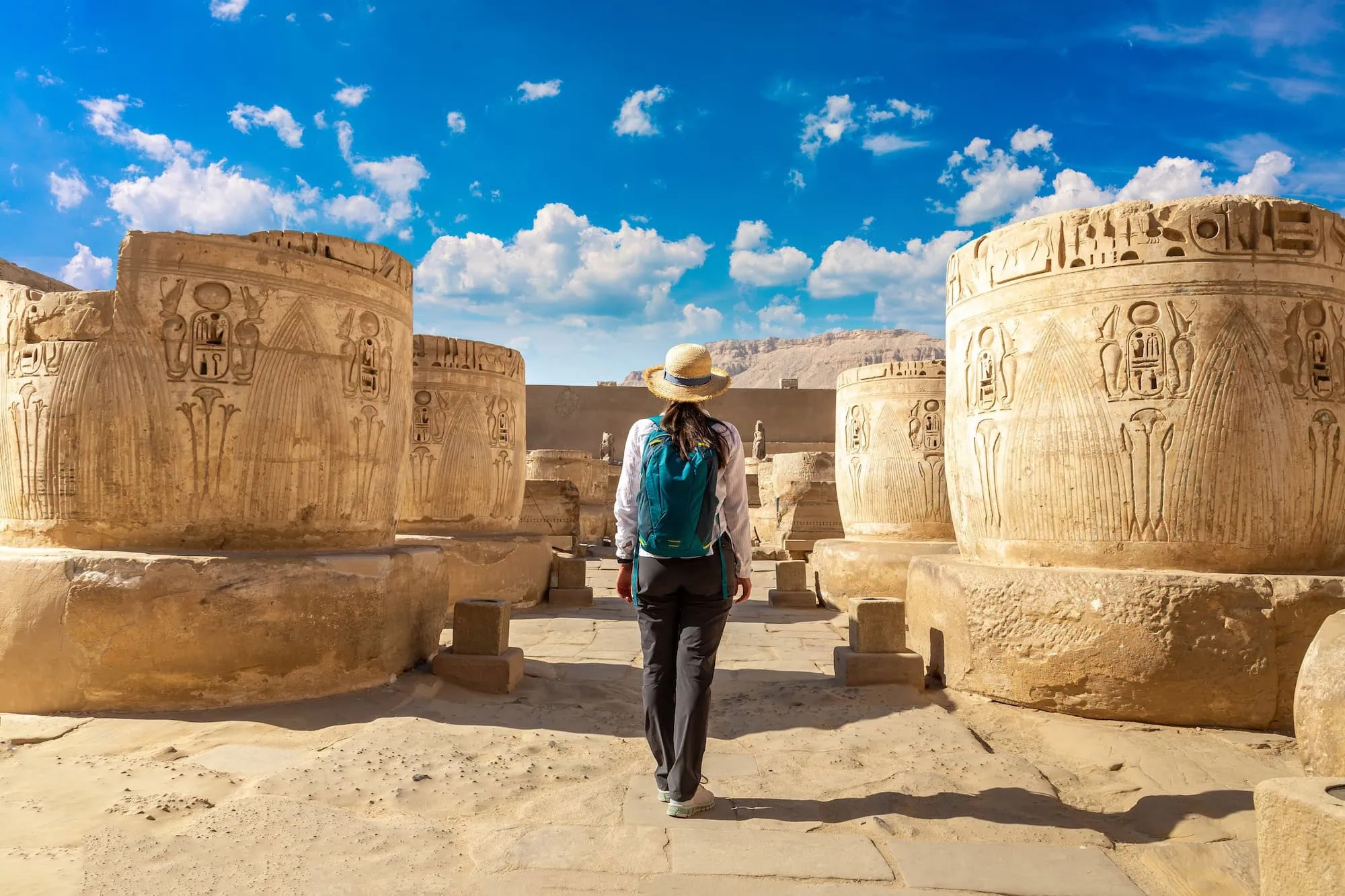
Our fascination with Medinet Habu stems from its unique position as both a masterpiece of Egyptian architecture and a living document of one of history’s most dramatic periods. When we stand before this massive complex on the west bank of Luxor, we’re witnessing the legacy of Ramesses III, Egypt’s last great pharaoh, who commissioned this monument around 1175 BC.
The temple complex covers nearly 10 hectares (25 acres) and represents the pinnacle of New Kingdom religious architecture, combining sacred spaces with practical defenses in ways that continue to amaze archaeologists today. What sets Medinet Habu apart isn’t just its impressive scale, but its remarkably preserved state.
While many Egyptian monuments have suffered from time and human interference, this complex retains much of its original splendor, including colorful reliefs and architectural details that transport visitors directly into the world of the pharaohs.
Table of Contents
The Sacred Origins of Djanet
Medinet Habu occupies ground that was sacred long before Ramesses III arrived with his ambitious building plans. Ancient Egyptians knew this site as Djanet, believing it marked the spot where the god Amun first appeared in the world.
This primordial connection to creation made the location especially significant for royal memorial temples, as pharaohs sought to link their earthly reign with divine origins. Archaeological evidence suggests religious activity here dates back to the Middle Kingdom, with earlier structures providing the foundation for later, grander constructions.
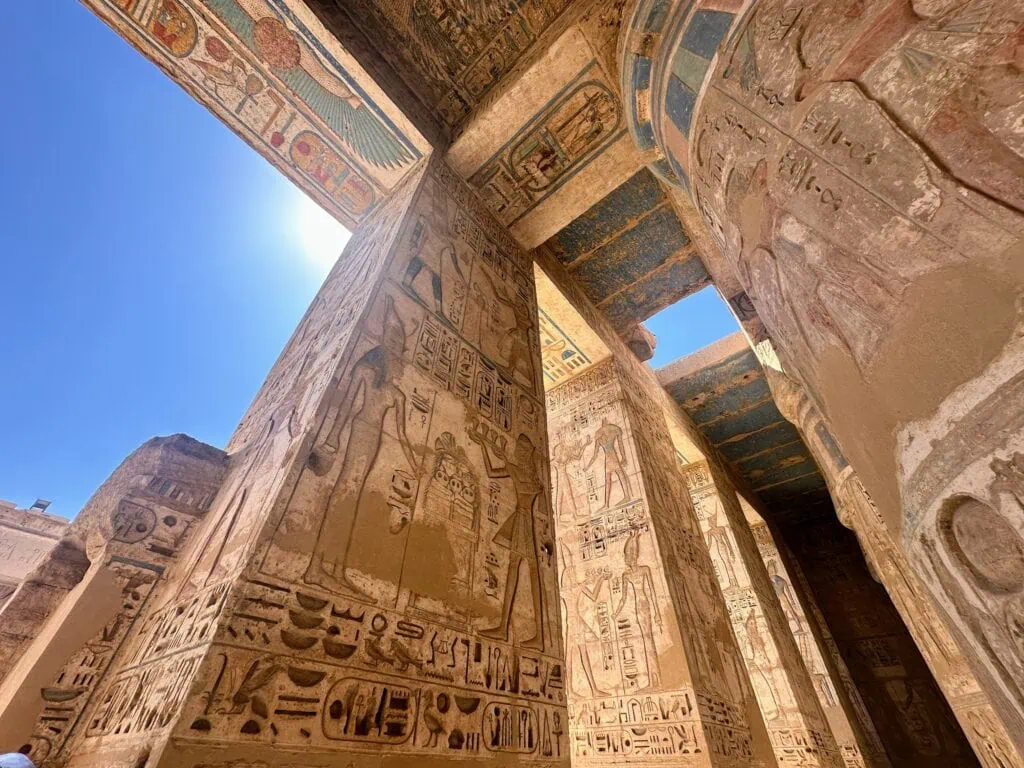
The Small Temple of Amun
Before examining Ramesses III’s massive contribution, we must acknowledge the elegant small temple that predates it by centuries. Built during the Eighteenth Dynasty and expanded by later rulers, this smaller complex served as the original center of worship at the site.
Its intimate scale contrasts beautifully with the monumental architecture that would later dominate the area. The small temple’s courtyard and sanctuary spaces demonstrate the evolution of Egyptian religious architecture.
Hatshepsut and Thutmose III both contributed to its development, establishing architectural traditions that Ramesses III would later incorporate into his own designs on a much larger scale.
Religious Significance in Ancient Beliefs
Djanet held special meaning in Egyptian cosmology beyond its association with Amun’s first appearance. Religious texts describe this location as a place where the boundaries between the earthly and divine realms grew thin, making it an ideal setting for the pharaoh’s eternal worship.
The site’s position on the west bank of the Nile, traditionally associated with the realm of the dead, reinforced its appropriateness for mortuary temples. This spiritual significance influenced every aspect of the complex’s design and decoration.
Priests performed daily rituals here that were believed to sustain the pharaoh’s spirit in the afterlife while maintaining cosmic order through proper religious observance.
Ramesses III’s Architectural Masterpiece
The mortuary temple of Ramesses III dominates Medinet Habu with an imposing presence that immediately communicates royal power. Construction began during the early years of Ramesses III’s reign and continued throughout his 31-year rule, creating a complex that demonstrates both traditional Egyptian design principles and innovative architectural solutions.
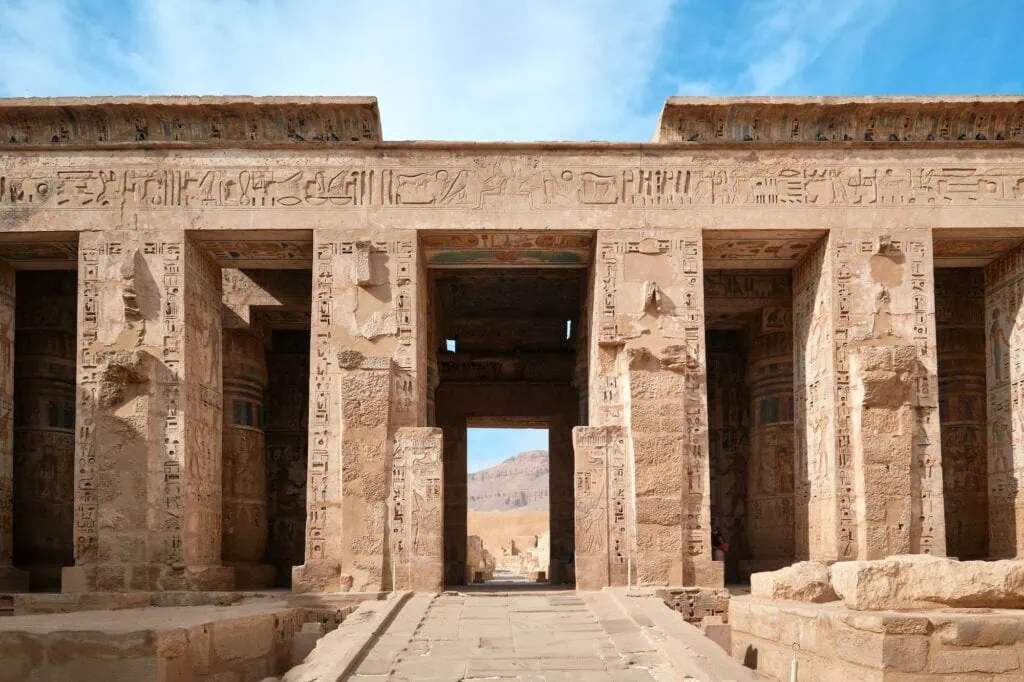
The temple follows orthodox Egyptian temple layout with its east-west orientation, but incorporates unique defensive features that set it apart from other memorial temples of the period. Our guides often point out how the entire complex was designed as both a place of worship and a fortified stronghold, reflecting the uncertain times in which it was built.
The Migdol Gate
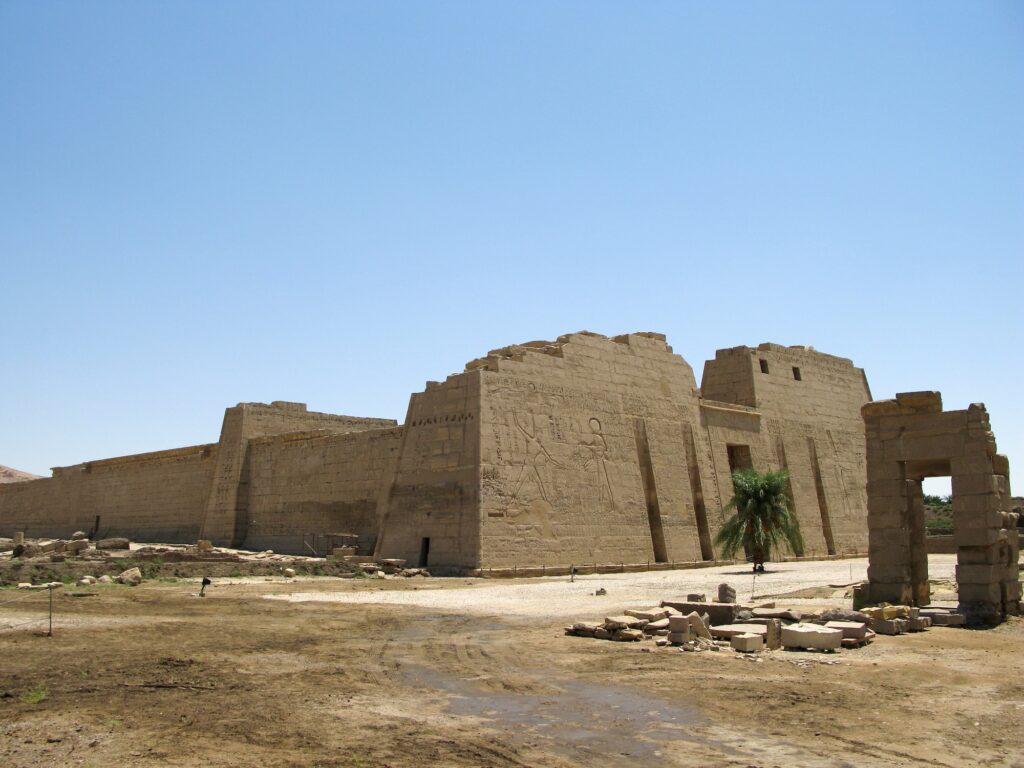
The eastern entrance features one of ancient Egypt’s most unusual architectural elements. Known as the Migdol Gate, this structure represents a direct borrowing from Syrian fortress design, demonstrating the international character of New Kingdom Egypt.
The gate’s two massive towers flank a central entrance, creating an imposing facade that would have impressed visitors and intimidated potential enemies. Detailed carvings on the gate depict Ramesses III in various triumphant poses, establishing the temple’s themes of royal victory and divine protection from the moment visitors entered the complex.
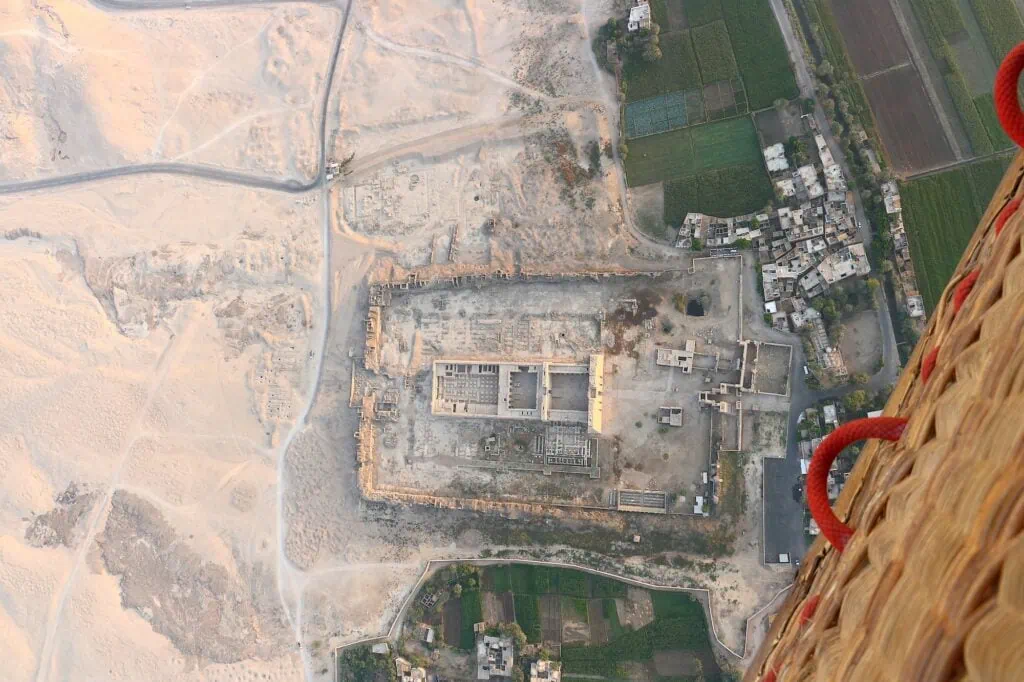
The Syrian architectural influence reflects Egypt’s extensive diplomatic and military contacts throughout the eastern Mediterranean during this period.
Temple Layout and Sacred Spaces
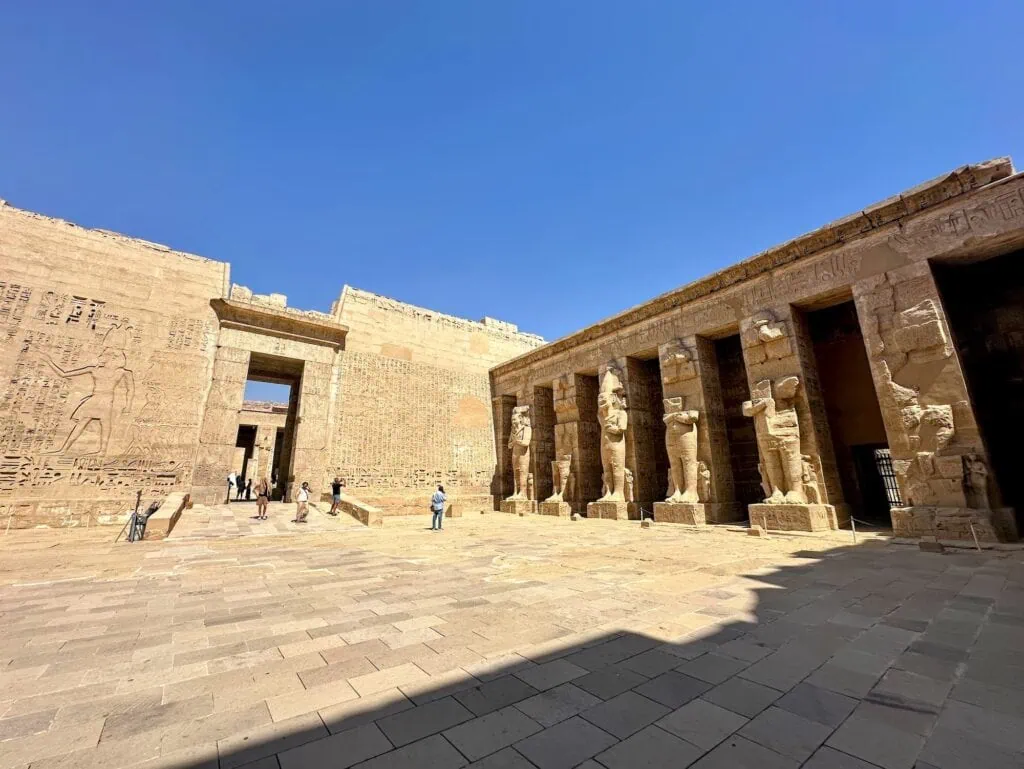
Beyond the Migdol Gate, the temple unfolds in a series of courtyards, halls, and sacred spaces that guide visitors progressively deeper into the pharaoh’s eternal realm. The first courtyard features colonnades decorated with scenes of royal festivals and religious ceremonies, while the second courtyard displays the famous battle reliefs that have made Medinet Habu internationally renowned.
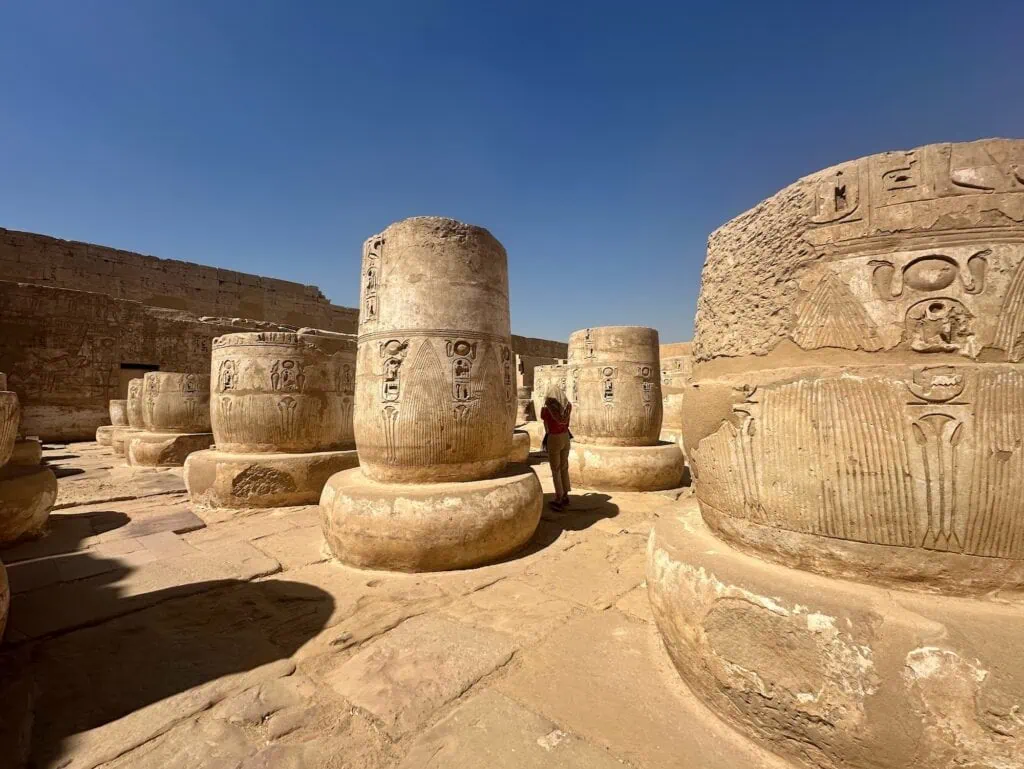
Three consecutive halls lead from the courtyards to the inner sanctuary, each more restricted and sacred than the last. The hypostyle halls feature massive columns carved to resemble papyrus bundles, creating forest-like spaces filled with religious imagery and hieroglyphic texts that preserve the pharaoh’s names and deeds for eternity.
The Palace Complex
Adjacent to the temple proper stands Ramesses III’s ceremonial palace, built from mudbrick and connected to the main temple through a window of appearances. This architectural feature allowed the pharaoh to participate in religious festivals while maintaining the sacred separation between divine and mortal realms.
The palace served specific ceremonial functions rather than daily residential purposes, with throne rooms and reception halls designed for state occasions and religious celebrations.
Chronicles of Ancient Warfare
Medinet Habu’s exterior walls function as a vast illustrated history book, preserving detailed accounts of Ramesses III’s military campaigns against Egypt’s enemies. The reliefs covering these walls represent some of ancient Egypt’s most dramatic and historically significant artistic achievements.
When we examine these carved narratives with our expert guides, we’re looking at eyewitness accounts of events that shaped the ancient Mediterranean world. The north exterior wall contains the most famous military scenes, depicting Egypt’s conflicts with the mysterious Sea Peoples who threatened the entire eastern Mediterranean around 1200 BC.
These weren’t mere decorative elements but served as powerful propaganda tools that reinforced royal authority while documenting historical events for both contemporary audiences and posterity.
The Sea Peoples Battles
The Battle of the Delta, carved in extraordinary detail along the temple’s exterior, shows Egyptian forces confronting a confederation of maritime invaders known collectively as the Sea Peoples. Among these groups were the Peleset, whom scholars identify as the biblical Philistines, making these reliefs crucial sources for understanding biblical archaeology and ancient Near Eastern history.
Relief scenes show Egyptian ships engaging enemy vessels in naval combat while archers rain arrows from the shore. The detailed depiction of weapons, clothing, and fighting techniques provides invaluable information about military technology and tactics during the Late Bronze Age collapse.
Women and children appear in ox-drawn carts, suggesting entire populations were migrating rather than simple military raids. The artistic style emphasizes Egyptian victory while providing remarkably accurate ethnographic details about enemy peoples.
Libyan Campaign Reliefs
Western walls document Ramesses III’s campaigns against Libyan tribes who repeatedly attempted to settle in the fertile Nile Delta. These reliefs show different artistic conventions from the Sea Peoples scenes, reflecting the land-based nature of these conflicts and the different cultural traditions of Egypt’s western enemies.
Libyan chieftains appear with elaborate feather headdresses and tattoos, details that correspond with descriptions from other ancient sources and archaeological evidence from Libyan sites. The precision of these ethnographic details suggests Egyptian artists had direct contact with their subjects, either through diplomatic missions or examination of prisoners.
Archaeological Discoveries and Scientific Research
The University of Chicago Oriental Institute has maintained an almost continuous archaeological presence at Medinet Habu since 1924, making this one of the longest-running excavation projects in Egypt. This sustained scientific attention has yielded extraordinary insights into both the temple’s construction and its later history as a Christian settlement.
Epigraphic Survey Work
The Oriental Institute’s epigraphic survey represents one of archaeology’s most meticulous documentation projects. Teams of artists and scholars have spent decades creating precise copies of the temple’s inscriptions and reliefs, preserving details that continue to fade due to environmental exposure.
This work has revealed layers of meaning in the temple’s decorations while creating a permanent record for future research. Digital photography and computer analysis have recently supplemented traditional hand-copying methods, allowing researchers to detect details invisible to the naked eye.
The Medinet Habu King List
Among the temple’s most significant inscriptional discoveries is a list of pharaohs that helps historians reconstruct New Kingdom chronology. This king list, though incomplete, provides valuable cross-references for dating purposes and understanding how later periods viewed their pharaonic predecessors.
The list’s placement within the temple complex suggests it served ritual purposes beyond mere historical record-keeping, possibly playing a role in ceremonies that connected Ramesses III with his royal ancestors and legitimized his divine authority.
The Coptic Christian Period
Christianity’s arrival in Egypt transformed Medinet Habu from a pharaonic temple into a thriving Christian settlement known as Jeme. This transformation, which began in the early centuries AD, created a unique archaeological palimpsest where Christian and pharaonic elements coexist in fascinating ways.
The Coptic settlement flourished from approximately the 4th through 9th centuries, with Christian families establishing homes within the ancient temple walls and converting pharaonic spaces into churches and workshops. This adaptive reuse preserved much of the original architecture while adding new layers of cultural meaning.
Christian Architecture Within Pharaonic Walls
Coptic Christians constructed several churches within the temple complex, carefully adapting ancient Egyptian spaces for Christian worship. The contrast between pharaonic reliefs depicting ancient gods and Christian crosses carved into the same walls creates a powerful visual dialogue between different religious traditions.
Archaeological evidence shows the Christian community maintained sophisticated economic and social structures, with workshops producing textiles, metalwork, and pottery within the temple grounds. This industrial activity helped preserve the site while gradually altering its appearance and function.
The Divine Adoratrices
During the Late Period, before Christianity’s arrival, Medinet Habu gained new religious significance as the burial place of the Divine Wives of Amun. These powerful priestesses, who held enormous religious and political authority during the Twenty-fifth and Twenty-sixth Dynasties, chose this sacred site for their eternal rest.
Their tombs, constructed within the temple complex, demonstrate the continuing religious importance of Medinet Habu centuries after Ramesses III’s death. The Divine Adoratrices’ presence connected the site to Thebes’ most prestigious religious institutions while maintaining its status as a center of royal mortuary worship.
Planning Your Visit to Medinet Habu
We recommend allowing at least 2-3 hours to properly explore this magnificent complex, though photography enthusiasts and history lovers often spend considerably longer absorbing its wealth of details. The temple opens daily from 6:00 AM to 5:00 PM (06:00-17:00), with admission fees of EGP 230 for international visitors.
These hours provide excellent opportunities for both early morning photography and afternoon exploration when the lighting enhances the relief carvings’ dramatic shadows.
Photography and Documentation
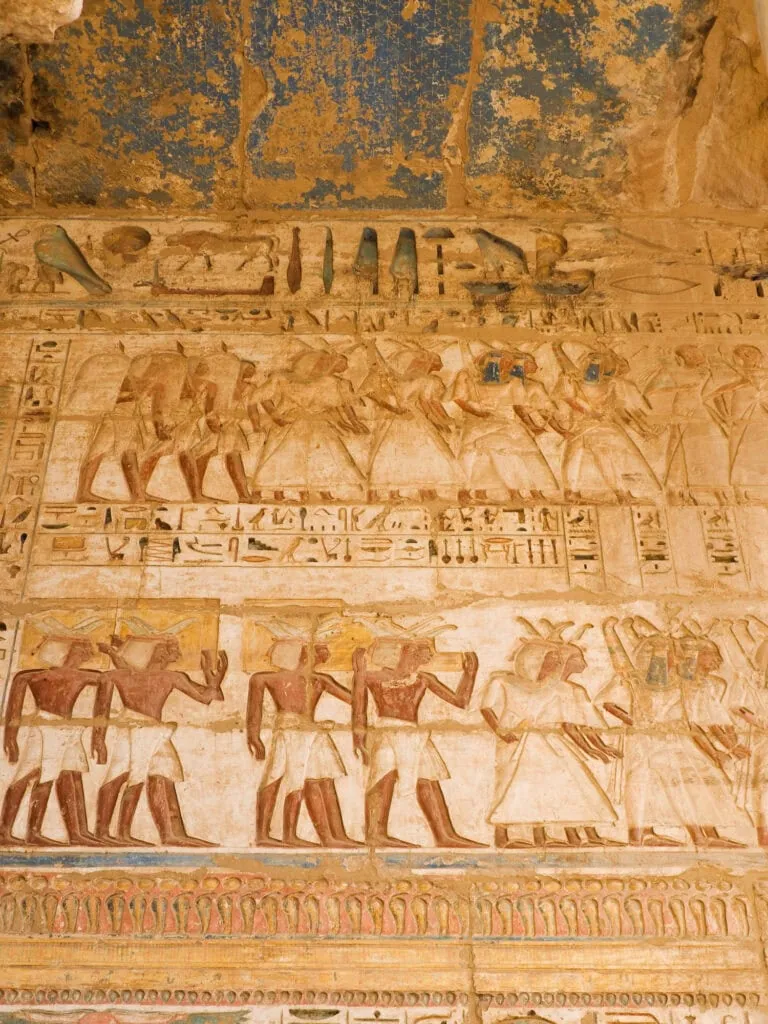
The preservation of original pigments on many reliefs makes Medinet Habu particularly rewarding for photography. We advise bringing both wide-angle lenses for architectural shots and telephoto lenses for detailed relief work.
The complex’s varied lighting conditions throughout the day offer different photographic opportunities, from dramatic shadows in the courtyards to subtle details in the interior halls. Video documentation is permitted throughout the complex, allowing visitors to create comprehensive records of their exploration.
Combining with Other West Bank Sites
Our Luxor West Bank tours often combine a visit to the Medinet Habu Temple with other iconic attractions such as the Valley of the Kings, Temple of Hatshepsut, and the Colossi of Memnon. This well-rounded itinerary offers a comprehensive exploration of ancient Thebes, highlighting its royal tombs, monumental temples, and impressive statues in one seamless experience.
This combination allows visitors to understand how Medinet Habu fits into the broader context of Egyptian royal mortuary architecture. The proximity to other major sites makes it practical to explore multiple locations in a single day, though we often recommend dedicating separate visits to fully appreciate each site’s unique characteristics and historical significance.
Discover The Grandeur Of Medinet Habu
Medinet Habu stands as one of Luxor’s most impressive yet often overlooked temples—where towering walls, vivid reliefs, and a sense of space create a truly immersive experience. With Egypt Tours Plus, we seamlessly include this remarkable site in a private journey that connects Luxor’s iconic landmarks with deeper, less crowded discoveries.
You choose your travel dates, your pace, and the experiences that shape your route. From in-depth temple exploration and expert-guided visits to Nile cruises and refined comfort throughout, we tailor every detail around your preferences—ensuring a smooth, enriching, and deeply personal travel experience.
Frequently Asked Questions
Most visitors spend 2-3 hours exploring Medinet Habu, while serious history enthusiasts and photographers often stay 4-5 hours to study the extensive reliefs and architectural details. The temple complex of Ramses III covers a large area on Luxor’s West Bank and includes courtyards, chapels, storerooms, and massive decorated walls. Compared with more crowded sites like Karnak, Medinet Habu offers a calmer and more immersive experience. Arriving early helps visitors explore the reliefs before tour groups and midday heat intensify.
Medinet Habu stands out because it combines a traditional pharaonic temple with defensive military architecture, including fortified walls and the famous Syrian-style Migdol gate. The temple is especially renowned for its exceptionally preserved battle reliefs showing Ramses III defeating the Sea Peoples around 1175 BCE during the late New Kingdom period. Unlike many Egyptian temples focused mainly on ritual scenes, Medinet Habu preserves detailed military narratives. The vivid carvings remain among the best historical records of Bronze Age warfare in Egypt.
Access to elevated sections at Medinet Habu varies depending on current conservation work and Egyptian antiquities regulations, although most visitors experience the site entirely from ground level. The lower courtyards, hypostyle halls, and exterior walls already provide excellent visibility of the temple’s major inscriptions and relief scenes. Certain stairways or upper chambers may occasionally open during restoration periods or special guided access. Comfortable walking shoes remain important because many pathways involve uneven ancient stone surfaces throughout the complex.
Yes, photography and video recording are generally permitted throughout Medinet Habu without additional personal-use fees, making the site especially popular among photographers and archaeology enthusiasts. The temple’s well-preserved reliefs, towering pylons, and quieter atmosphere provide excellent conditions for detailed architectural photography compared with more crowded Luxor monuments. Flash photography may still be discouraged inside darker chambers to help protect surviving pigments and delicate surfaces. Early morning lighting creates particularly dramatic shadows across Ramses III’s battle scenes.
Early morning between approximately 6:00 am and 8:00 am is widely considered the best time to visit Medinet Habu because temperatures are cooler and the angled sunlight highlights the temple’s carved reliefs beautifully. Late afternoon also offers excellent photography conditions, especially along the outer walls and courtyards. Midday visits can become uncomfortable from May through September when Luxor temperatures often exceed 40°C (104°F). Visiting early additionally helps avoid the larger West Bank tour groups arriving later in the morning.
Medinet Habu contains some of the most important ancient depictions of the Sea Peoples, including figures many scholars associate with the Peleset, often linked to the biblical Philistines. The battle reliefs commissioned by Ramses III document invasions and military conflicts around the 12th century BCE during the collapse of several eastern Mediterranean civilizations. These carvings provide valuable archaeological evidence for regional instability described in later biblical traditions. Historians frequently reference Medinet Habu when discussing connections between Egypt and the ancient Levant.
Medinet Habu offers limited accessibility features, although some main pathways and open courtyard areas can be navigated by visitors with moderate mobility limitations. Uneven stone surfaces, ancient thresholds, and occasional loose sand create challenges for wheelchair users and travelers requiring significant assistance. Compared with tomb sites containing steep staircases, however, Medinet Habu is generally easier to navigate because much of the complex remains at ground level. Private guided transportation helps simplify arrival and reduce unnecessary walking across the West Bank area.
Visitors to Medinet Habu should bring comfortable walking shoes, sunscreen, sunglasses, bottled water, and a camera with extra batteries because the temple complex is large and exposed to strong desert sunlight. Lightweight breathable clothing is recommended, particularly during summer months when daytime temperatures regularly exceed 38°C (100°F). Shade inside the site is limited outside certain halls and covered chambers. Carrying small cash notes for tickets, tips, or nearby vendors can also be useful during extended West Bank excursions.
Yes, visitors can still see traces of Medinet Habu’s later Coptic Christian occupation integrated into the ancient pharaonic complex, although some restricted sections may require special permission during conservation work. After the decline of traditional temple worship, Christian communities reused parts of the site between the 4th and 9th centuries CE, adding crosses, modified rooms, and altered wall surfaces. These layers reveal how the temple evolved across different religious eras. Guides often point out Christian additions easily overlooked by independent visitors.
Ancient canal systems once connected Medinet Habu directly to the Nile River, allowing ceremonial boats and temple processions to travel between the river and the sacred complex. During the New Kingdom, these waterways played an important role in religious festivals, especially ceremonies linked to the god Amun and the Opet traditions centered in Thebes. Although the canals no longer function today, archaeologists have identified remnants of harbor structures and processional routes. The temple’s placement reflected both spiritual symbolism and practical river access.
The fortified Migdol gate at Medinet Habu is significant because it reflects architectural influences from Syria and the eastern Mediterranean rather than traditional Egyptian temple entrances alone. Built during the reign of Ramses III in the 12th century BCE, the massive gateway resembles military fortifications used in Levantine cities and demonstrates Egypt’s international political connections during the late New Kingdom. Its defensive appearance also reinforced royal authority during periods of regional instability. Few Egyptian temples preserve such a striking foreign-inspired structure.
Yes, guided tours of Medinet Habu are available in multiple languages, including English, Arabic, French, German, Spanish, and several other European languages depending on guide availability. Professional Egyptologists help visitors understand the temple’s military reliefs, religious symbolism, and architectural evolution far more effectively than signage alone. Egypt Tours Plus regularly arranges multilingual guided experiences for travelers exploring Luxor’s West Bank. Booking guides in advance during peak season from October through April is recommended for the best language selection.
Design Your Custom Tour
Explore Egypt your way by selecting only the attractions you want to visit