

Dendera Temple Complex – Home to Egypt’s Best Preserved Temple
Sand shifts but stone endures at one of Egypt’s most remarkable archaeological treasures.
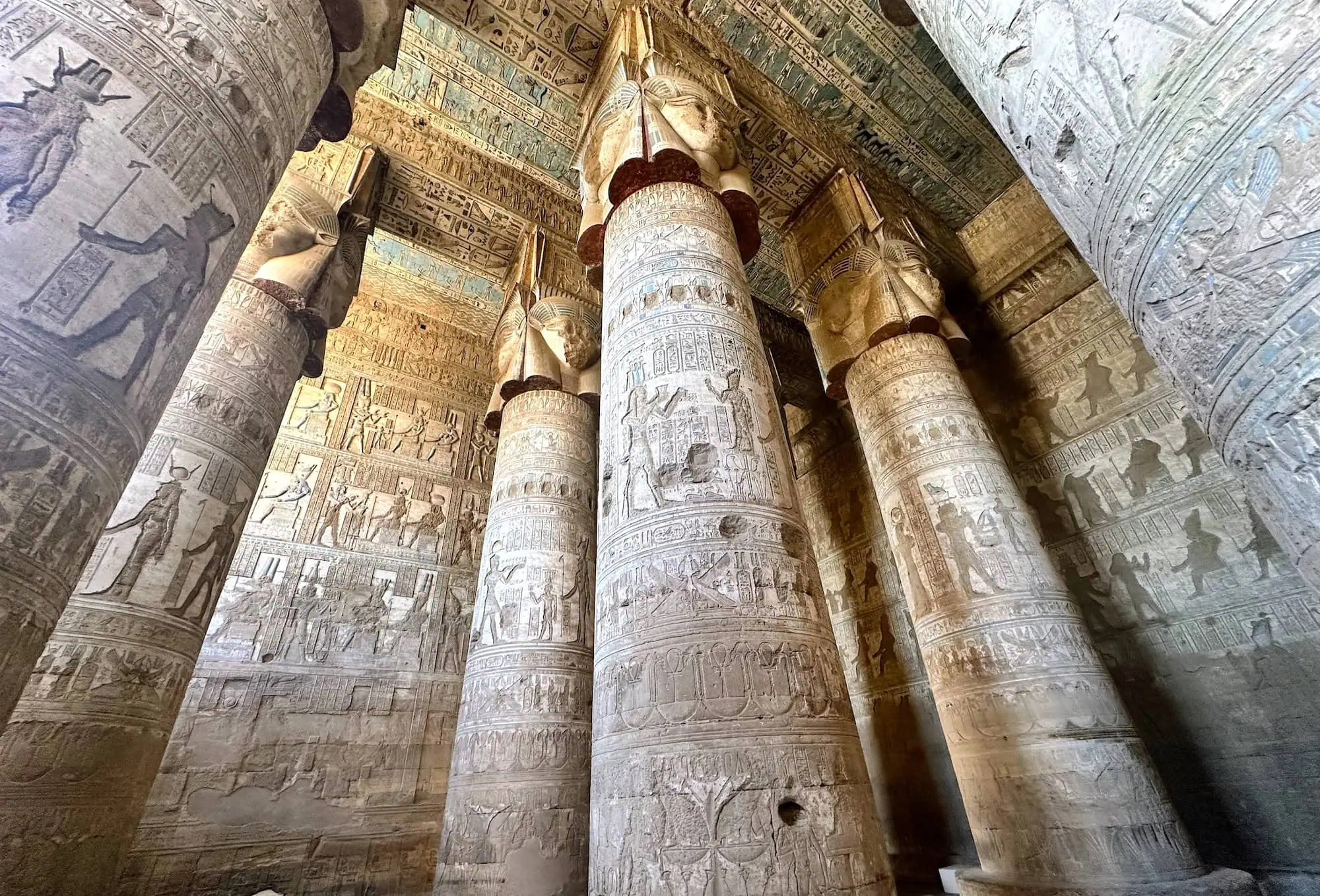
Walking through the Dendera Temple Complex feels like stepping into the pharaohs’ world unchanged by millennia. This extraordinary site, located about 60 km (37 miles) north of Luxor along the Nile River, showcases the finest preservation of ancient Egyptian temple architecture anywhere in the country. Unlike many archaeological sites where time has worn away colors and details, Dendera maintains its vibrant paintings, intricate astronomical ceilings, and sacred spaces exactly as ancient worshippers experienced them. The complex spans nearly 40,000 square meters and represents over 2,000 years of continuous religious devotion, making it an essential destination for understanding Egypt’s spiritual heritage.
For travelers seeking authentic encounters with ancient Egypt beyond the typical tourist circuit, we believe Dendera offers an unmatched window into the past where every wall tells a story.
Table of Contents
The Sacred Legacy of Hathor Worship
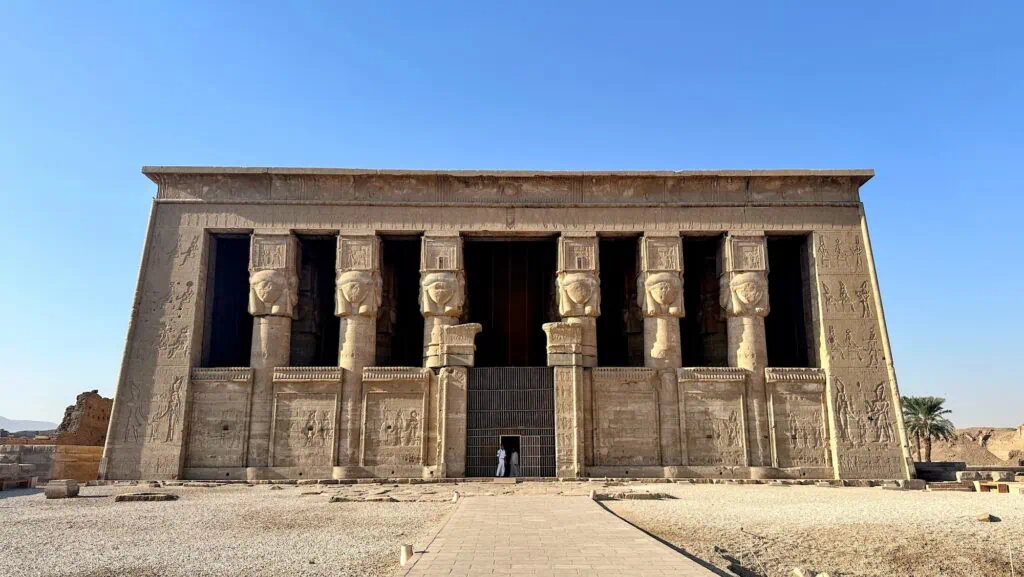
The entire complex centers around the magnificent Temple of Hathor, Egypt’s beloved goddess of fertility, music, and motherhood. Construction began during the Middle Kingdom under Mentuhotep II around 1995 BCE, but the structure we see today primarily reflects Ptolemaic and Roman architectural vision. The temple served as the focal point for the powerful Hathor cult, drawing pilgrims from across the Mediterranean world seeking healing and divine intervention.
Hathor’s Divine Attributes and Symbolism
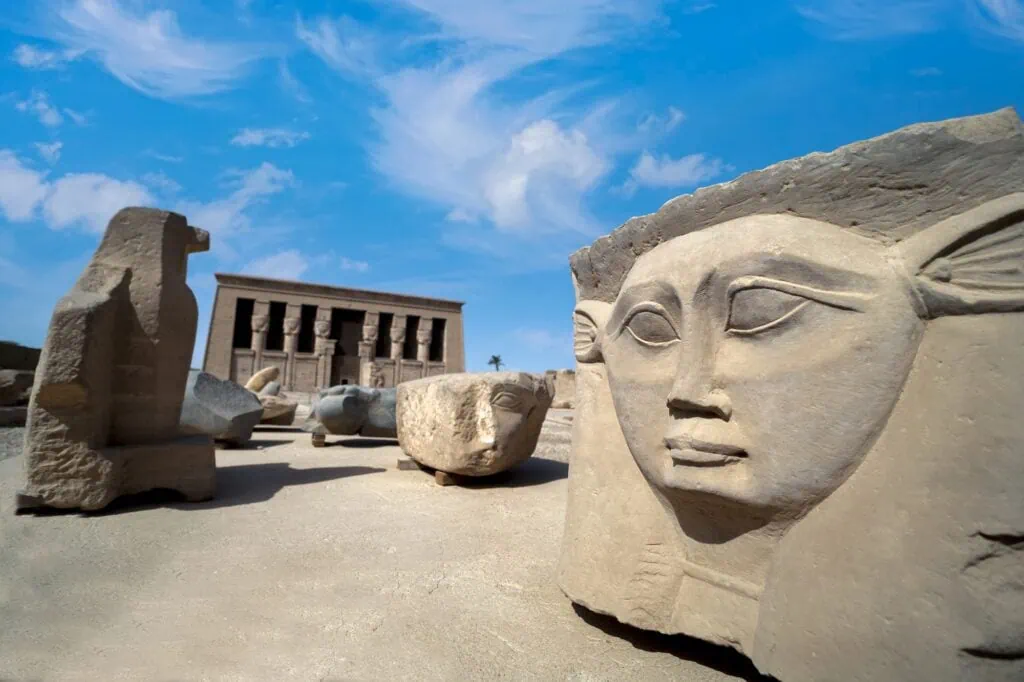
Ancient Egyptians revered Hathor as the “Lady of the Sky,” often depicted as a cow goddess or woman with cow ears. Her sacred sistrum, a metal rattle used in religious ceremonies, appears throughout the temple’s decorative program.
The goddess represented the protective, nurturing aspects of divine femininity, making her temple a sanctuary for women seeking assistance with childbirth and fertility. Roman emperors like Trajan and Domitian appear in relief carvings making offerings to Hathor, demonstrating how this Egyptian deity transcended cultural boundaries during the Greco-Roman period.
The Happy Reunion Festival
Each year, the temple hosted the spectacular Happy Reunion Festival, when priests would transport Hathor’s sacred statue south to Edfu Temple for her mystical marriage to Horus. This journey along the Nile coincided with the annual flood season and represented the renewal of Egypt’s agricultural cycle. The festival lasted several days and included elaborate processions, ritual offerings, and communal celebrations that brought together worshippers from throughout Upper Egypt. Archaeological evidence suggests these festivals continued well into the Roman period, highlighting the enduring appeal of Hathor’s cult across different ruling dynasties.
Architectural Marvels That Defy Time
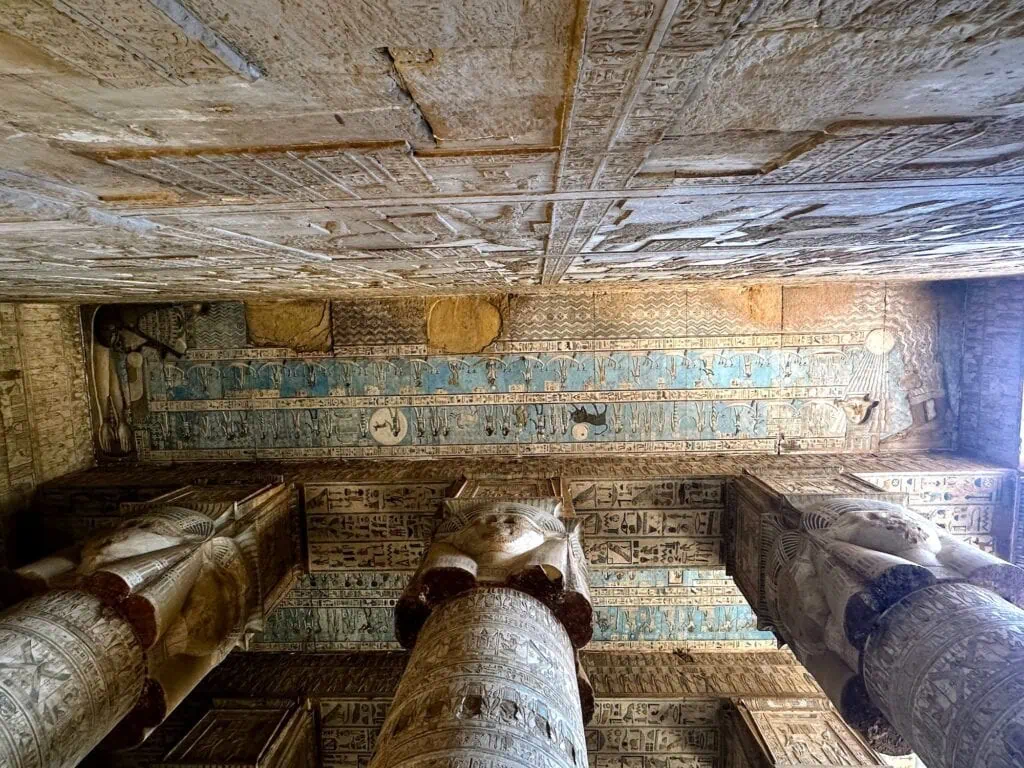
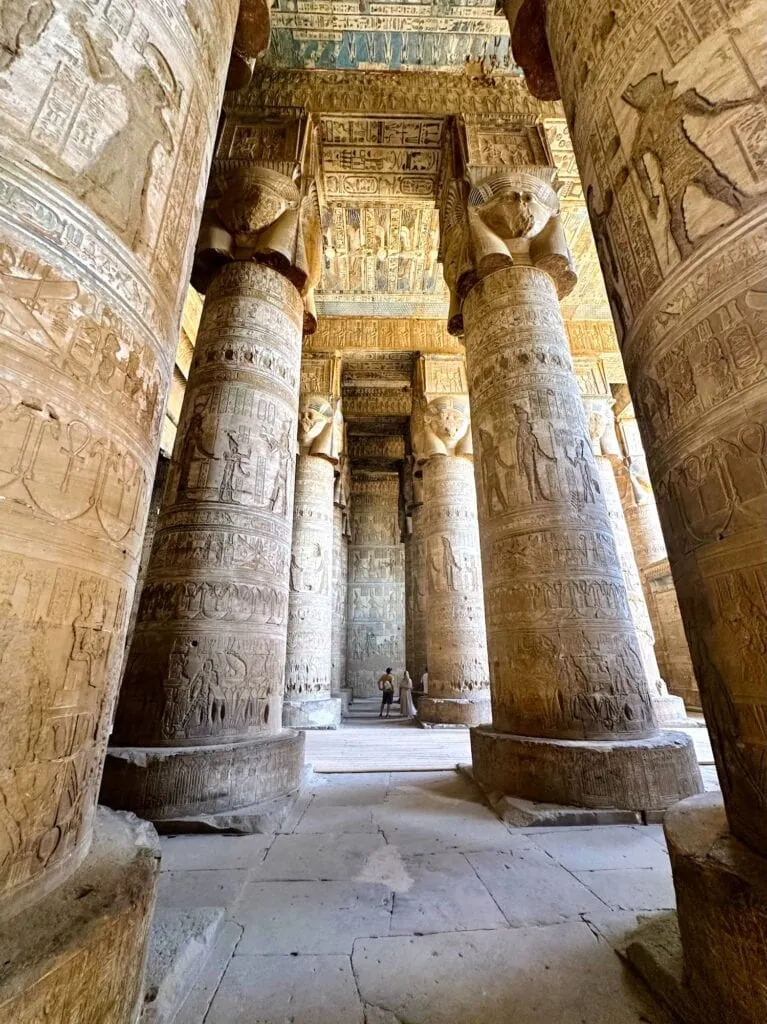
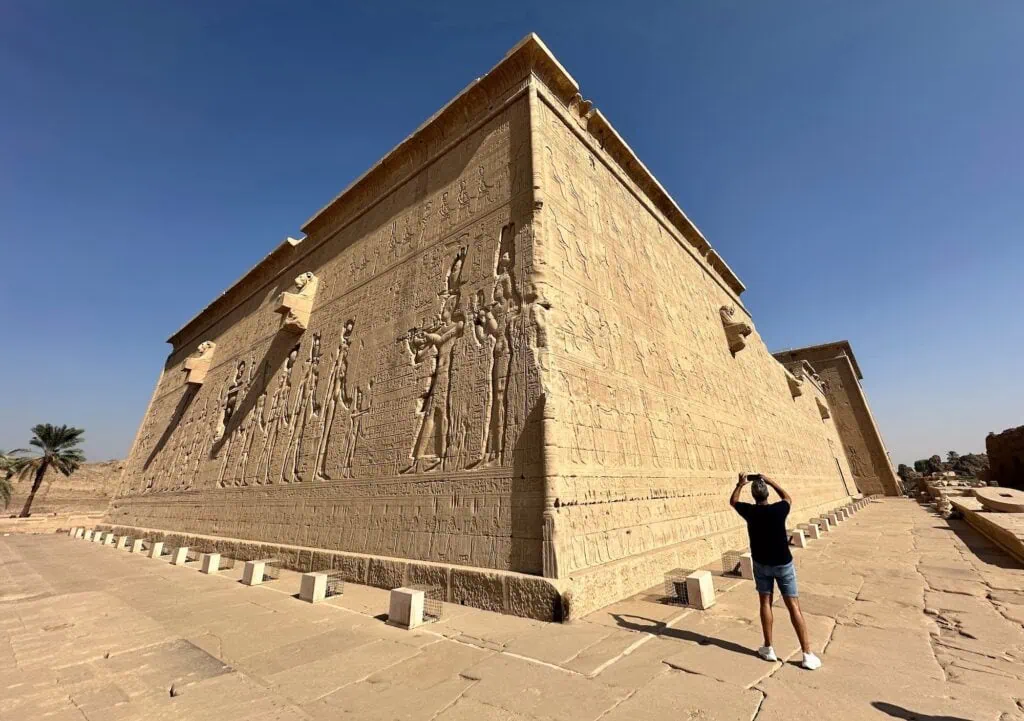
The Temple of Hathor stands as one of ancient Egypt’s most architecturally sophisticated structures. Its massive hypostyle hall contains 24 columns topped with four-faced Hathor capitals, each carved with remarkable precision and artistic detail. The columns support a ceiling decorated with astronomical charts showing the journey of the sun god Ra across the heavens. What makes Dendera unique among Egyptian temples is its exceptional state of preservation – visitors can still see original paint colors on walls and ceilings that have remained vivid for over 2,000 years.
The complex includes several smaller structures surrounding the main temple. A sacred lake once provided holy water for purification rituals. The mammisi, or birth house, celebrated the divine birth of Hathor’s child and featured elaborate relief scenes of royal and divine births. Underground crypts beneath the temple stored precious religious artifacts and temple treasures, accessible only to high-ranking priests through hidden passages.
Roman additions to the complex include a massive wall surrounding the entire site and additional chapels dedicated to both Egyptian and Roman deities. The architectural fusion demonstrates how Roman rulers adapted to local religious traditions while adding their own imperial symbolism. Emperor Marcus Aurelius appears in several relief carvings, showing how Roman pharaohs maintained legitimacy by participating in traditional Egyptian religious practices.
The Mysterious Dendera Zodiac
Perhaps no single artifact from ancient Egypt has generated more fascination and controversy than the Dendera Zodiac. Originally carved into the ceiling of a chapel within the Hathor Temple, this circular relief contains detailed astronomical information representing the ancient Egyptians’ sophisticated understanding of celestial movements. The zodiac combines Egyptian religious symbolism with Greek astronomical knowledge, creating a unique star map that has puzzled scholars for centuries.
From Temple Ceiling to Parisian Museum
In 1820, French archaeologist Jean-François Champollion and a team of workers carefully removed the zodiac relief from its original location and transported it to France. Today, the original resides in the Louvre Museum, while a plaster replica remains at Dendera. This removal sparked one of archaeology’s earliest repatriation debates, with Egyptian authorities under Muhammad Ali Pasha protesting the artifact’s export. The controversy continues today as Egypt seeks the return of cultural treasures housed in foreign museums.
Astronomical Precision and Ancient Knowledge
The zodiac reveals the ancient Egyptians’ remarkable astronomical knowledge. Star positions depicted in the relief allow modern astronomers to date its creation to approximately 50 BCE, during the Ptolemaic period. The circular design incorporates traditional Egyptian religious figures alongside Greek zodiac symbols, showing how Hellenistic influence blended with native traditions. Some researchers suggest the zodiac served as both a religious calendar and an astronomical teaching tool for temple priests.
Roman Egypt and Cultural Fusion
Dendera exemplifies the complex cultural exchange that characterized Roman Egypt from 30 BCE to 641 CE. Rather than simply imposing Roman culture, imperial administrators recognized the importance of maintaining Egyptian religious traditions to ensure political stability.
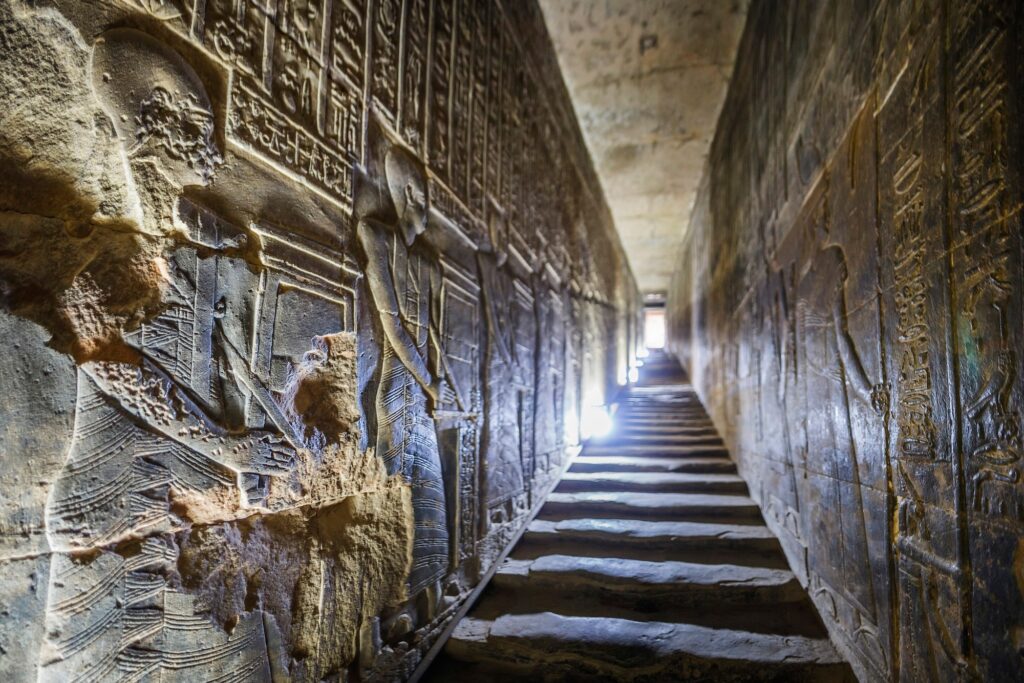
The temple walls contain numerous scenes of Roman emperors performing traditional pharaonic rituals before Egyptian gods. Trajan appears making offerings to Hathor, while Domitian participates in temple dedication ceremonies. These images weren’t merely decorative – they represented genuine attempts by Roman rulers to legitimize their authority through participation in ancient Egyptian religious practices. The cultural synthesis created at Dendera influenced Roman religious thought and contributed to the eventual rise of syncretic mystery religions throughout the empire.
Archaeological evidence shows that temple activities continued unchanged under Roman rule. Priests maintained traditional rituals, pilgrims still sought Hathor’s healing powers, and festivals followed ancient calendrical cycles. Roman contributions to the complex include enhanced security walls, additional storage facilities, and improved infrastructure for managing large crowds during religious festivals.
Planning Your Visit to Dendera
Getting There from Luxor
Most travelers reach Dendera as a day trip from Luxor, located approximately 60 km (37 miles) to the south. The journey takes about one hour by private car or taxi. We recommend departing early morning around 8:00 am (08:00) to avoid crowds and afternoon heat. The road follows the Nile’s west bank through agricultural villages and offers scenic views of rural Egyptian life.
Best Times to Visit
The temple complex opens daily at 9:00 am (09:00) and closes at 5:00 pm (17:00). October through March provides the most comfortable weather conditions, with temperatures ranging from 20-25°C (68-77°F). Summer visits require early morning arrival due to temperatures often exceeding 40°C (104°F). The site receives significantly fewer tourists than major Luxor attractions, making it possible to explore without large crowds even during peak season.
What to Expect Inside
Allow at least 3-4 hours to properly explore the entire complex. The main Hathor Temple requires about 2 hours, while smaller structures and the surrounding area need additional time. Comfortable walking shoes are essential as the site involves considerable walking on uneven ancient stone surfaces.
The Ancient Hospital and Healing Center
Beyond its religious significance, Dendera functioned as one of ancient Egypt’s most important healing centers. The temple complex included facilities that modern archaeologists describe as an ancient sanatorium where sick pilgrims sought miraculous cures from Hathor’s divine power.
Sacred waters from underground springs were believed to possess healing properties when blessed by Hathor’s priests. Patients would stay in special chambers within the complex while undergoing treatment that combined religious ritual with practical medical care. Egyptian medical papyri found at other sites describe treatments for various ailments that were likely practiced at Dendera’s healing center.
The goddess Hathor was particularly associated with women’s health, childbirth, and fertility treatments. Women throughout the ancient Mediterranean world made pilgrimages to Dendera seeking divine assistance with reproductive issues. Archaeological finds include numerous votive offerings left by grateful patients who believed they received healing through Hathor’s intervention.
Mysteries and Modern Theories
The temple complex contains several features that continue to puzzle archaeologists and generate alternative theories about ancient Egyptian technology and knowledge.
The “Dendera Light” Controversy
Certain relief carvings in underground chambers appear to depict bulb-like objects connected to cables, leading some researchers to propose that ancient Egyptians possessed electrical knowledge. Mainstream Egyptologists interpret these images as traditional religious symbols – the “bulb” represents a lotus flower containing a serpent, while the “cables” are lotus stems. The djed pillar appearing in these scenes symbolizes stability and divine power in Egyptian religious iconography.
Stellar Alignments and Sacred Geometry
Recent archaeological surveys using satellite technology have revealed that Dendera’s builders positioned the temple according to precise astronomical alignments. The main temple axis aligns with the star Sirius, sacred to the goddess Isis and crucial for predicting Nile flood seasons. Secondary structures align with other significant stars, suggesting the entire complex functioned as a massive astronomical instrument for tracking celestial cycles important to Egyptian agricultural and religious calendars.
Conservation Efforts and Future Preservation
Since 2005, the Supreme Council of Antiquities has undertaken extensive restoration work at Dendera in partnership with French archaeological teams. These efforts focus on stabilizing ancient structures, cleaning pollution damage from stone surfaces, and protecting vulnerable painted areas from environmental degradation.
Climate-controlled monitoring systems now track temperature and humidity levels throughout the complex to prevent further deterioration of painted surfaces. Advanced photographic documentation creates detailed records of existing decorations before they fade further. International funding supports training programs for Egyptian conservators who will continue preservation work for future generations.
The restoration project has already revealed previously hidden decorative details and architectural features. Cleaned wall surfaces show the original brilliance of ancient Egyptian artistry, demonstrating why Dendera ranks among the world’s most important archaeological sites. Ongoing work focuses on making the site more accessible to visitors while protecting its fragile ancient elements.
Uncover The Beauty Of Dendera Temple Complex
The Dendera Temple Complex offers one of Egypt’s most visually stunning and well-preserved temple experiences—where intricate carvings, vibrant سقف reliefs, and sacred symbolism bring ancient beliefs to life. With EgyptToursPlus, we seamlessly include this extraordinary site in a private journey that connects lesser-visited gems with Egypt’s most iconic landmarks.
You choose your travel dates, your pace, and the experiences that shape your route. From detailed temple exploration and cultural insights to Nile journeys and refined comfort throughout, we tailor every element around your preferences—ensuring a smooth, immersive, and deeply personal travel experience.
Frequently Asked Questions
Most visitors should plan at least 3 to 4 hours to explore the Dendera Temple Complex properly, including the Temple of Hathor, rooftop chapels, sacred lake, and surrounding Roman-era structures. Located about 60 km north of Luxor, Dendera rewards slower exploration because of its unusually detailed reliefs, astronomical ceilings, and preserved paintwork. Photography enthusiasts and travelers interested in Egyptian religion often stay longer than expected. Arriving early in the morning helps avoid midday heat and larger tour groups from Luxor
Dendera can be challenging for travelers with mobility limitations because the site includes uneven stone flooring, raised thresholds, narrow staircases, and ancient pathways worn smooth over centuries. Accessing rooftop areas and underground crypts requires climbing steep stone steps that may not suit wheelchair users or visitors with balance concerns. However, the main courtyard and large sections of the Temple of Hathor remain relatively accessible with assistance. Comfortable supportive footwear is strongly recommended throughout the complex.
The most practical way to reach Dendera from Luxor is by private car or taxi, with travel time averaging about one hour each way along the west side of the Nile Valley. Dendera lies approximately 60 km (37 miles) north of Luxor near the town of Qena, making it suitable for a half-day or full-day excursion. Organized tours simplify transportation logistics and often combine Dendera with Abydos Temple for a comprehensive Upper Egypt itinerary. Early departures provide cooler temperatures and lighter road traffic.
Photography inside Dendera Temple is permitted with an additional photography ticket purchased separately from the main admission ticket, subject to current Egyptian antiquities regulations. Interior photography is especially popular because Dendera preserves some of the finest surviving ancient Egyptian colors, astronomical carvings, and ceiling decorations anywhere in Egypt. Flash photography may be restricted in sensitive areas to protect pigments and relief surfaces. Visitors interested in the famous zodiac ceiling or crypts usually consider the extra photography fee worthwhile.
Dendera is widely regarded as the best-preserved major temple complex in Egypt, particularly for its surviving painted ceilings, detailed relief carvings, and remarkably intact architectural features. While Karnak impresses through scale and Abu Simbel through monumentality, Dendera stands out for the clarity of its artwork and Greco-Roman period decoration. The Temple of Hathor contains vivid blues, reds, and gold tones still visible after nearly 2,000 years. Travelers interested in symbolism, astronomy, and ancient ritual often rank Dendera among Egypt’s most rewarding temples.
Visitors to Dendera should wear lightweight modest clothing, comfortable walking shoes, sunglasses, and strong sun protection because the temple complex is largely exposed to Upper Egypt’s intense desert climate. Temperatures frequently exceed 38°C (100°F) between May and September, especially during midday hours. Shoes with good grip are helpful for navigating worn stone surfaces and staircases leading to rooftop areas and crypt chambers. Carrying bottled water is advisable since shade inside the broader archaeological complex remains limited.
Basic visitor facilities, including restrooms and small refreshment stands, are available near the entrance to the Dendera Temple Complex, although food and beverage options remain limited compared with larger sites in Luxor. Travelers should bring bottled water, snacks, and any personal necessities before arriving, especially during summer months when temperatures can become extreme. The site itself focuses primarily on archaeological preservation rather than extensive tourist infrastructure. Morning visits generally provide the most comfortable conditions for extended exploration.
Dendera is generally considered safe for independent travelers, especially during daytime hours when tourist activity and site security are strongest. However, many visitors prefer organized transportation or private drivers because the temple lies outside Luxor and public transportation options can be inconsistent for international tourists. Guided excursions also provide historical context that enhances appreciation of the temple’s symbolism and artwork. Travelers driving independently should plan routes carefully and avoid returning late after dark through unfamiliar rural roads.
The Dendera Zodiac is one of the ancient world’s most famous astronomical carvings because it presents a detailed celestial map combining Egyptian religious symbolism with Greco-Roman zodiac traditions. Originally carved on the ceiling of a chapel dedicated to Osiris, the relief includes constellations, planetary symbols, and representations of the twelve zodiac signs. The original zodiac now resides in the Louvre Museum in Paris, while a replica remains at Dendera. Historians consider it vital evidence of advanced ancient astronomical knowledge and cultural exchange.
Older children and teenagers interested in mythology, archaeology, or ancient astronomy often find Dendera especially engaging because of its colorful ceilings, hidden crypts, and dramatic carvings of gods and zodiac symbols. Younger children may struggle with the site’s length, heat, and detailed historical focus, particularly during warmer months. Families visiting with children should bring water, hats, and snacks to stay comfortable during exploration. The rooftop views and underground chambers usually hold younger visitors’ attention better than standard temple courtyards.
Entrance fees for Dendera Temple vary according to nationality, student status, and current government pricing policies, with additional charges typically required for interior photography permits. International visitor tickets are generally priced similarly to other major Upper Egypt temple sites, while students holding valid identification may receive discounts. Combined excursions with Abydos or guided tours may include transportation and entry costs together. Travelers should confirm updated ticket prices shortly before visiting because fees can change seasonally.
Dendera and Edfu were spiritually connected through the annual “Beautiful Reunion” festival, during which the goddess Hathor traveled by ceremonial boat from Dendera to visit Horus at Edfu Temple. This sacred journey symbolized divine marriage, fertility, renewal, and cosmic harmony within ancient Egyptian religion. Priests conducted elaborate river processions, rituals, and celebrations that strengthened ties between the two major temple centers along the Nile. The festival also highlights how interconnected Upper Egypt’s religious landscape remained during the Ptolemaic period.
Design Your Custom Tour
Explore Egypt your way by selecting only the attractions you want to visit