

Djoser Step Pyramid – One of Egypt’s Most Famous Tombs
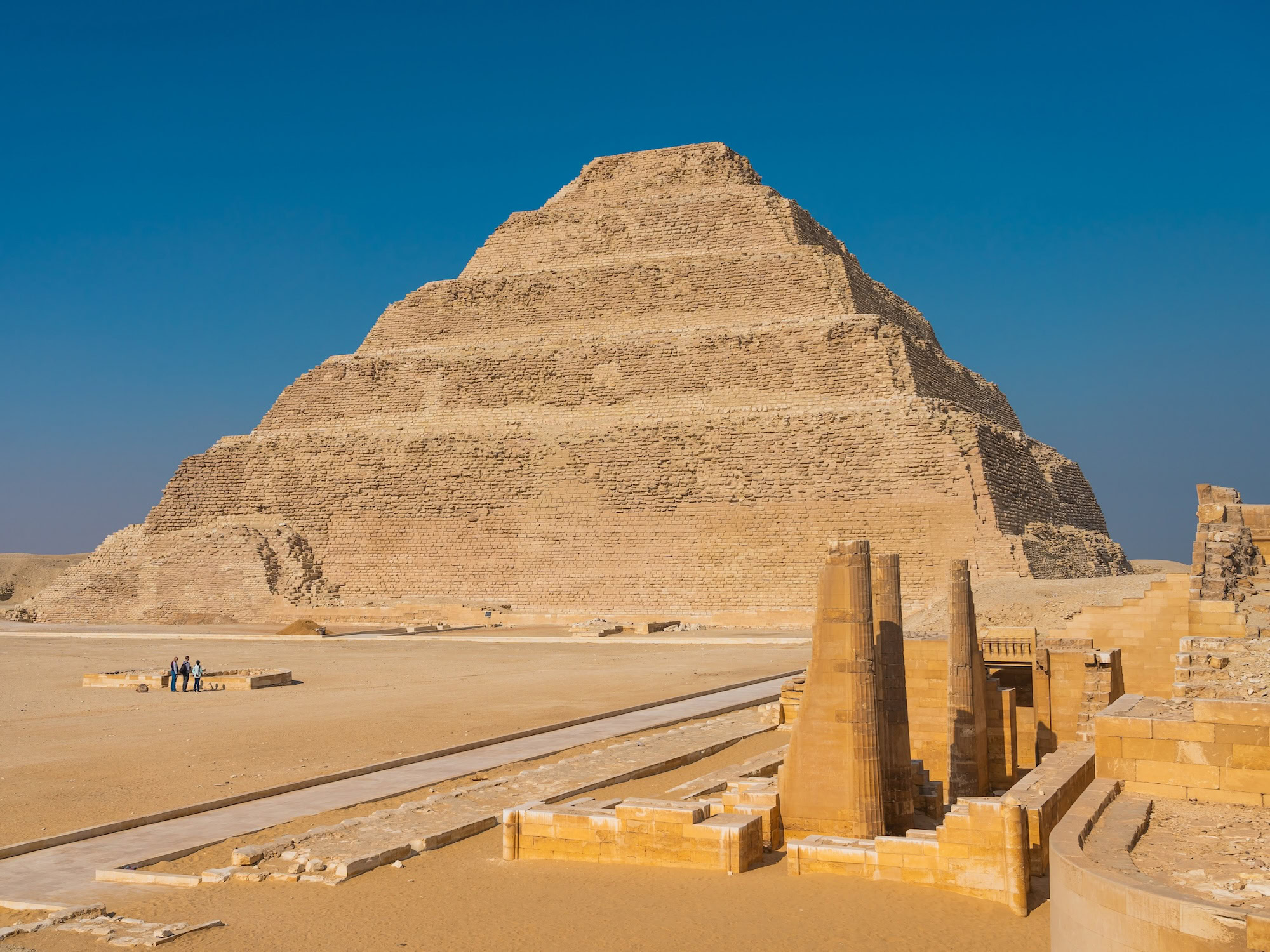
Egypt’s first pyramid stands as more than stone and mortar. Rising from Saqqara’s desert landscape, the Step Pyramid of Djoser transformed Egyptian architecture forever.
Built around 2670 BCE during the Third Dynasty, this ancient wonder represents humanity’s first successful attempt at monumental stone construction. King Djoser, originally named Netjerykhet, commissioned what would become the prototype for all future pyramids.
We’ve explored this remarkable structure extensively throughout our decades guiding visitors through Egypt’s treasures. The Step Pyramid continues to reveal new secrets about ancient Egyptian engineering and religious beliefs.
Origins and Historical Context
The Third Dynasty marked a turning point in Egyptian civilization. King Djoser ruled during an era of unprecedented prosperity and technological advancement. His reign witnessed the transition from mud-brick mastaba tombs to the revolutionary stone pyramid design that would define Egyptian royal burials for millennia.
The Mastaba Foundation
Traditional mastaba tombs had served Egyptian royalty for centuries before Djoser’s reign. These rectangular, flat-topped structures provided adequate burial space but lacked the symbolic power Djoser envisioned.
The king demanded something grander—a structure that would proclaim his divine status and ensure his eternal journey to the afterlife.
Revolutionary Stone Construction
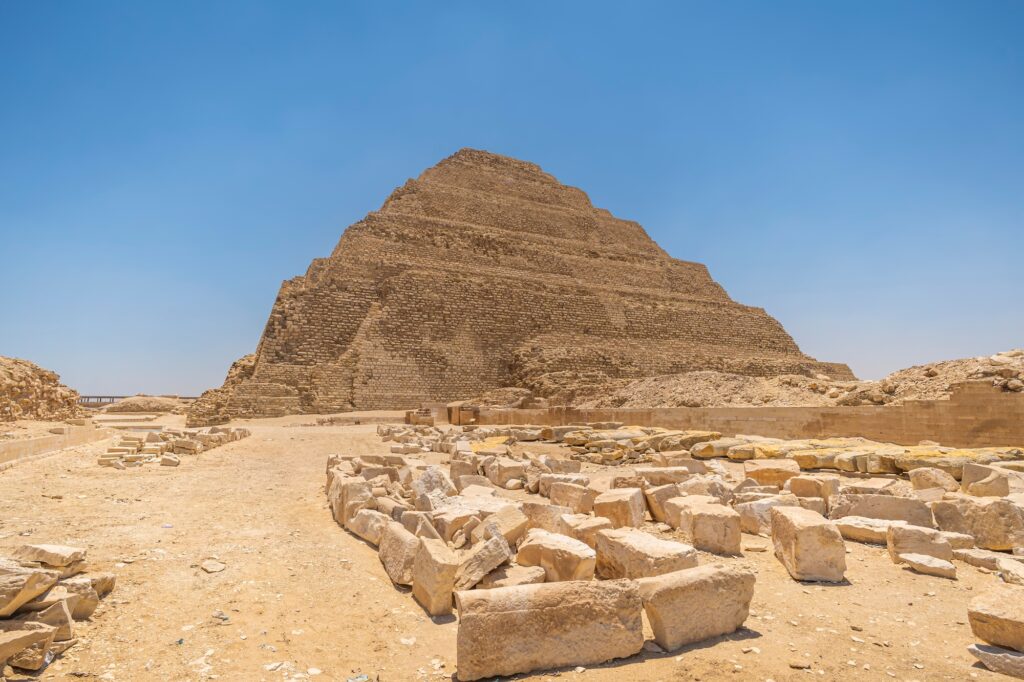
Ancient Egyptian builders had worked primarily with mud bricks and wood until Imhotep’s groundbreaking design. The architect chose limestone blocks from nearby Tura quarries, creating the world’s first large-scale stone building.
This transition revolutionized construction techniques and established stone as the material of choice for sacred architecture.
Third Dynasty Innovations
The period saw remarkable advances in quarrying, transportation, and construction methods. Workers developed new tools for cutting limestone blocks and invented sophisticated ramp systems for moving massive stones. These innovations directly influenced later pyramid construction at Giza and throughout Egypt.
Imhotep: The Master Architect
Few names from ancient Egypt carry more reverence than Imhotep. This brilliant architect, physician, and advisor to King Djoser designed not just a tomb, but an entire sacred complex that redefined monumental architecture.
His genius lay in vertical thinking. Rather than expanding outward like traditional mastabas, Imhotep conceived a structure reaching toward the heavens. The six-stepped design symbolized the primordial mound from which all creation emerged according to Egyptian mythology.
Contemporary texts describe Imhotep as “Chancellor of the King of Lower Egypt, First after the King of Upper Egypt, Administrator of the Great Palace, Hereditary Lord, High Priest of Heliopolis.” His medical knowledge earned him deification in later periods, when Greeks identified him with their god of healing, Asclepius.
Archaeological evidence suggests Imhotep supervised every aspect of construction. Stone blocks bear markings indicating his quality control standards. The precision of measurements and alignment demonstrates his mathematical expertise and understanding of engineering principles that wouldn’t be matched for centuries.
Construction Phases and Development
The Step Pyramid evolved through six distinct construction phases spanning approximately 19 years. Each phase reveals Djoser’s changing vision and Imhotep’s adaptive engineering solutions.
Initial Mastaba Design
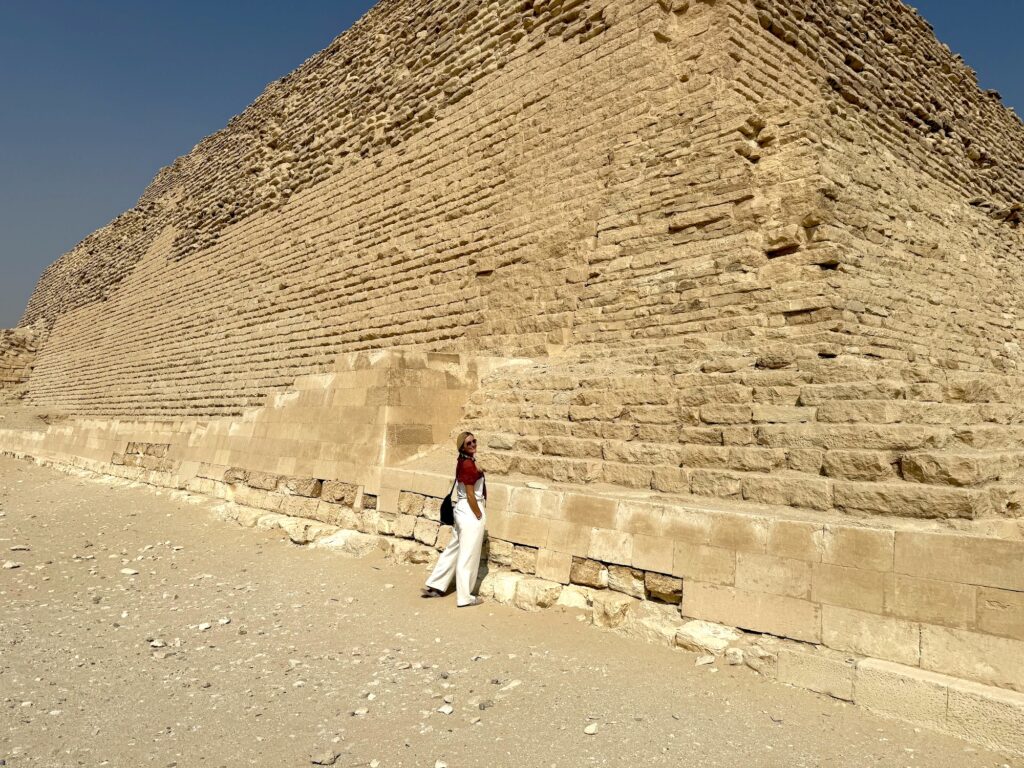
Construction began with a traditional square mastaba measuring 63 meters on each side. This foundation used locally quarried limestone blocks bound with Nile mud mortar.
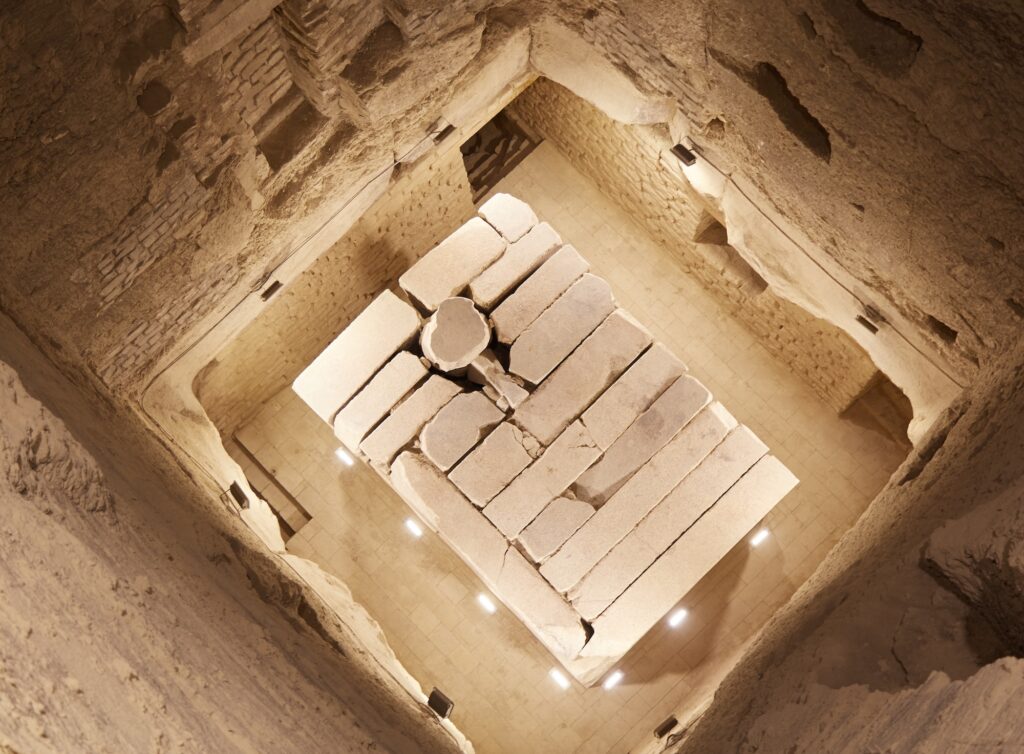
Workers dug a vertical shaft 28 meters deep into the bedrock below.
First Expansion
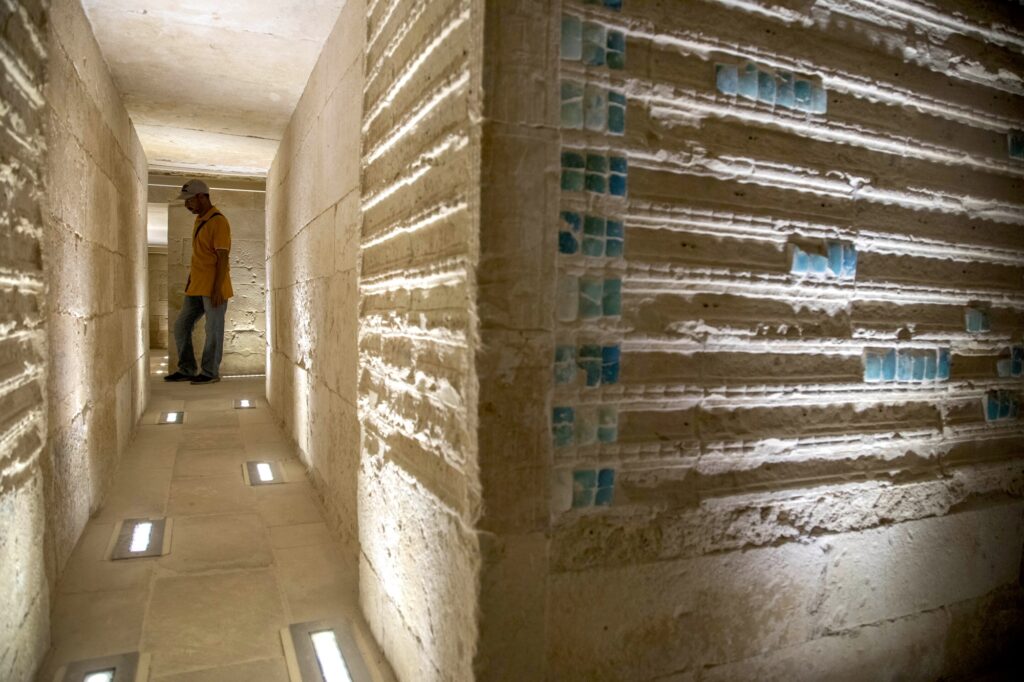
Djoser ordered the mastaba enlarged by adding 4.2 meters to each side. This expansion created space for additional burial chambers and storage rooms for grave goods. The enhanced design included a complex of underground tunnels and chambers decorated with blue faience tiles.
Transformation to Steps
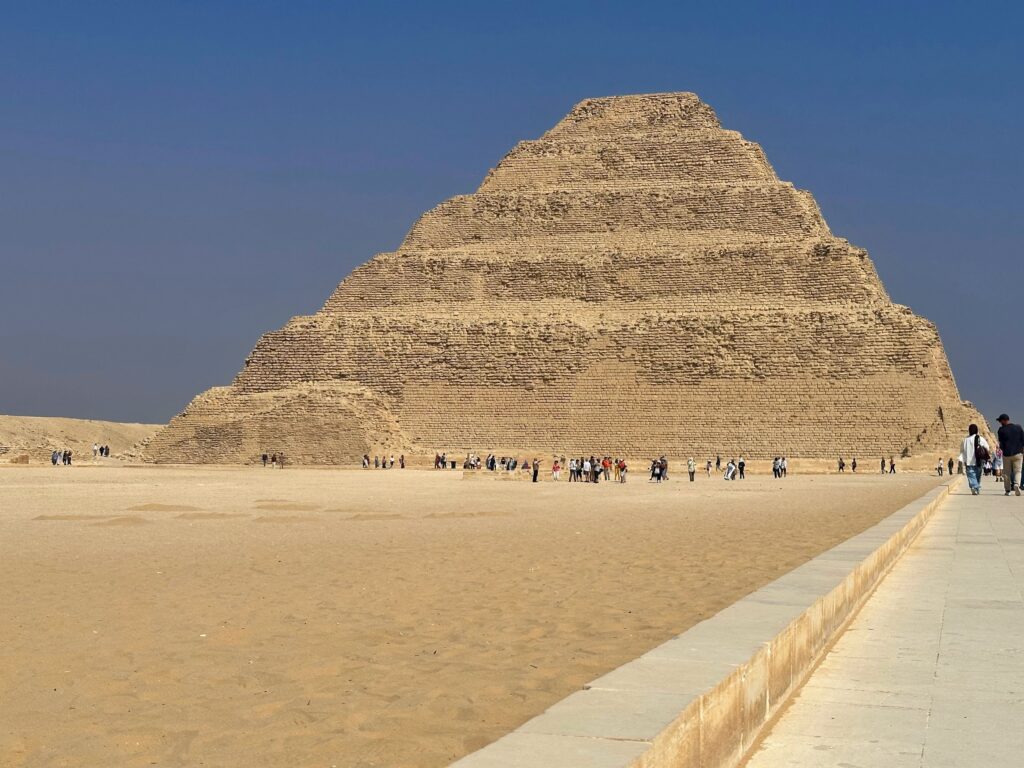
The third phase saw Imhotep’s revolutionary vertical expansion. Four rectangular platforms were stacked atop the original mastaba, creating the first stepped structure. Each level decreased in size, producing the distinctive pyramid silhouette.
Final Configuration
The completed pyramid reached 62.5 meters in height with six unequal steps. The base measured 109 x 125 meters, making it larger than many later pyramids. Interior chambers contained over 40,000 stone vessels and containers for the pharaoh’s afterlife needs.
The Sacred Complex Layout
Beyond the pyramid itself, Djoser’s mortuary complex encompassed 15 hectares of sacred buildings and courtyards. This vast ceremonial space served multiple religious and practical functions.
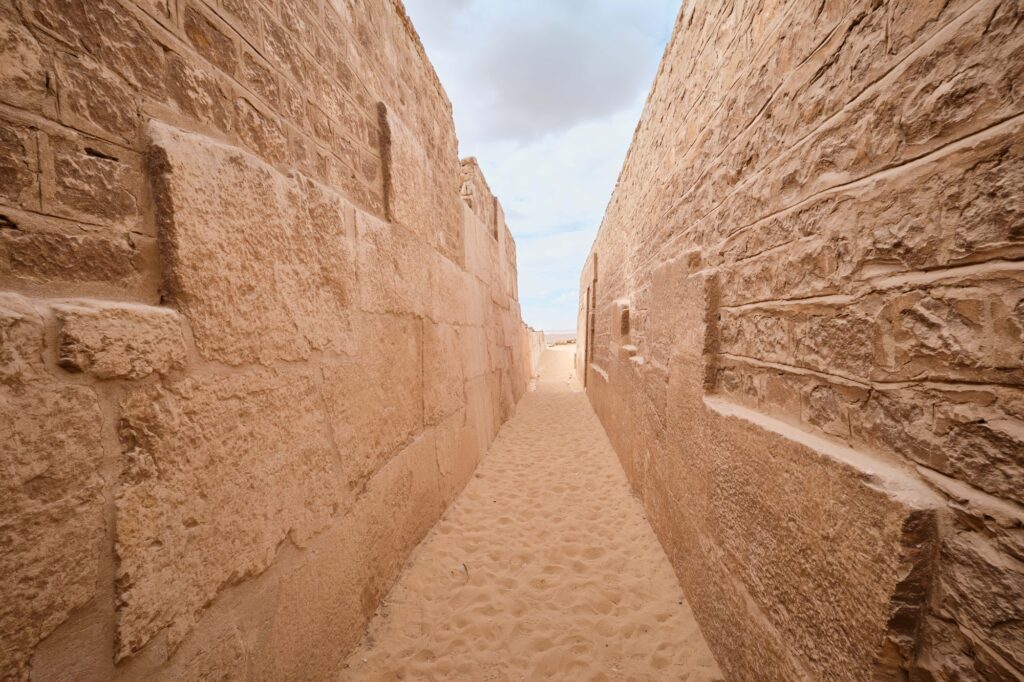
The entire complex was enclosed by a limestone wall 10.5 meters high and 1.6 kilometers long. Fourteen false doors decorated the wall, with only one functional entrance on the southeast corner. This design emphasized the boundary between the living world and the pharaoh’s eternal domain.
The South Tomb Mystery
A second burial structure, known as the South Tomb, sits at the complex’s southern end. This smaller pyramid-like building duplicates many features of the main pyramid’s substructure.
Egyptologists debate whether it housed Djoser’s internal organs, served as a cenotaph, or provided space for Sed festival rituals.
Ceremonial Courts and Buildings
The complex includes the Heb-Sed court where Djoser would have performed ritual runs demonstrating his continued vitality. Surrounding buildings represent Upper and Lower Egypt’s traditional architecture, symbolizing his rule over the unified kingdom.
These structures showcase advanced stone-cutting techniques that mimicked earlier wood and reed construction methods.
Temple and Offering Chambers
The mortuary temple on the pyramid’s north side provided space for daily offerings to sustain Djoser’s spirit. Priests maintained rituals here for centuries after the pharaoh’s death. Connected chambers stored ritual implements and offerings brought by devotees and official ceremonies.
Engineering Marvels and Techniques
The Step Pyramid’s construction required solving unprecedented engineering challenges. Imhotep’s solutions influenced pyramid building for the next thousand years.
Workers quarried limestone blocks weighing between 300-500 kilograms each. Teams used copper tools, wooden levers, and rope systems to extract stones from Tura quarries across the Nile. River transport on specially constructed barges brought materials to Saqqara’s building site.
Construction crews developed the first known ramp systems for raising heavy stones to increasing heights. Archaeological evidence suggests both straight and zigzag ramps were employed depending on the construction phase. These techniques were refined and expanded for later pyramid projects.
The precision of stone cutting and fitting demonstrates advanced mathematical knowledge. Blocks fit together with minimal gaps, creating structures that have survived 4,700 years of earthquakes, floods, and human interference. Joint accuracy often measures less than 2 millimeters.
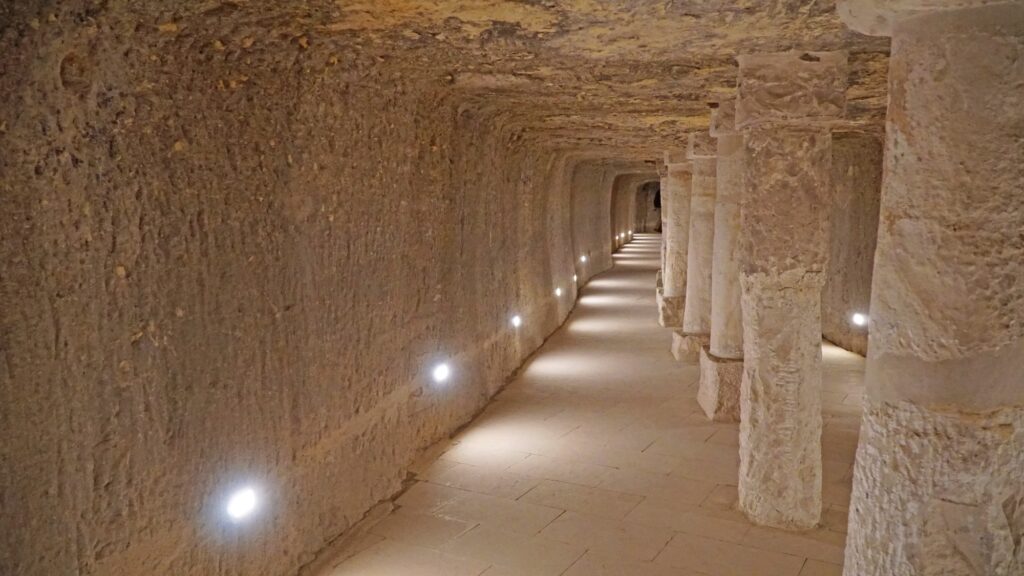
Underground construction presented unique challenges. Workers excavated chambers and passages through solid bedrock using bronze tools and fire-setting techniques. The subterranean complex extends over 5.7 kilometers of tunnels, chambers, and galleries beneath the pyramid.
Religious Significance and Symbolism
The Step Pyramid embodied profound religious concepts central to ancient Egyptian beliefs about death and rebirth.
Solar Symbolism
The pyramid’s eastern orientation aligned with sunrise, connecting Djoser’s eternal journey with the sun god Ra’s daily rebirth. The stepped profile created a symbolic stairway for the pharaoh’s spirit to ascend to the heavens. This solar connection became fundamental to later pyramid theology.
Sed Festival Connection
The complex’s design facilitated eternal celebration of the Sed festival, demonstrating Djoser’s perpetual renewal of royal power. The pharaoh would symbolically run around ceremonial markers, proving his vitality to rule both Upper and Lower Egypt. Death could not interrupt this divine responsibility.
Primordial Mound Representation
Egyptian creation mythology described the first land emerging from primordial waters as a pyramid-shaped mound. Djoser’s tomb recreated this cosmic moment, positioning him at the center of creation itself. The stepped design emphasized this connection through its mountain-like silhouette rising from the desert plateau.
Archaeological Discoveries and Treasures
Excavations at the Step Pyramid have yielded remarkable artifacts illuminating Third Dynasty court life and burial practices.
The burial chamber contained over 40,000 stone vessels carved from various materials including granite, diorite, and alabaster. Many bore inscriptions identifying them as belonging to earlier pharaohs, suggesting Djoser inherited them or acquired them through political marriages and alliances.
The Blue Faience Tiles
Underground chambers feature stunning blue faience tiles depicting Djoser performing religious ceremonies. These tiles represent some of the finest artistic work from the Old Kingdom period. The blue color symbolized regeneration and the heavens, reinforcing the pyramid’s spiritual functions.
Djoser’s Mummy Mystery
Despite extensive excavations, archaeologists have never conclusively identified Djoser’s mummy. A foot and some organic material found in the burial chamber may represent his remains, but definitive identification proves elusive. The pharaoh’s body may have been removed during ancient tomb robberies or relocated for protection.
Storage Chamber Contents
Subsidiary chambers contained thousands of objects for Djoser’s afterlife use: furniture, clothing, food containers, and ritual implements. Many items show evidence of actual use rather than being manufactured specifically for burial, suggesting they came from the royal palace.
Modern Conservation and Restoration
The Step Pyramid has undergone extensive restoration work to preserve this irreplaceable monument for future generations.
Major conservation began in the 1920s under Jean-Philippe Lauer, who dedicated his career to understanding and restoring Djoser’s complex. His work continued for over 70 years, establishing many current interpretations of the site’s original appearance and function.
Recent restoration projects have focused on structural stability and visitor safety. Engineers have reinforced weakened areas while maintaining historical authenticity. Advanced surveying techniques monitor structural movement and identify areas requiring immediate attention.
Reopening to Tourism
Following a 14-year closure for restoration, the Step Pyramid reopened to visitors in 2020. New visitor pathways allow access to previously restricted areas while protecting fragile decorations and structural elements. Climate control systems maintain stable conditions in underground chambers.
Conservation Challenges
Desert conditions, tourist traffic, and natural settling continue to threaten the pyramid’s integrity. Salt deposits from groundwater damage limestone blocks, while temperature fluctuations cause expansion and contraction stress. Ongoing monitoring ensures early identification of potential problems.
Visiting the Step Pyramid Today
The Step Pyramid offers visitors an unparalleled glimpse into ancient Egyptian architectural genius and royal burial practices.
We recommend allowing at least two hours to explore the complete complex. The pyramid interior features narrow passages and low ceilings requiring moderate physical fitness. Photography is permitted in most areas, though flash photography may be restricted in decorated chambers.
Best Visiting Times
Early morning visits between 8:00 am and 10:00 am offer cooler temperatures and fewer crowds. The site opens daily from 8:00 am to 5:00 pm during winter months, with extended hours until 6:00 pm in summer.
What to Expect
Entry includes access to the pyramid interior, surrounding complex buildings, and the visitor interpretation center. Guided tours provide detailed historical context and point out architectural features easily missed by casual observers. The climb to the pyramid’s upper levels offers panoramic views across the Saqqara plateau.
Practical Information
The site is located 30 km south of Cairo and easily accessible by road. Comfortable walking shoes and sun protection are essential. Water is available at the visitor center, though bringing personal supplies is recommended for extended visits.
Through our decades of experience guiding visitors to Egypt’s most significant monuments, we’ve witnessed firsthand how the Step Pyramid continues to inspire awe and wonder. This architectural masterpiece represents not just ancient achievement, but humanity’s eternal drive to create lasting monuments to our highest aspirations.
Frequently Asked Questions
Who built the Step Pyramid of Djoser?
King Djoser commissioned the pyramid around 2670 BCE, with Imhotep serving as the architect and chief engineer.
How tall is the Step Pyramid?
The pyramid reaches 62.5 meters in height with six unequal steps.
Why was it called the Step Pyramid?
The distinctive stepped design differentiates it from later smooth-sided pyramids with symbolic stairway to heaven.
Can visitors go inside the Step Pyramid?
Yes, the interior is open to visitors following recent restoration work and includes decorated underground passages.
What makes this pyramid historically significant?
It represents the world’s first large-scale stone building and established the pyramid form for millennia.
How long did construction take?
Archaeological evidence suggests construction spanned approximately 19 years through six distinct building phases.
What happened to Djoser’s mummy?
Djoser’s remains have never been conclusively identified, likely removed during ancient tomb robberies.
Is the Step Pyramid older than the Giza pyramids?
Yes, it predates the Great Pyramid of Giza by approximately 150 years.
How much does it cost to visit?
Entry fees vary by season and package options, booking in advance is recommended.
What other attractions are nearby?
The Saqqara complex includes multiple pyramids, mastaba tombs, and the Serapeum nearby.
Design Your Custom Tour
Explore Egypt your way by selecting only the attractions you want to visit