

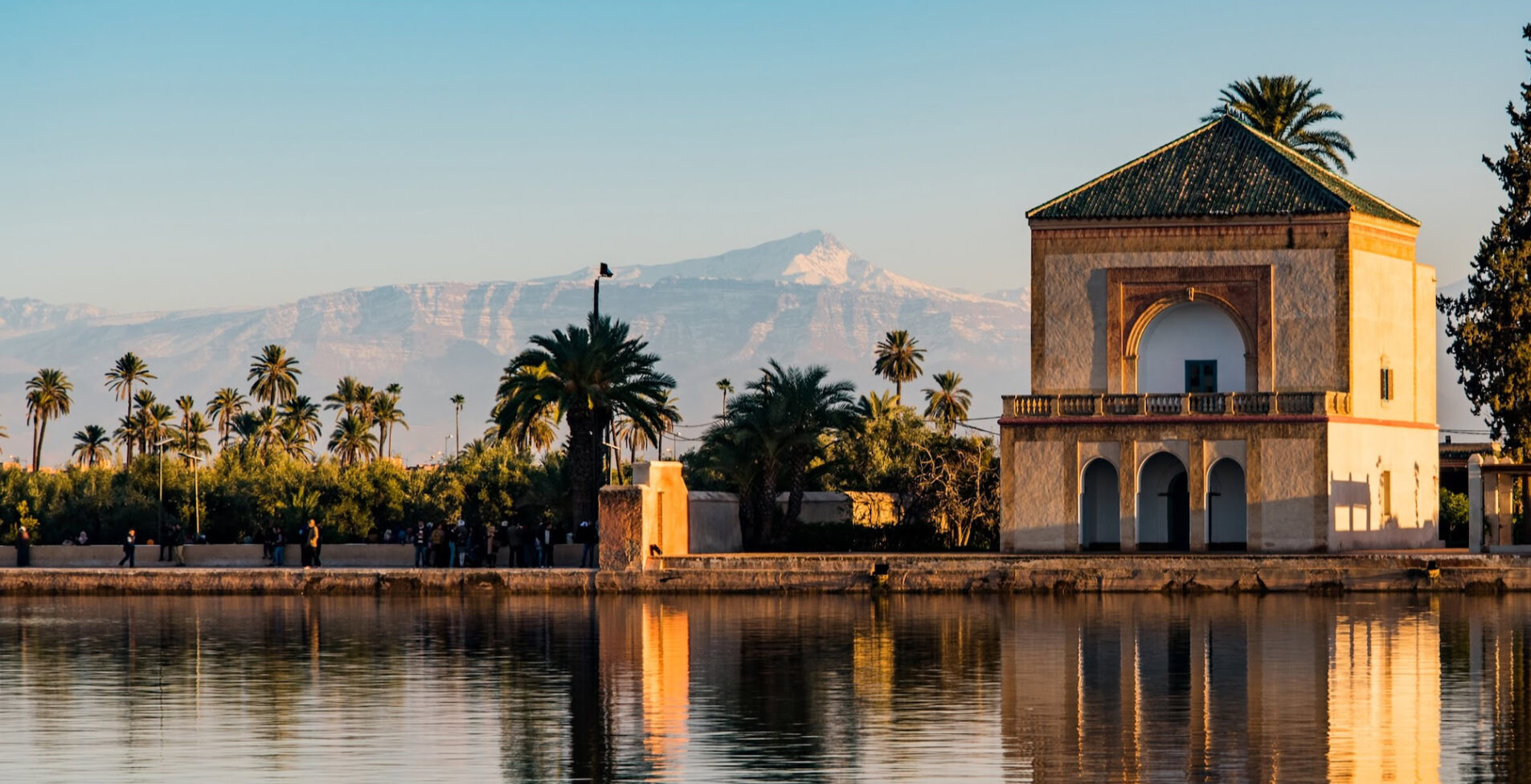
Desert kingdoms, timeless memories
Egypt and Morocco Tours
Egypt and Morocco Tours unite the grandeur of ancient temples with the charm of vibrant medinas—crafted entirely around your travel style. With 70+ years of expertise you enjoy fully customizable itineraries and 24/7 support from specialists who ensure an effortless, unforgettable journey.
Egypt and Morocco Tours: North Africa, End to End
From the Pyramids to the Marrakech medina, across the Sahara that links them.
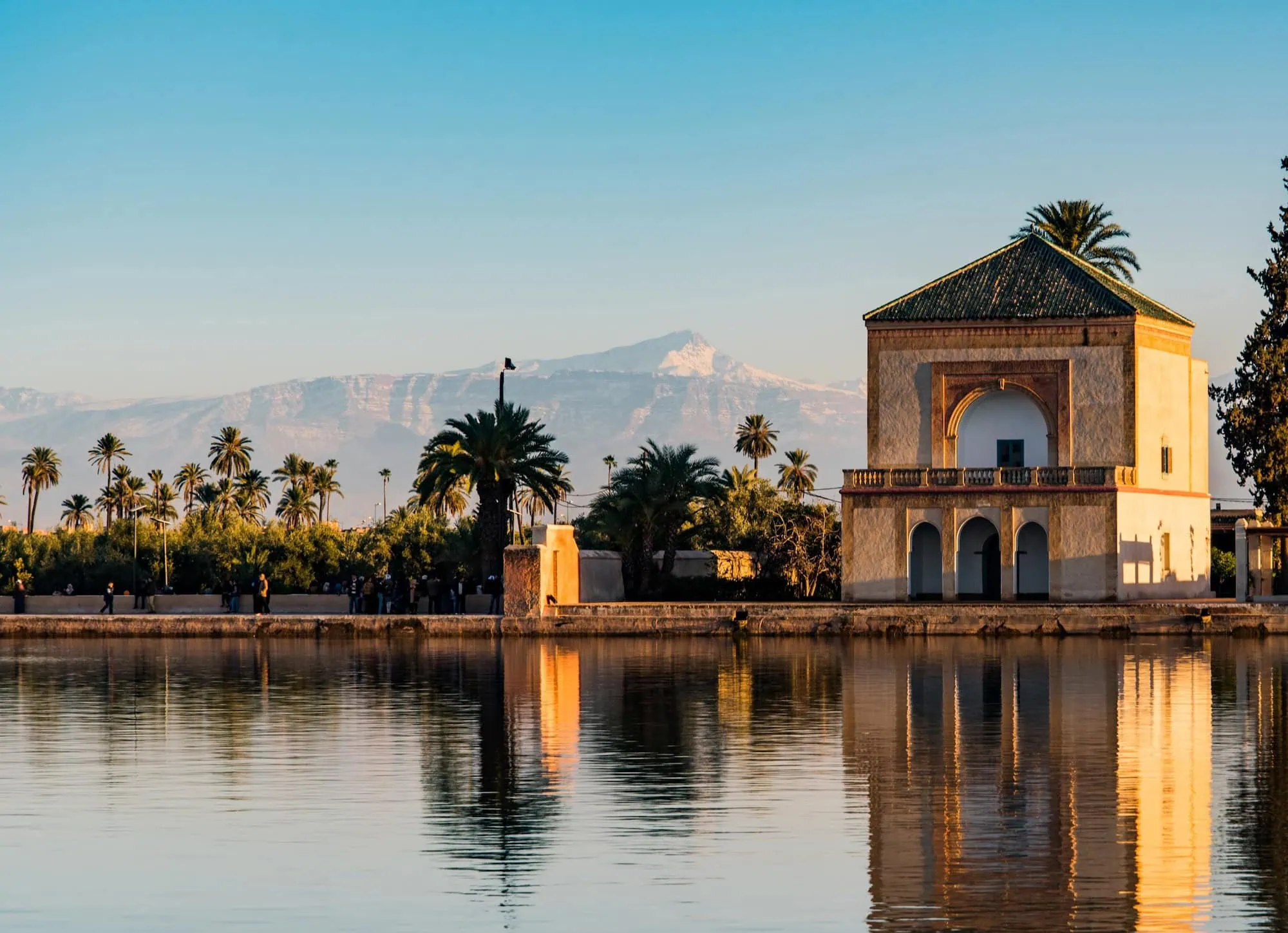
Egypt and Morocco bookend North Africa. Egypt sits at the eastern edge of the Sahara, with the Nile running through it. Morocco sits at the western edge, with the Atlas Mountains and the Atlantic on either side. The two countries share the desert that runs between them, the legacy of medieval Arab-Islamic civilisation, and the two greatest surviving souks of that era: Cairo’s Khan El Khalili and the Marrakech medina.
A direct EgyptAir or Royal Air Maroc flight links Cairo with Casablanca or Marrakech in roughly five and a half hours, no European stopover required. That single flight is what makes Egypt and Morocco a serious two-country itinerary rather than two separate vacations.
We’ve been building Egypt journeys since 1955, and we run our Egypt and Morocco programmes as one continuous trip, planned end-to-end by a single Travel Concierge: same point of contact, coordinated flights and transfers, same standard of guides on both sides of the Sahara.
Table of Contents
Why Egypt and Morocco Pair So Well
Three reasons the pairing works as a single trip rather than two stitched-together vacations.
Twin scholarly capitals at either end of the Arab west
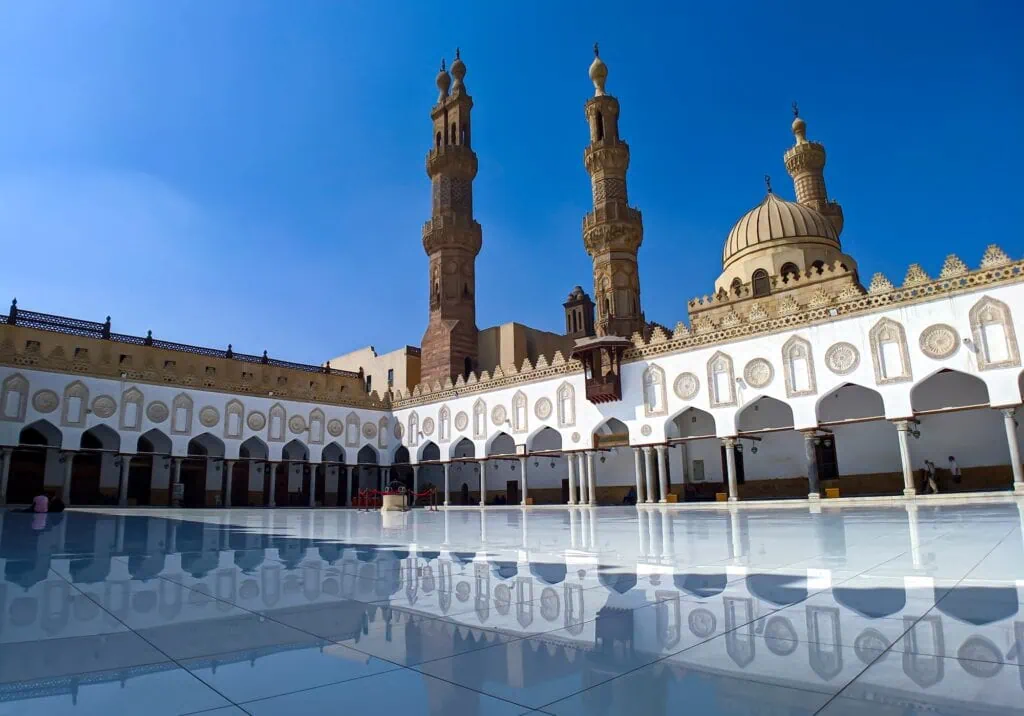
From the Fatimids in the 10th century onwards, Cairo and Fez sat as the two great academic anchors of the Arab world: Al-Azhar in Cairo (founded 970) and Al-Qarawiyyin in Fez (founded 859, the world’s oldest continuously operating university).
Both still stand at the heart of their respective historic medinas, surrounded by the architecture, scholarship, and craftsmanship traditions that grew up around them. Walking through the old city of Cairo and Fez el-Bali in a single trip turns 1,000 years of parallel North African history into something physical you can stand inside.
Travel seasons that line up
Both countries are best from October through April. Egypt’s comfortable touring window (20–25°C / 68–77°F daytime) overlaps almost perfectly with Morocco’s strongest weather: cool dry days in Marrakech and Fez, mild Atlantic coast, manageable Atlas Mountain trekking, and the post-summer Sahara when desert nights are crisp rather than freezing.
Two cuisines with shared roots
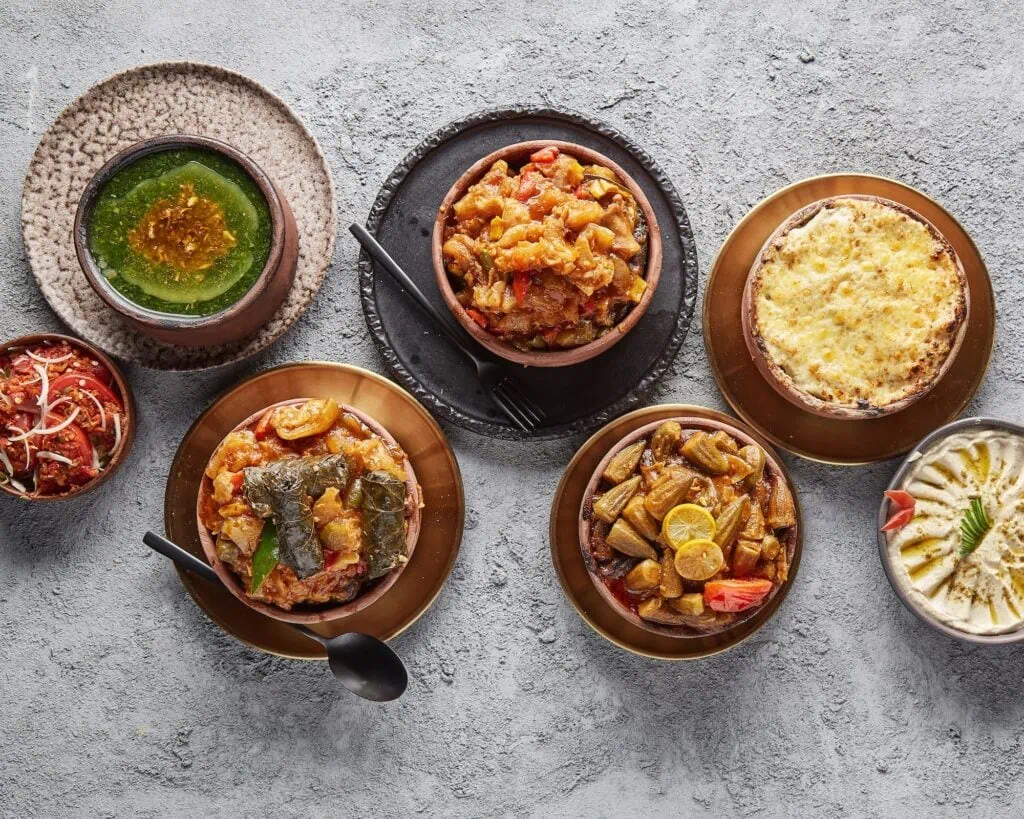
Egyptian and Moroccan cooking share Andalusian-era roots that diverged after the 13th century. You’ll see the family resemblance in tagines and Egyptian fattah, in the use of preserved lemon and olive on both sides of the continent, and in the flatbread traditions.
The two halves of the trip don’t repeat each other. They rhyme.
How We Build an Egypt and Morocco Trip
The standard combined itinerary runs 15 to 17 days. Anything under 14 cuts at least one country to the bone.
Typical day split
For a 15-day trip:
- 6–7 days in Morocco (typically Casablanca arrival, Rabat, Fez, Marrakech, plus one Atlas or Sahara extension)
- 7–8 days in Egypt (Cairo, fly to Aswan or Luxor, Nile cruise, Abu Simbel optional)
- 1 inter-country travel day
For a 17-day trip we add the Sahara overnight in Morocco (Erg Chebbi camp) and Abu Simbel in Egypt.
Order of travel
Either direction works logistically. Most travellers prefer Morocco first, Egypt second: the Moroccan imperial cities run at a slower pace, which acclimatises you for the heavier sightseeing days in Egypt. Cairo airport is also the stronger long-haul return hub for many travellers’ onward connections. Egypt-first routing makes sense if you’re tying Egypt to a Jordan or Greece extension immediately after, and want Morocco as the culminating leg.
Cruise or no cruise on the Egypt Side
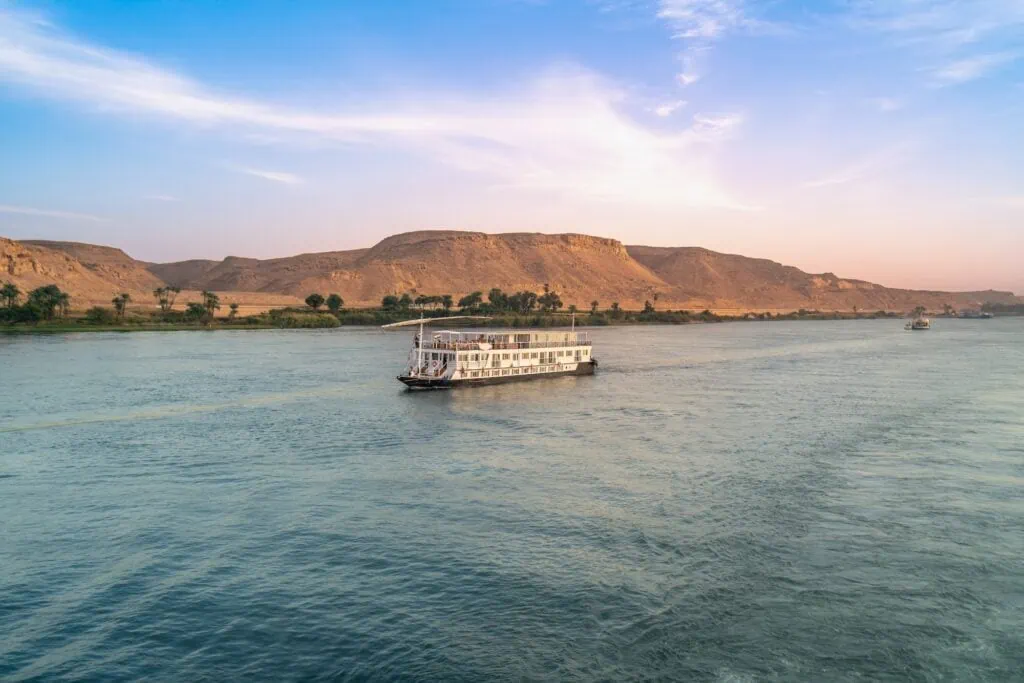
We strongly recommend keeping the Nile cruise in the Egypt segment. Without it you can still see Cairo and Luxor as land-based touring, but you lose Edfu, Kom Ombo, and the slow-paced river days that make Egypt feel different from any other destination. The standard cruise inclusion is a 4-day / 3-night Luxor–Aswan sailing on a Luxury Nile Cruise vessel; longer 5-, 6-, 7-, and 8-night cruises are available, and a 3- to 5-night Dahabiya (8–16 guests, traditional twin-mast sailing vessel) is the alternative if you want a smaller, quieter ship.
Sahara or no Sahara on the Morocco side
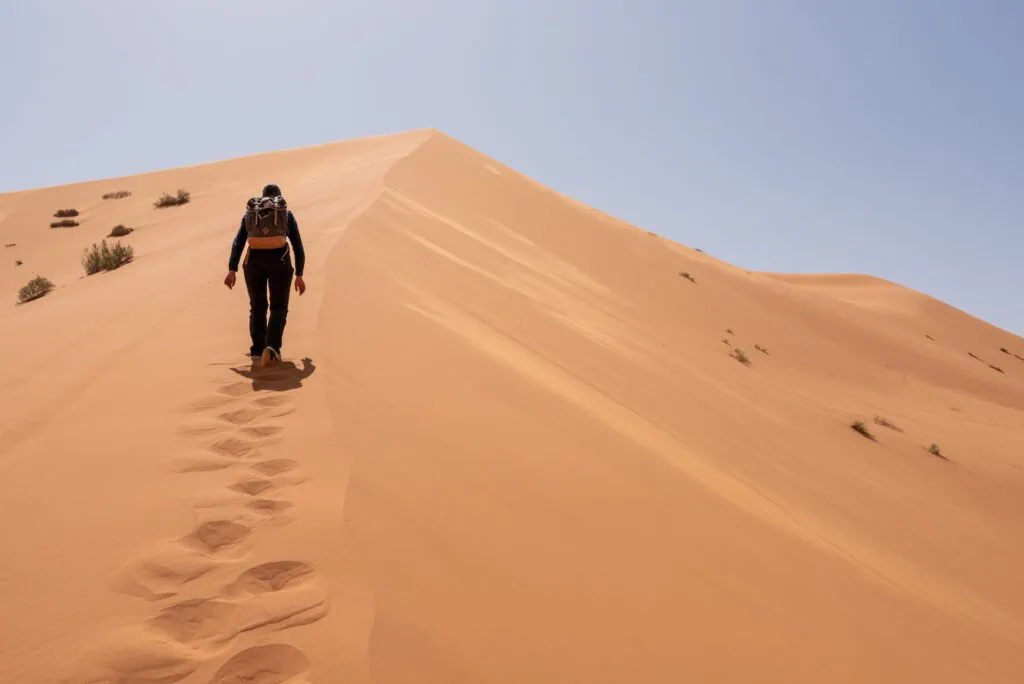
The Erg Chebbi dunes near Merzouga are the most common Morocco choice: a 9- to 10-hour drive from Marrakech (broken with overnight stops in Aït Benhaddou and the Dades or Todra gorges), one or two nights in a desert camp under the dunes, and back via a different route.
The shorter alternative is the Erg Chigaga route via M’Hamid, which is more remote and has fewer crowds. The shortest alternative is to skip the Sahara entirely and stay focused on the imperial cities and the Atlantic coast.
Two Saharas, Two Civilisations: Egypt and Morocco at Either End of North Africa
This is the page’s core argument, and it’s worth unpacking rather than treating as a marketing line. Egypt and Morocco are the two anchor states of North Africa, geographically and culturally, with the Sahara desert and the Mediterranean as the two connecting elements between them.
The Egyptian half: pharaonic continuity, then Mediterranean and Islamic layers
Egypt’s pharaonic state is the longest continuous political and cultural record we have, running roughly 3,000 years from the Old Kingdom (Khufu’s Great Pyramid, around 2,560 BC) through to the end of the Ptolemaic dynasty in 30 BC.
The Greek, Roman, Coptic, and then Islamic layers that followed all built on top of, rather than replacing, what came before. The Khan El Khalili bazaar, founded in 1382 under the Mamluks, is one of the great medieval markets of the Arab-Islamic world and still functions as one today.
The Moroccan half: Berber foundations, then Andalusian, then imperial
Morocco’s deep history is Berber (Amazigh), with the Roman period as a thin intermediate layer (the ruins of Volubilis near Meknes are the surviving evidence). The transformative arrival was Islam in the late 7th and 8th centuries, followed by waves of Andalusian refugees and craftsmen after the Christian reconquest of Spain in the 13th to 15th centuries.
The Andalusian wave is what gave Morocco its zellige tilework, its plaster carving, the layout of its medinas, much of its music, and a cuisine that carries clear Iberian and Maghrebi-Andalusian roots.
The Marrakech medina (founded 1070 under the Almoravids) and Fez el-Bali (founded 789 under the Idrisids) are UNESCO World Heritage sites built around these traditions and still inhabited by their original craft guilds.
The desert as connector
The Sahara is the same desert in both countries. On the Egyptian side, the Western Desert holds the White and Black Deserts, the oasis chains of Bahariya, Farafra, Dakhla, and Siwa, and the Great Sand Sea.
On the Moroccan side, Erg Chebbi (about 50 m to 150 m dunes near Merzouga) and Erg Chigaga (further west, more remote) are the two main dune fields. Different geography, same desert.
Many travelers describe seeing both halves as the moment the trip stops feeling like two holidays glued together and starts feeling like one continuous journey across North Africa.
What Egypt Gives You
Cairo and Giza
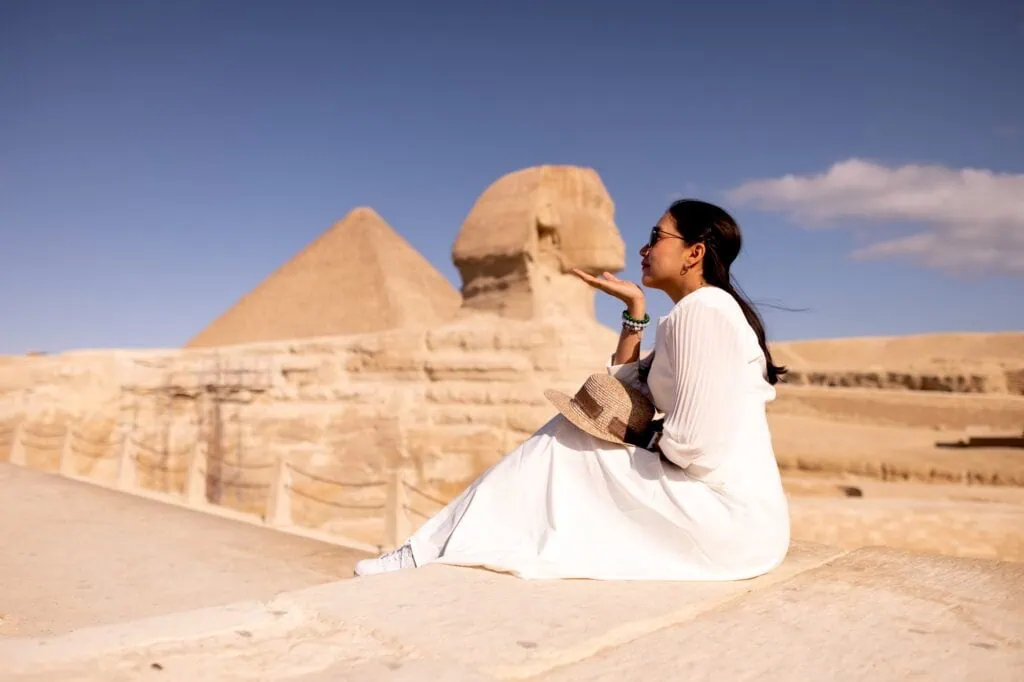
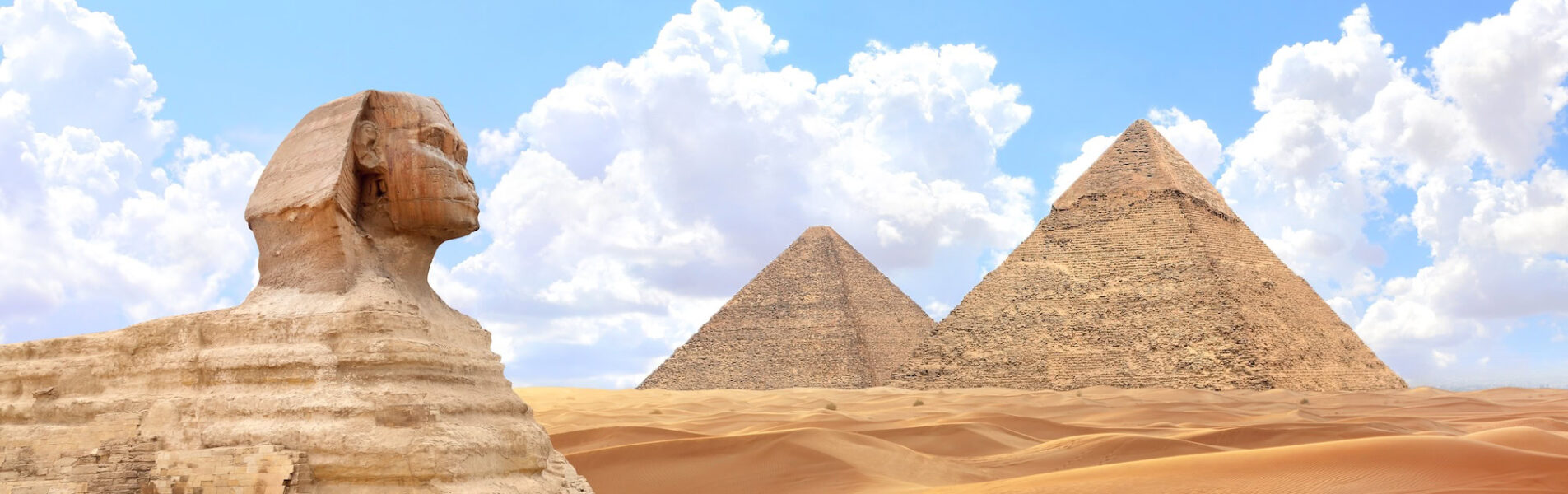
The Pyramids of Giza (Khufu, Khafre, Menkaure) and the Great Sphinx remain in their original 4,500-year-old setting. The Grand Egyptian Museum, fully open at the foot of the plateau, holds over 100,000 artifacts, with the complete Tutankhamun collection (over 5,000 pieces) displayed together for the first time.
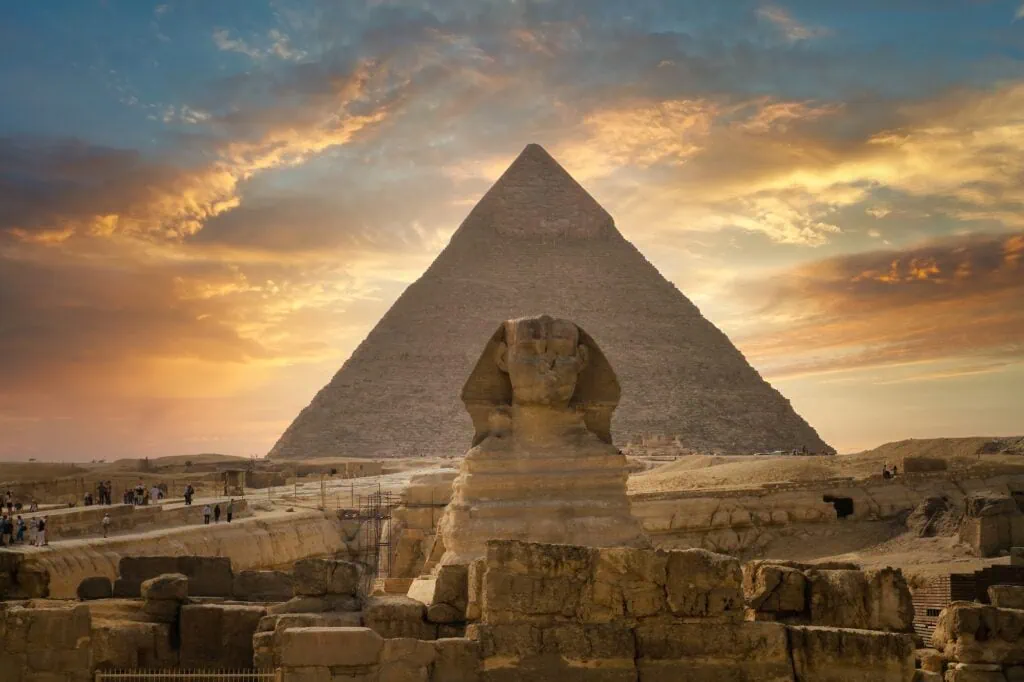
The Egyptian Museum at Tahrir Square is the complementary stop, and the National Museum of Egyptian Civilization (NMEC) holds the Royal Mummies Hall with 22 royal mummies.
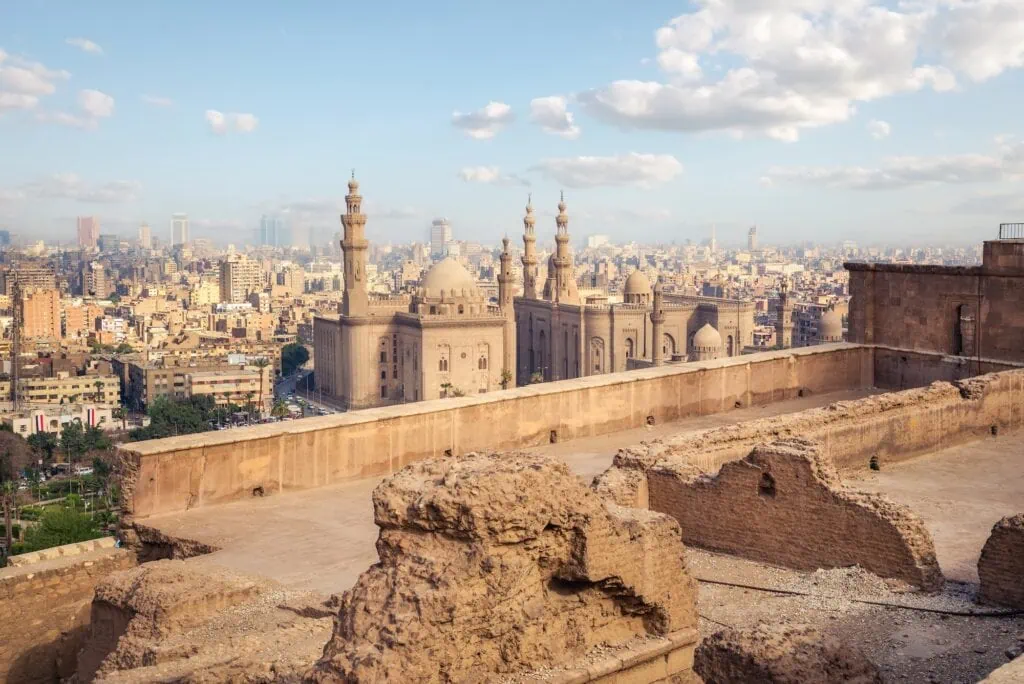
Coptic Cairo (the Hanging Church / Al-Muallaqa, Ben Ezra Synagogue, Saints Sergius and Bacchus), Islamic Cairo (the Citadel of Saladin, the Mosque of Muhammad Ali, the Sultan Hassan and Al-Rifa’i mosques), and Khan El Khalili bazaar fill out the Cairo days.
Luxor
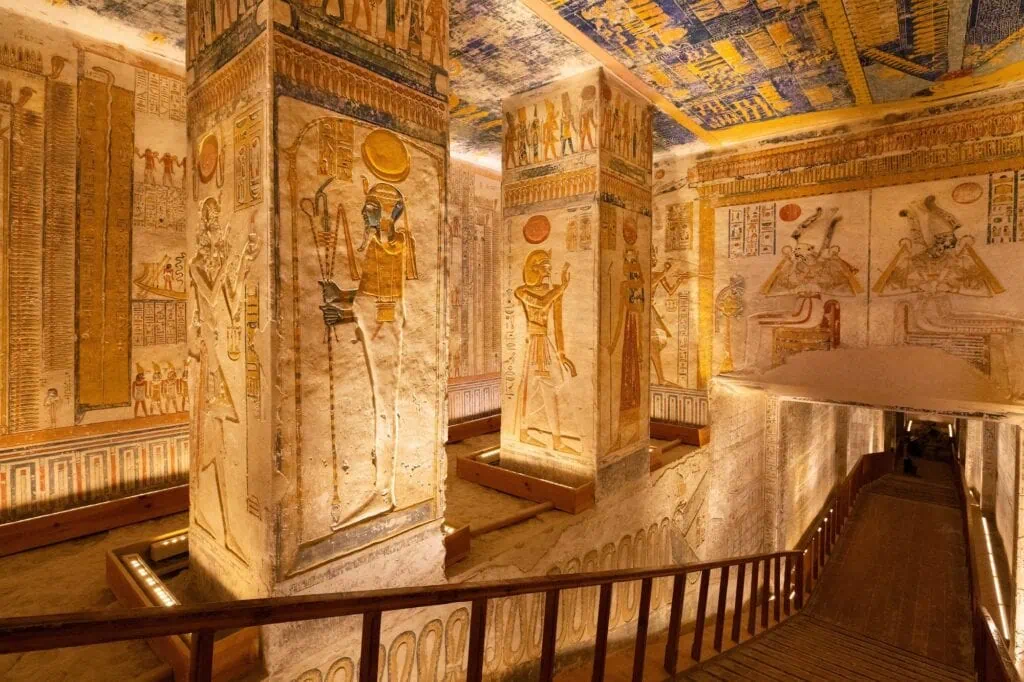
The Karnak Hypostyle Hall with its 134 columns, the Avenue of Sphinxes (2.7 km, with over 1,000 sphinxes recently restored end-to-end), Luxor Temple, the Valley of the Kings on the West Bank with rotating tomb access, Hatshepsut’s Mortuary Temple at Deir el-Bahari, the Colossi of Memnon, and the Ramesseum.
Aswan and Abu Simbel
Philae Temple on its island, the Unfinished Obelisk, the High Dam, and a felucca sail around Elephantine Island.
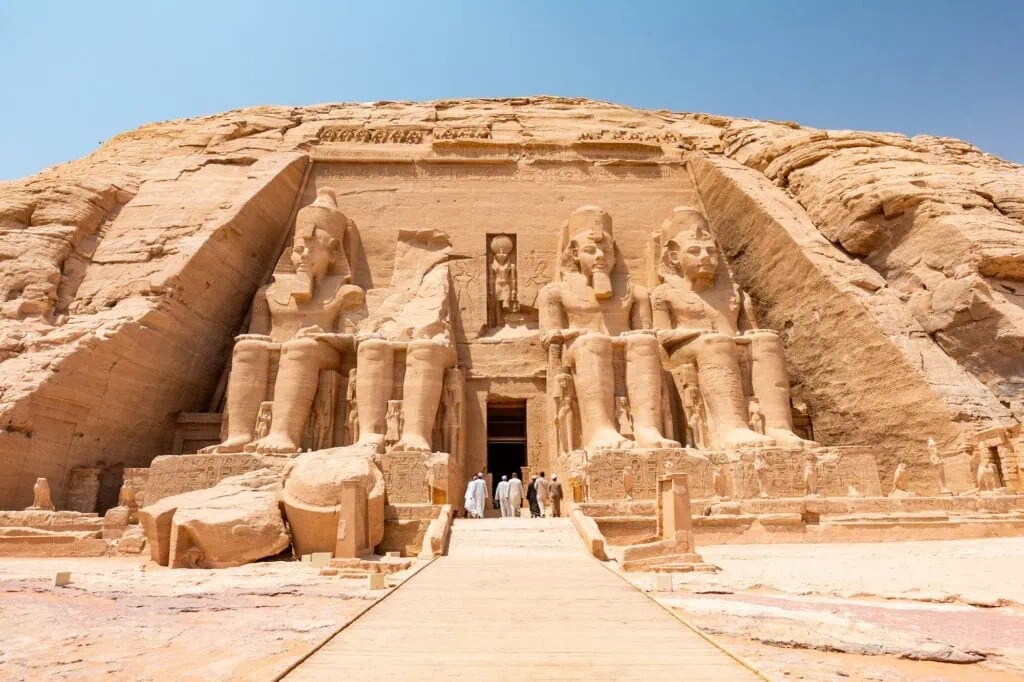
Abu Simbel can be added three ways: a 45-minute flight from Aswan (private, adds 1 day), a small-group road convoy through the Western Desert (3-hour drive each way, departing pre-dawn, the cost-effective option, runs as small group not private, adds 1 day), or a 3- or 4-night Lake Nasser cruise from Aswan visiting the relocated Nubian temples en route (adds 3 to 4 days).
Nile cruise
A note on cruise shore excursions. On Luxury Nile Cruises, shore excursions run as small group experiences (around 12 guests per Egyptologist), shared with fellow ship passengers. Fully private excursions can be arranged on request at additional cost.
On Dahabiyas, the boat itself is small enough that excursions feel essentially private. All your land-based touring in Cairo, Luxor, Aswan, and across Morocco is fully private throughout: just your party plus your guide and driver.
What Morocco Gives You
Marrakech
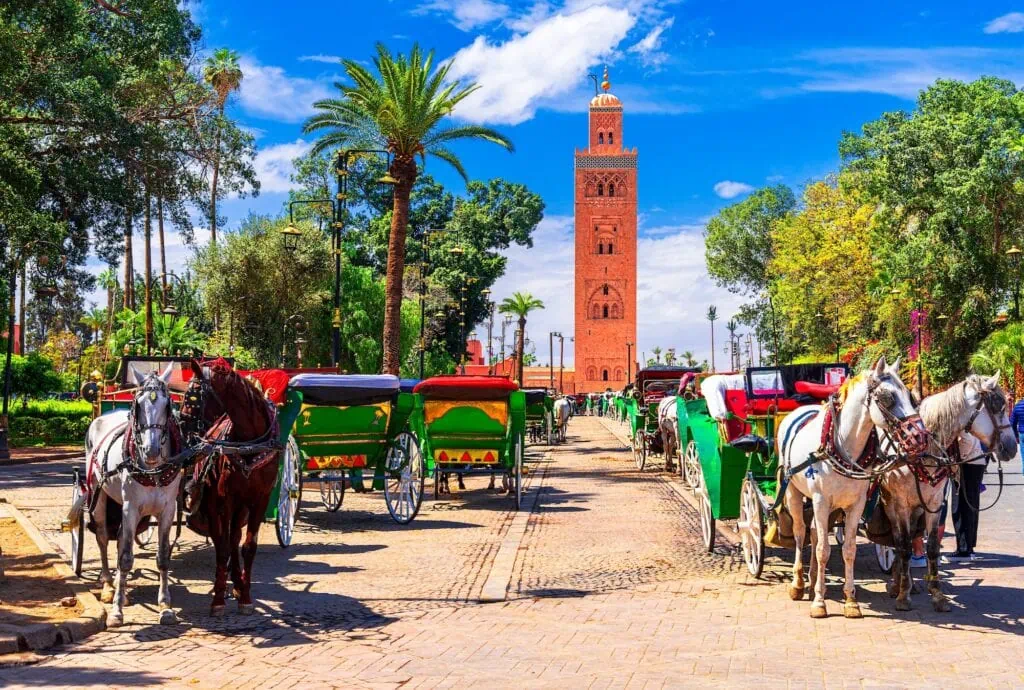
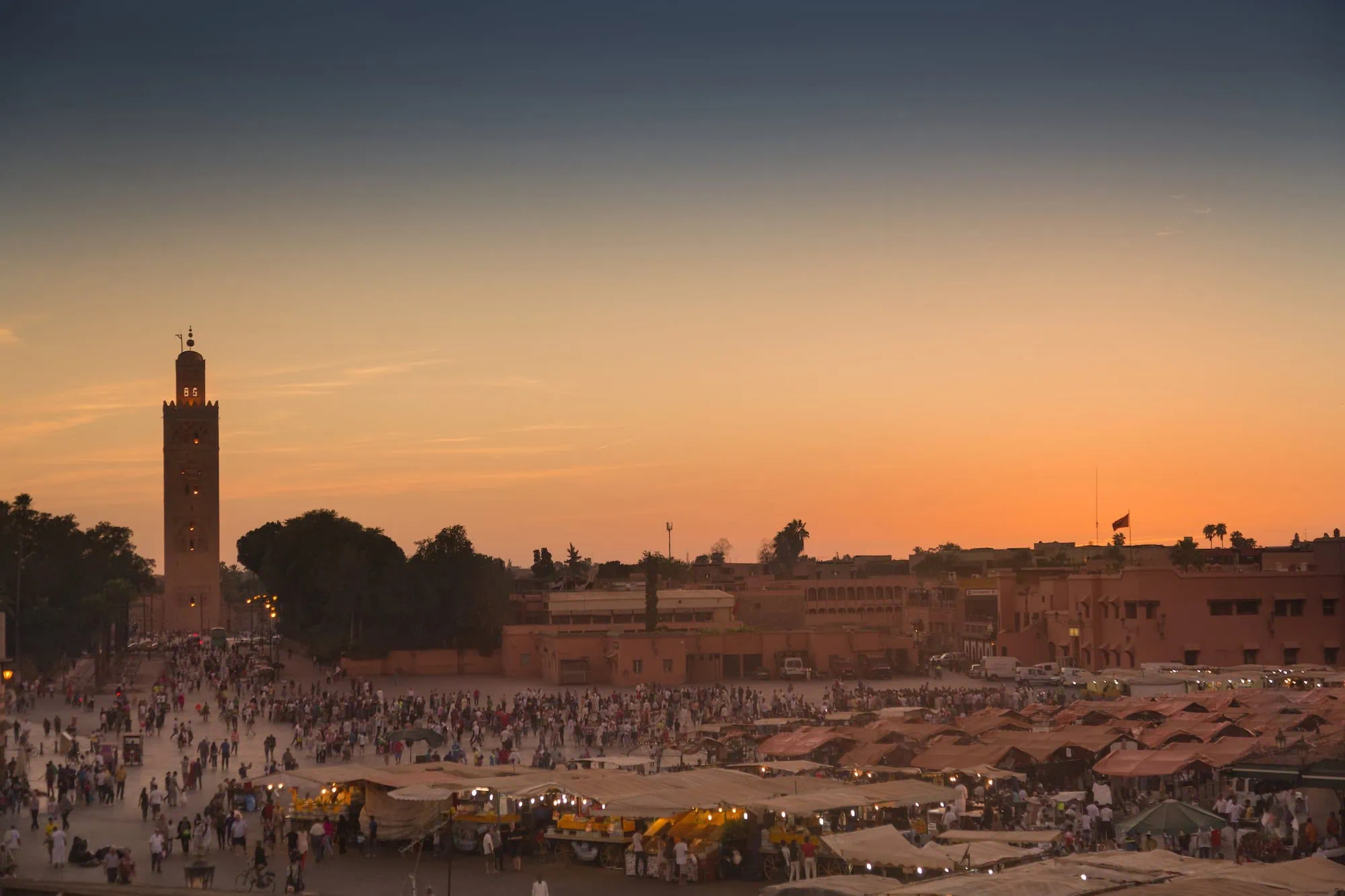
The Jemaa el-Fnaa square (a UNESCO Intangible Cultural Heritage site) at sunset, with its food stalls, storytellers, and musicians. The Koutoubia Mosque and its 12th-century minaret. The Bahia and El Badi palaces, the Saadian Tombs, the Majorelle Garden.
The Marrakech medina with its souks for leather, lanterns, slippers (babouches), spices, and carpets.
Fez
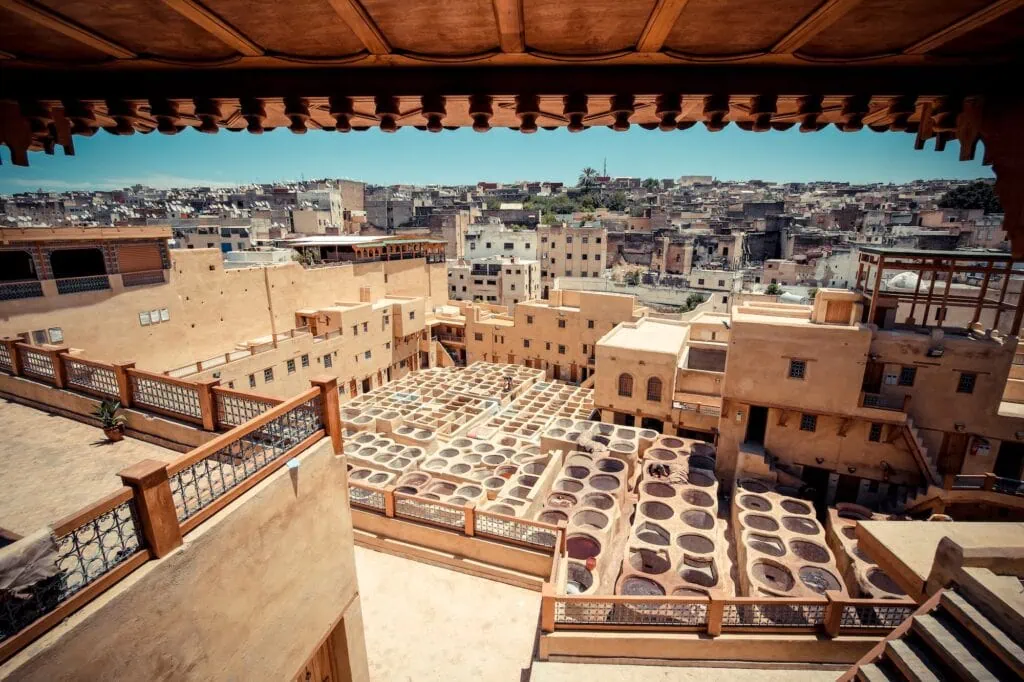
Fez el-Bali, the medieval medina, contains around 9,000 alleys and the Al-Qarawiyyin University-Mosque complex. The Chouara Tannery is the photograph everyone remembers, but the medersa schools (Bou Inania, Al-Attarine) are the architectural anchors.
Fez is the working heart of Moroccan craft tradition: brassware, ceramics, textiles, calligraphy.
The Atlas and Sahara
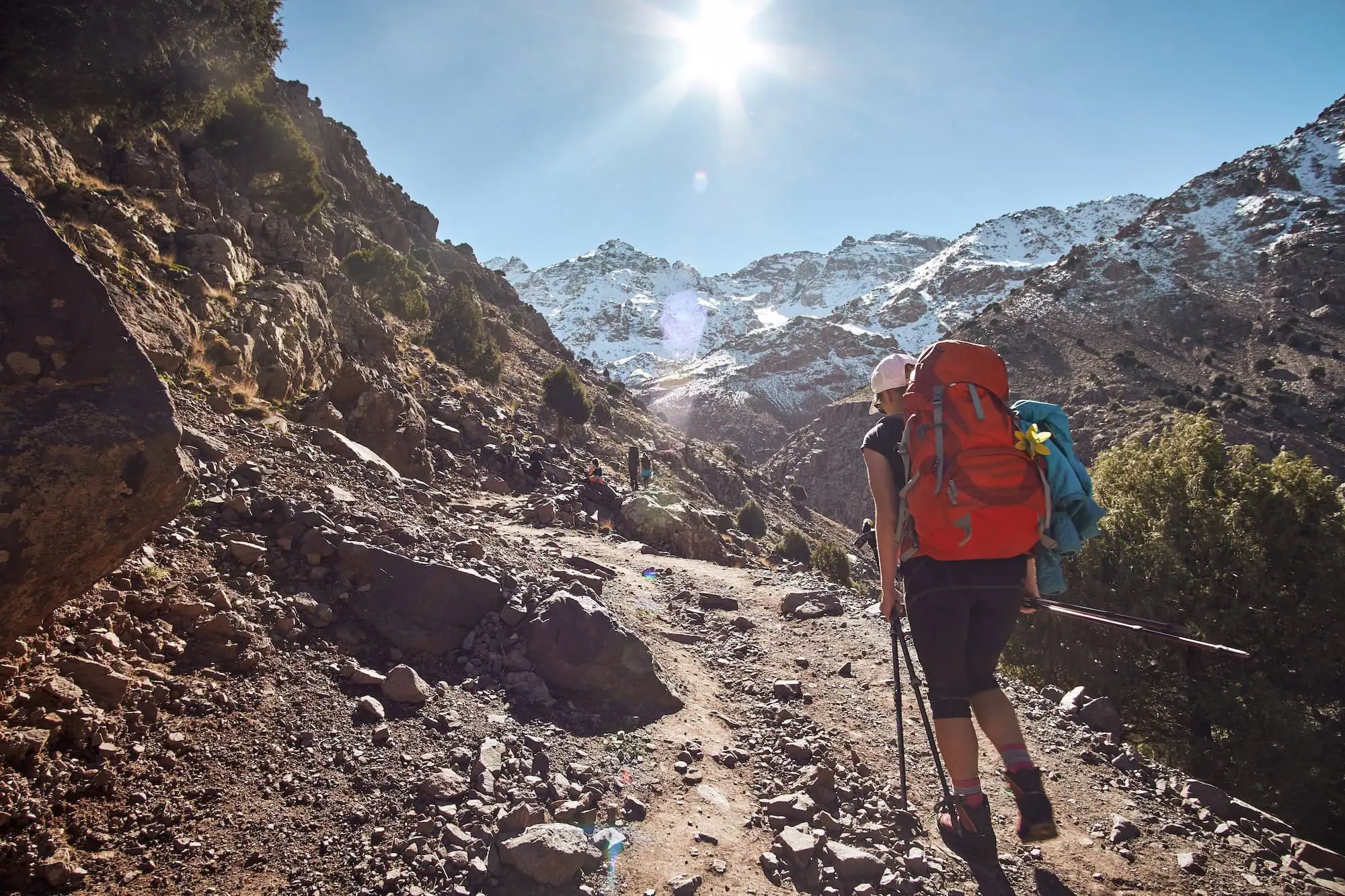
A drive south from Marrakech crosses the High Atlas via the Tizi n’Tichka pass (2,260 m) to Aït Benhaddou, the fortified ksar that doubles as a film location for almost every desert film made in the last forty years.
From there, the route descends through the Dades and Todra gorges to Merzouga and Erg Chebbi. Camel trek into the dunes, dinner under stars in a desert camp, sunrise from the high dunes, and the long drive back via a different route.
Casablanca, Rabat, and Chefchaouen
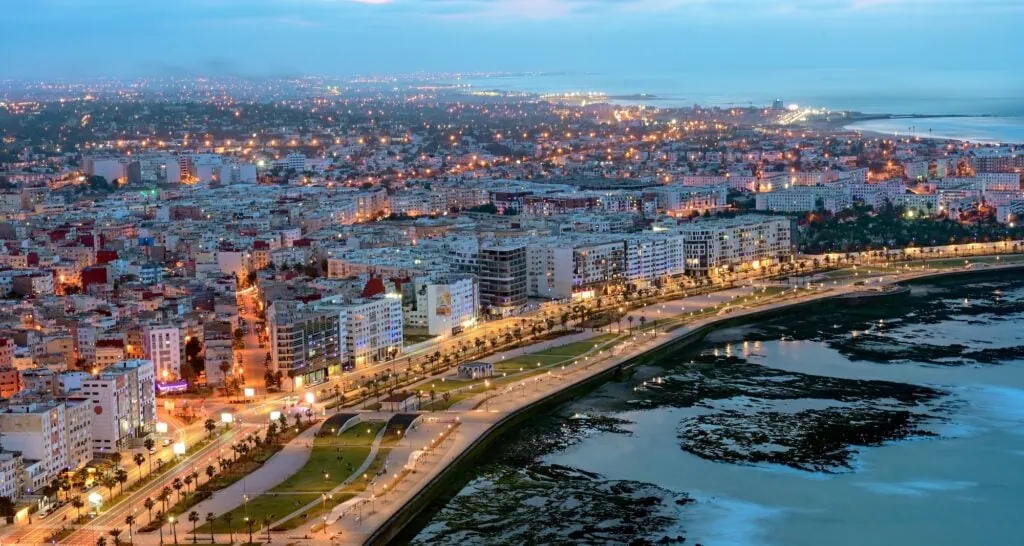
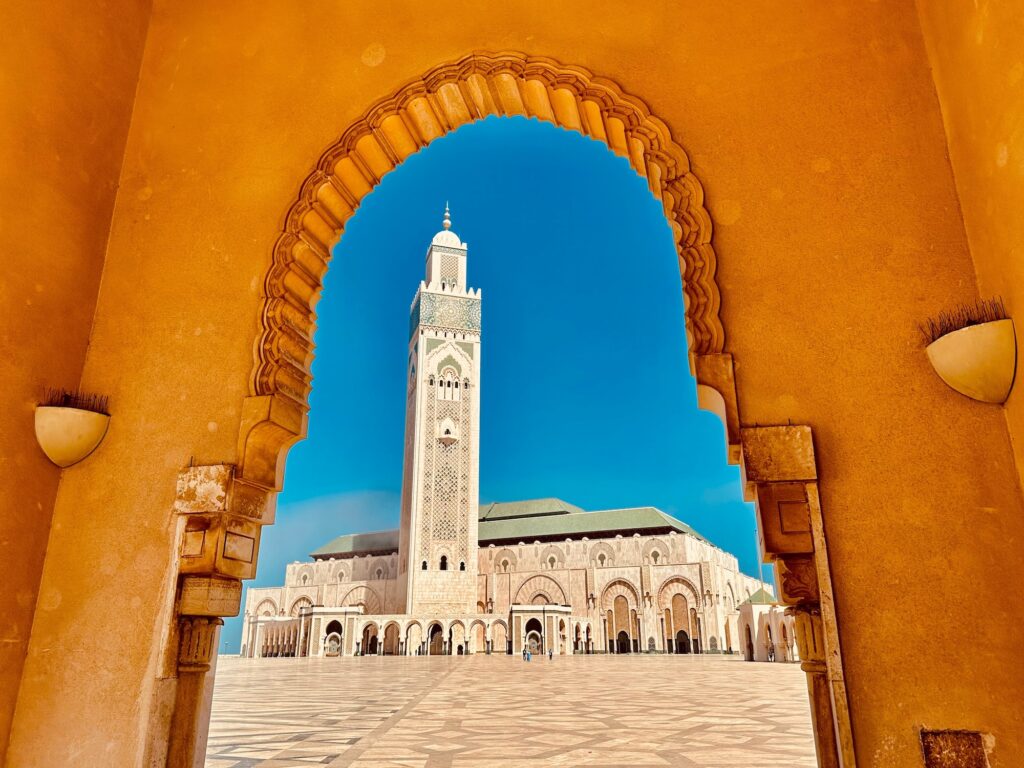
Casablanca holds the Hassan II Mosque, the second-largest mosque in Africa, with its minaret rising directly over the Atlantic.
Rabat (the modern capital) holds the Hassan Tower, the Kasbah of the Udayas, and the Mausoleum of Mohammed V.
Chefchaouen, in the Rif Mountains four hours from Fez, is the famous blue-painted town and a slower-paced contrast to the imperial cities.
Essaouira and the Atlantic coast
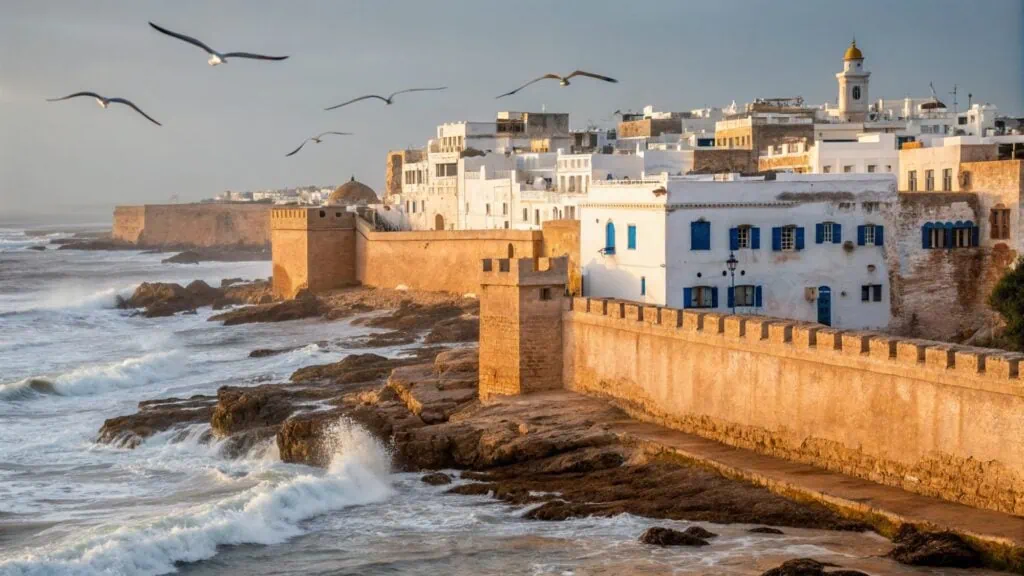
A walled Atlantic port town with Portuguese and French traces, fresh seafood off the boats, and a much milder summer climate than the interior.
Often added as a 1- or 2-night break between Marrakech and Casablanca.
Hotels Across Both Countries
Each tour itinerary on the site lists the specific hotels included in that package. We work with a tested set of properties in both countries, ranging from comfortable mid-tier riads and 4-star Cairo hotels to ultra-luxury 5-star landmarks, restored riads with private courtyards, and luxury tented camps under the dunes.
We match the hotel category on the Egypt side to the riad category on the Morocco side so the trip sits at one consistent level rather than swinging between tiers. Specific properties are confirmed in your itinerary based on availability for your dates.
Visas, Practicalities, and Money
Egypt entry
Most travelers, including U.S., U.K., E.U., Canadian, Australian, and many Latin American nationalities, can obtain a 30-day Egypt tourist visa on arrival at Cairo Airport for $25 USD, or apply for an e-visa online before departure.
Morocco entry
Morocco is visa-free for short stays (up to 90 days) for most U.S., U.K., E.U., Canadian, Australian, and many Latin American nationalities. No visa application or fee is required; you receive an entry stamp at the airport.
Your passport must have at least six months of remaining validity from the date of entry.
Currency
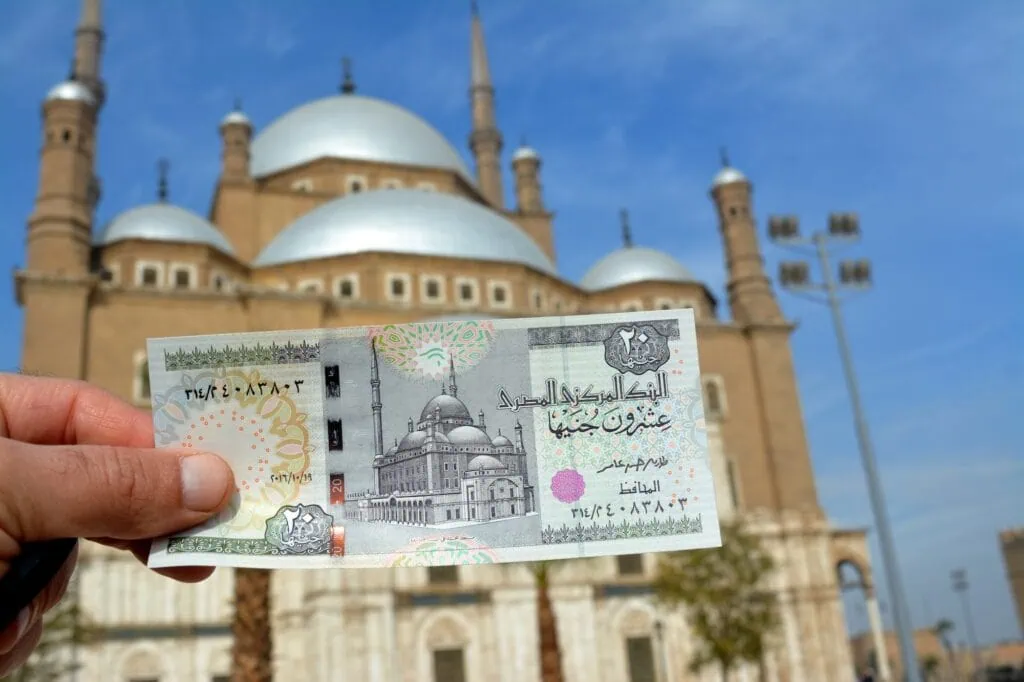
Egypt uses the Egyptian Pound (EGP); ATMs are widely available in Cairo, Luxor, and Aswan, and U.S. dollars are accepted at most hotels.
Morocco uses the Moroccan Dirham (MAD), which is a closed currency: it cannot legally be obtained outside Morocco, and must be acquired at the airport, ATMs, or licensed exchange offices on arrival, then spent or exchanged back before departure.
Bargaining is expected in both medinas. We share guidance on customary tipping for guides, drivers, and camp staff in the pre-departure pack.
Guides
Whatever your language, you’ll be matched with an Egyptologist guide who speaks it — English, Italian, Spanish, Portuguese, German, French, and others available on request.
On the Morocco side, our guides are licensed by the Moroccan Ministry of Tourism and operate primarily in English, French, Spanish, and Italian, with Portuguese, German, and Arabic available on request.
Best Time to Travel
The cleanest window for the combined trip is October through April. Daytime temperatures in Cairo, Luxor, and Aswan sit in the comfortable 20–25°C (68–77°F) range, evenings cool.
In Marrakech and Fez, the same months give you 18–24°C days with cool evenings, ideal for medina walking and Atlas excursions. Sahara nights in this window run cool (sometimes below 10°C / 50°F in deep winter) but daytime desert temperatures remain warm and pleasant.
May, June, September, and early October are shoulder months. Both countries are still travel-able, with the trade-off being rising heat: Marrakech regularly above 35°C (95°F) in June through August, and Upper Egypt above 35°C from May through September. We adjust pacing with very early morning starts and longer lunch breaks during the warmer months.
July and August are the hottest months in both countries’ interiors, but the Moroccan Atlantic coast (Essaouira, Casablanca, Rabat) stays in the mid-20s°C and works well as a heat refuge.
Ramadan dates shift each year on the Islamic lunar calendar. Travel during Ramadan remains entirely possible in both countries, but daytime restaurant and café availability is more limited, and some monument hours change. We flag the dates and adjust the itinerary accordingly.
Pairing With a Third Country
Egypt and Morocco already covers a lot of ground, but a third country sometimes makes sense, particularly if you’ve flown long-haul to reach the region.
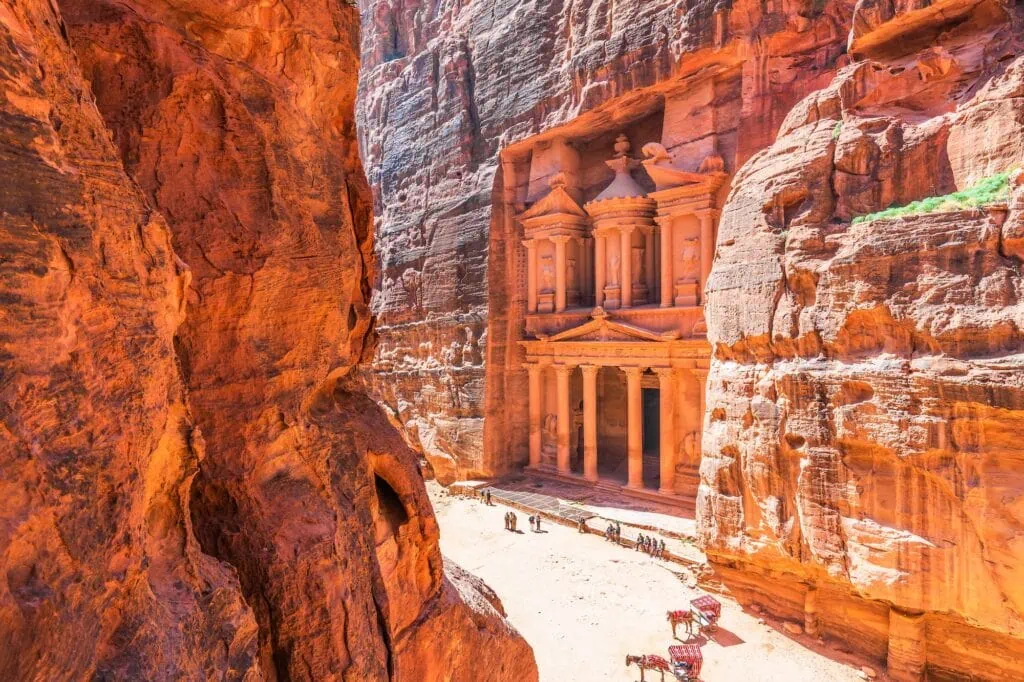
Egypt + Morocco + Jordan. Three Arab civilisations on one trip: pharaonic Egypt, Andalusian Morocco, Nabataean Jordan with Petra and Wadi Rum. Logistically clean via Cairo as the hub. Adds 5 to 7 days.
Egypt + Morocco + Spain (Andalusia). This is the historically logical extension: Granada, Córdoba, and Seville hold the surviving monumental architecture (the Alhambra, the Mezquita) that the Andalusian craftsmen who shaped Morocco came from.
Many travelers describe it as the trip that completes the Egypt and Morocco arc. Adds 5 to 7 days.
Egypt + Morocco + Turkey. Three of the strongest Islamic-era architectural traditions: Mamluk and Ottoman in Egypt, Marinid and Saadian in Morocco, Ottoman in Istanbul. Adds 5 to 7 days.
If you want to explore three- or four-country options, the easiest starting point is our custom tour planner, where you can select the countries and rough dates and we build a draft.
How the Planning Process Actually Works
The Egypt and Morocco pairing has a specific set of friction points: choosing whether to include the Sahara on the Morocco side (and which Sahara — Erg Chebbi via Merzouga, or Erg Chigaga via M’Hamid), deciding how many imperial cities you actually want, the cruise-or-no-cruise question on the Egypt side, and the order-of-travel call.
Marrakech is non-negotiable. Fez is strongly recommended. Meknes, Rabat, and Chefchaouen are all good but accumulate driving days. None of these are deal-breakers; they’re the conversations we have early so the itinerary doesn’t need to be torn up later.
Your Travel Concierge builds a first-draft itinerary based on one conversation: your dates, who’s travelling, what you want included, pace preferences, hotel category, and how the time should split between Cairo–Luxor–Aswan and Marrakech, Fez, the Atlas, and the Sahara. The first draft typically lands in your inbox within 1 to 12 hours.
What follows is the back-and-forth, and it’s the part that matters most. We swap hotels, change cabin categories on the cruise, move you between riads, add or pull out the Sahara overnight, reroute Abu Simbel between flight, road convoy, and Lake Nasser cruise, change the Atlas crossing route, and rework the trip until every piece sits right.
Most travelers go through two to four rounds of revisions before booking, though some take significantly more until every detail is locked. There’s no pressure to commit at any stage. The itinerary is finalised only when you’re 100% satisfied and ready to confirm.
Ready to Plan Your Egypt and Morocco Tour?
Cairo to Casablanca, the Pyramids to the Marrakech medina, all on a single coordinated trip. Tell us your dates and what you want from each side, and we’ll come back with a full draft, costed, within 1 to 12 hours.
Frequently Asked Questions
Most travelers spend between 14 and 21 days. Below 14 days you start losing depth on one side or both. Above 21 days usually means a third country has been added.
The most common sweet spot is 15 to 17 days, split roughly 8 to 9 days in Egypt (Cairo + Luxor + Aswan + cruise) and 7 to 8 days in Morocco (Marrakech, Fez, Atlas, Sahara overnight).
Both directions work cleanly. Egypt-first is the most common choice: front-load the dense temple-and-tomb archaeology while you’re freshest, then slow down into Morocco’s medina-and-mountain rhythm.
Morocco-first is also a solid option, especially if you want to begin with Marrakech riads and end on the Nile.
Direct flights run between Cairo (CAI) and Casablanca (CMN) on EgyptAir and Royal Air Maroc, with flight time around 5 to 5.5 hours, daily availability.
We book the inter-country leg as part of your itinerary, including any internal connection from Casablanca to Marrakech or Fez (both around 50 minutes) or vice versa.
A standard package includes accommodations across both countries, domestic flights, Nile cruise on full board if a cruise is included, all entrance fees to standard sites, private Egyptologist guide and personal driver throughout the Egypt land portion, licensed Moroccan guides and private driver in Morocco, airport meet-and-greet in both countries, and 24/7 support.
International long-haul and inter-country flights, tipping, optional add-ons (interior pyramid access, special-access tombs, balloon flight over Luxor, Lake Nasser cruise, hot-air balloon flight over Marrakech, Sahara camel trek upgrades), personal expenses, and travel insurance are not included.
Each tour itinerary on the site lists the precise inclusions and exclusions for that specific package — those are the authoritative reference, and your Travel Concierge will confirm everything in your final itinerary.
All land-based touring in both countries is fully private: just your party, your guide, and your driver.
The one exception is shore excursions on Nile Cruises, which run as small group experiences (around 12 guests per Egyptologist) shared with fellow ship passengers. Fully private cruise excursions can be arranged on request at additional cost. Dahabiya excursions are small enough to feel essentially private.
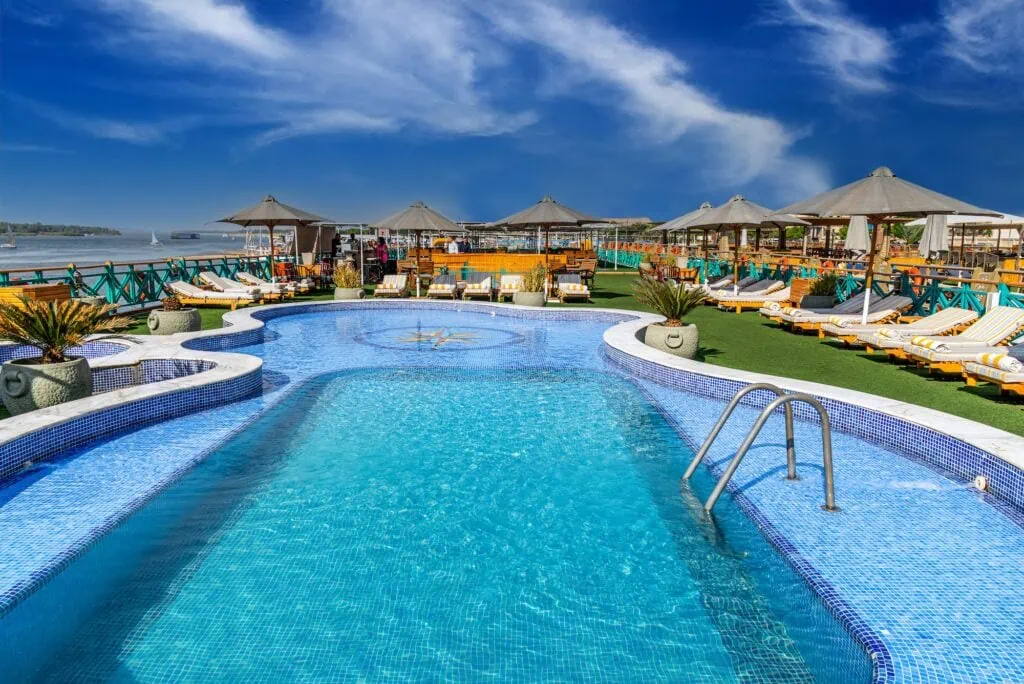
Yes, and most travelers do. We offer Luxury Nile Cruises (50–150 guests, refined 5-star vessels, sun-deck pools, sailing Luxor–Aswan or reverse) and Dahabiyas (8–16 guests, traditional sailing vessels, quieter river stretches inaccessible to large ships).
Cruise lengths run 4, 5, 6, 7, or 8 days; the 4-day Luxor–Aswan cruise is the default in most packages.
Yes, with three options. A 45-minute flight from Aswan (private, adds 1 day), a small-group road convoy from Aswan (3-hour drive each way through the Western Desert, departs pre-dawn, the cost-effective option, runs as small group not private, adds 1 day), or a 3- or 4-night Lake Nasser cruise from Aswan visiting the relocated Nubian temples en route (adds 3 to 4 days).
Yes. EgyptAir and Royal Air Maroc both run direct flights between Cairo and Casablanca, with daily availability and a flight time of around 5 to 5.5 hours.
Connections via European hubs (Madrid, Paris, Frankfurt) exist but add 4 to 8 hours of total travel time.
The Sahara overnight is a built-in option, not a separate booking. We include it in most itineraries by default, with the choice of Erg Chebbi (the dunes near Merzouga, more accessible from Marrakech) or Erg Chigaga (further west, more remote, fewer crowds).
If you’d rather skip the Sahara and stay focused on the imperial cities, we adjust the itinerary accordingly.
Yes. The most common additions are Jordan (Petra and Wadi Rum), Spain’s Andalusia (Granada, Córdoba, Seville — historically the source of Morocco’s Andalusian heritage), and Turkey (Istanbul).
For three- and four-country builds, the custom planner at /travel-planner/ is the easiest starting point.
Egypt’s best window is October through April: 20–25°C (68–77°F) daytime, cool evenings. Summer (June through August) regularly exceeds 35°C (95°F) in Upper Egypt and we adjust with very early starts.
Morocco follows a similar pattern in Marrakech and Fez (cool dry winters, hot summers in the interior), but the Atlantic coast (Essaouira, Casablanca, Rabat) stays mild year-round. Sahara nights in winter run cool, sometimes below 10°C / 50°F.
Yes, but only one of the two requires action. Egypt: most travelers get a 30-day visa on arrival at Cairo for $25 USD, or apply for the e-visa in advance.
Morocco: visa-free for stays up to 90 days for most U.S., U.K., E.U., Canadian, Australian, and many Latin American nationalities. Your passport must have at least six months of validity from the date of entry to Morocco.
Whatever your language, you’ll be matched with an Egyptologist guide who speaks it — English, Italian, Spanish, Portuguese, German, French, and others available on request.
Moroccan guides are licensed by the Ministry of Tourism and operate primarily in English, French, Spanish, and Italian, with Portuguese, German, and Arabic on request.
Yes. The standard tourist routes in both countries are well-trafficked and well-guided. We use private transport throughout, vetted accommodations, and local guides who know on-the-ground conditions in real time.
Our 24/7 support runs across both countries. Travel insurance with medical evacuation coverage is recommended.
Yes, across all hotels, riads, cruise vessels, and desert camps. We confirm dietary requirements (vegetarian, vegan, gluten-free, halal, kosher, allergies) in writing before departure and pass them to every property in advance.
Three things in practice. First, one Travel Concierge runs the trip end-to-end across both countries, so you have one inbox and one phone number from first email to return home.
Second, the Egypt half is delivered by a team that has been operating Egypt journeys since 1955, with TripAdvisor Travelers’ Choice 2020 through 2025 in our pocket.
Third, the trip is built one conversation at a time: a first draft within 1 to 12 hours, then 2 to 4 rounds (or as many as needed) of revisions until every piece sits right, with no pressure to commit at any stage.
Design Your Custom Tour
Explore Egypt and Morocco your way by selecting only the attractions you want to visit