

Qalawun Complex – A Tale of a Sultan and His Prisoners of War
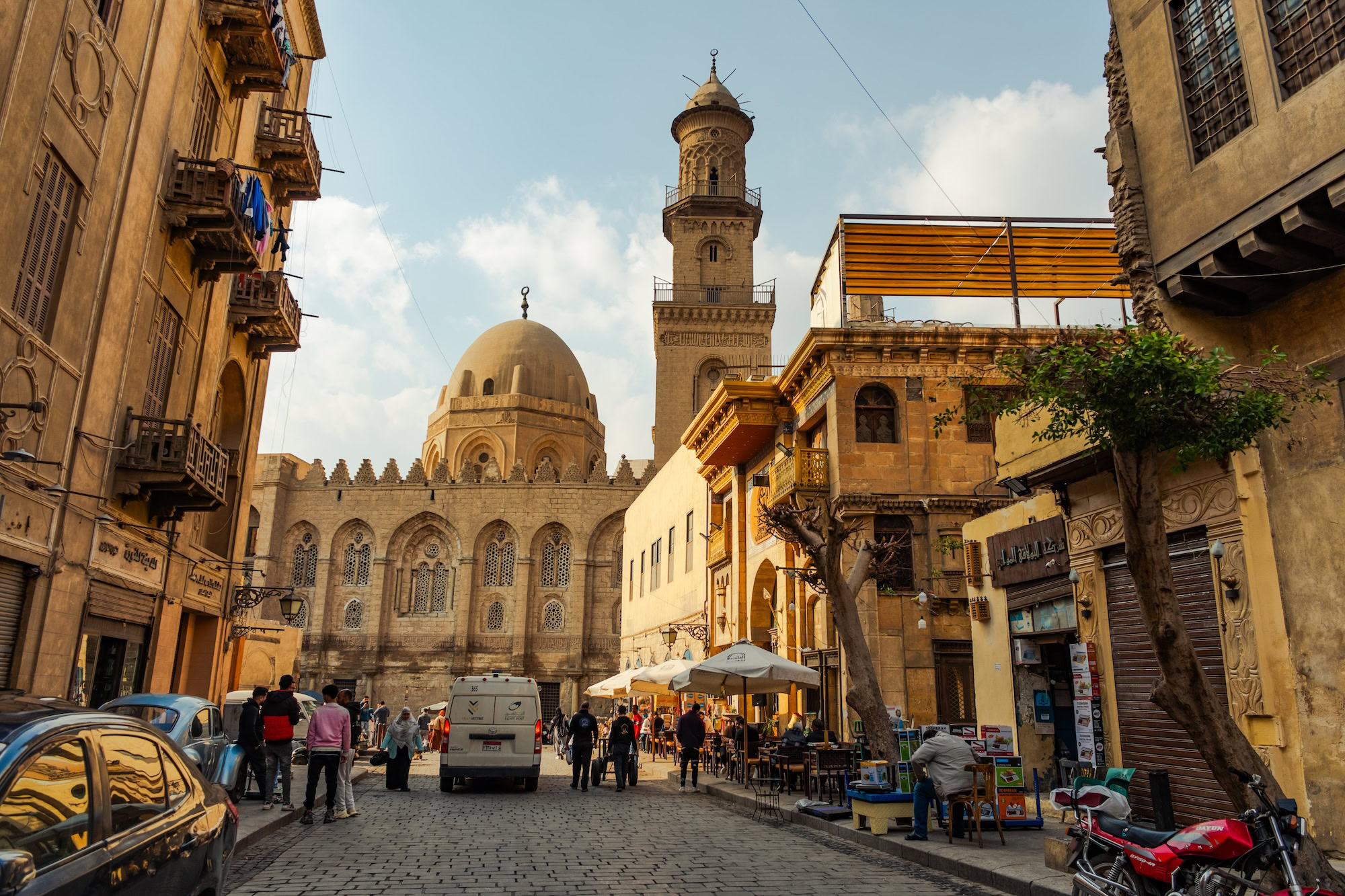
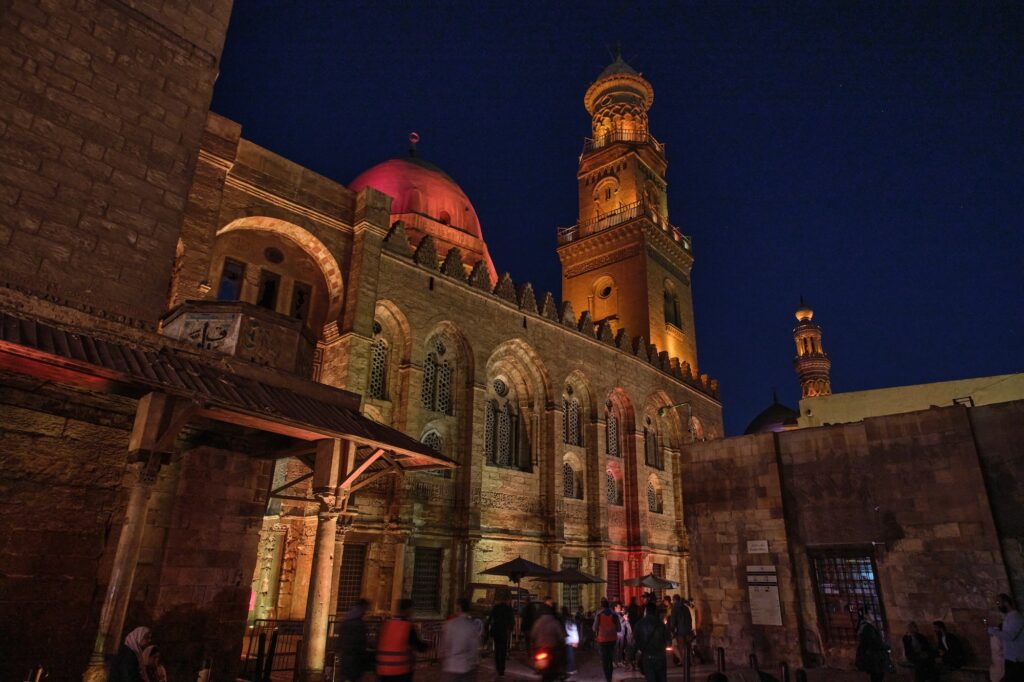
Standing majestically on al-Mu’izz Street, the Qalawun Complex represents one of Islamic Cairo’s most extraordinary architectural achievements.
This remarkable monument perfectly embodies the ambition and innovation of Mamluk Sultan al-Mansur Qalawun, who commissioned this multifunctional masterpiece in 1284. The complex revolutionized Islamic architecture by seamlessly integrating four distinct institutions: a madrasa for religious education, a bimaristan (hospital) for medical care, a mausoleum for royal burial, and a mosque for prayer. Each structure showcases breathtaking craftsmanship, from intricate marble revetment inlaid with mother-of-pearl to soaring minarets that pierce Cairo’s skyline.
Today, this UNESCO World Heritage site attracts visitors worldwide who come to witness its stunning blend of Islamic, Andalusian, and Gothic architectural elements. We guide travelers through this architectural marvel, revealing the stories carved into its walls and the legacy that continues to inspire modern architects and historians alike.
A Monument Built in Record Time
The Qalawun Complex stands as testimony to medieval Cairo’s extraordinary construction capabilities. In just thirteen months, from June 1284 to August 1285, Sultan al-Mansur Qalawun’s vision transformed into reality. This breakneck construction pace required unprecedented organization and resources.
The Controversial Construction Process
Contemporary historian Al-Maqrizi documented the brutal conditions under which this architectural wonder arose. The sultan employed Mongol prisoners of war as forced laborers, a practice that sparked considerable controversy even in medieval times. Despite these harsh methods, skilled craftsmen from across the Islamic world contributed their expertise to create decorative elements that remain unmatched today.
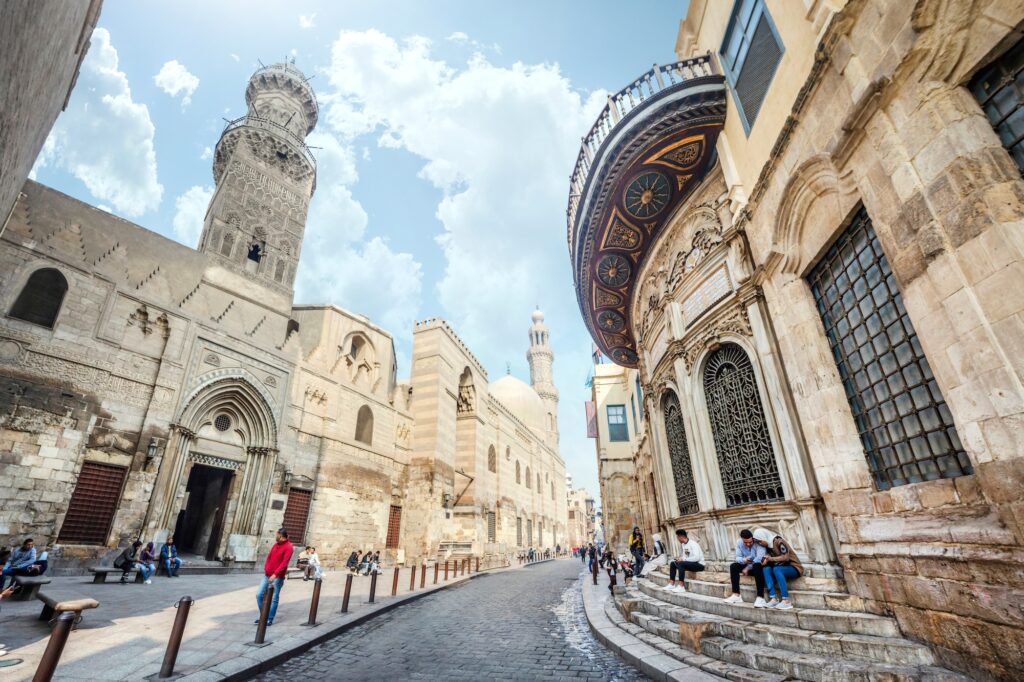
Emir Alam al-Din Sanjar supervised the daily construction operations, coordinating hundreds of workers who labored around the clock. The project consumed massive quantities of marble, granite, and precious materials sourced from dismantled Fatimid structures.
Strategic Location and Royal Ambitions
The complex’s location at Bayn al-Qasrayn wasn’t coincidental. This prestigious address on al-Mu’izz Street positioned Qalawun’s monument among Cairo’s most important religious and political buildings. The site previously housed parts of the Fatimid Western Palace, adding layers of historical significance to the new construction.
Qalawun deliberately chose this location to showcase his dynasty’s legitimacy and power, creating a visual statement that would overshadow previous rulers’ achievements.
Architectural Innovation Meets Functional Excellence
The Qalawun Complex pioneered the concept of integrated Islamic architecture, where multiple building types shared common walls while maintaining distinct functions.
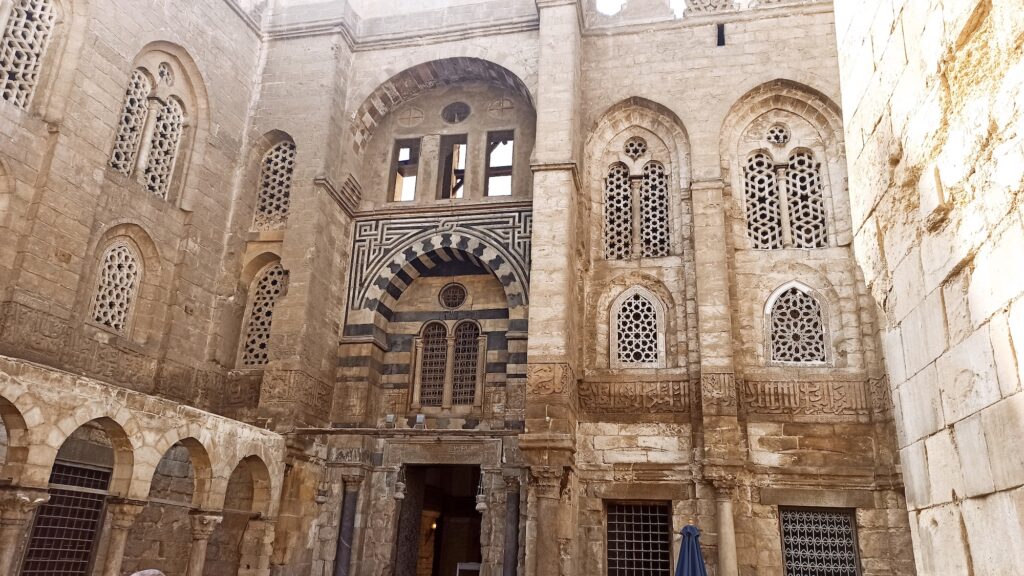
This revolutionary design allowed worshippers, students, patients, and mourners to coexist within the same complex without interference. The genius lies in the circulation patterns that connect all four structures through a series of courtyards and corridors. Visitors enter through an ornate portal that immediately demonstrates the building’s grandeur through its pointed arch decorated with intricate geometric patterns.
The complex’s most striking feature is its unique three-part basilica-like iwan facing the qibla direction. This architectural element, unprecedented in Islamic construction, incorporates rounded horseshoe arches that create an almost cathedral-like atmosphere. Modern architectural historians compare this space to Norman churches, highlighting the remarkable cross-cultural exchange that influenced Mamluk builders.
The Madrasa: Center of Islamic Learning
The madrasa component housed one of medieval Cairo’s most prestigious educational institutions. Four separate teaching halls accommodated the four Sunni schools of Islamic jurisprudence, ensuring comprehensive religious education for students from across the Islamic world.
Academic Organization and Daily Life
Each madhhab (legal school) operated independently within the complex, with dedicated faculty and specialized curricula. Students received free education, accommodation, and meals, making this institution accessible regardless of economic background. The library contained thousands of manuscripts covering Islamic law, theology, medicine, and science.
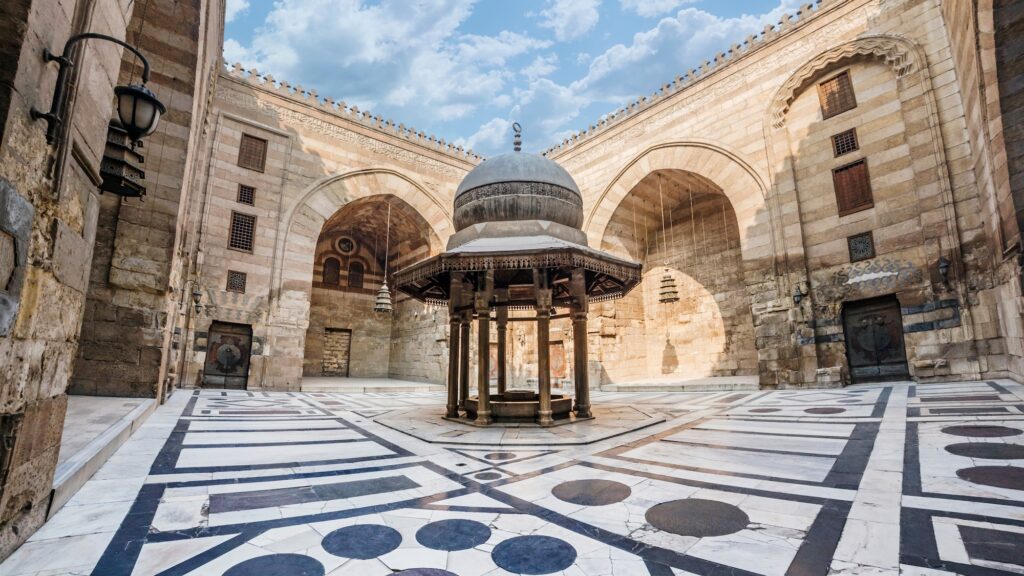
Classes began before dawn with Quran recitation and continued throughout the day with lectures on Islamic jurisprudence, Arabic grammar, and theological debates. Advanced students participated in scholarly discussions that often attracted visitors from distant cities.
Architectural Features Supporting Education
The madrasa’s design specifically supported its educational mission. Small study cells provided quiet spaces for individual contemplation and memorization. A central courtyard served as an informal gathering space where students could discuss lessons and build scholarly relationships. Ornate decoration in teaching halls created an atmosphere of reverence and intellectual seriousness.
Medical Innovation at the Bimaristan
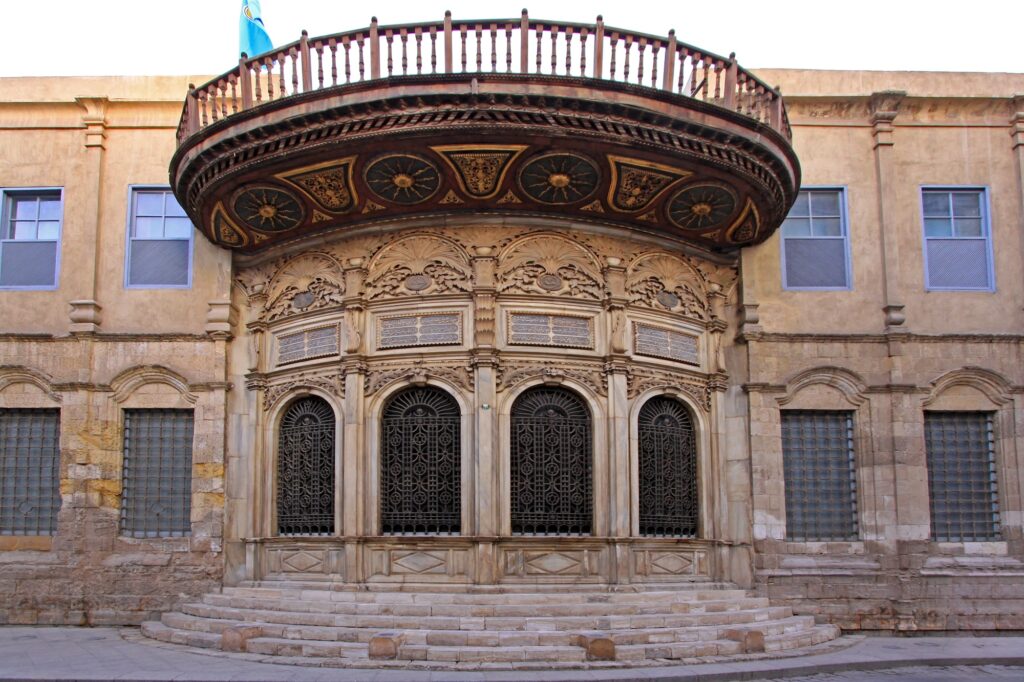
The hospital within the Qalawun Complex represented medieval medicine’s pinnacle in the Islamic world. This bimaristan provided free healthcare to all patients regardless of social status or religious affiliation, establishing a model that influenced hospital design for centuries.
Comprehensive Medical Services
The facility employed doctors specializing in surgery, internal medicine, ophthalmology, and mental health. Nurses provided round-the-clock patient care, while pharmacists prepared medications from herbs and minerals. The hospital’s reputation attracted patients from throughout the Mediterranean region.
Medical students received hands-on training by observing experienced physicians during patient rounds. This educational component made the bimaristan a teaching hospital centuries before such institutions became common in Europe.
Architectural Design for Healing
Architects designed the hospital spaces to promote patient recovery through natural light, ventilation, and peaceful courtyards. Separate wards accommodated male and female patients, with private rooms available for wealthy clients. A dedicated pharmacy prepared medications using the latest medical knowledge of the time.
The Mausoleum: Royal Burial in Splendor
Sultan Qalawun’s mausoleum showcases medieval Islamic art at its most refined level. The octagonal structure originally featured a stunning dome that unfortunately fell victim to 18th-century destruction, later replaced by Max Herz Bey’s concrete reconstruction in 1903.
The interior decoration overwhelms visitors with its intricate marble revetment, carved wooden screens, and elaborate stucco ornamentation. Geometric patterns flow across every surface, creating visual rhythms that guide the eye toward the central tomb. Mother-of-pearl inlays catch light from colored glass windows, producing an ethereal atmosphere appropriate for royal burial.
This space connects to the madrasa through a long entrance passage that creates a processional route for funeral ceremonies and commemorative visits. The mausoleum’s design influenced subsequent Mamluk burial architecture throughout Egypt and Syria.
Artistic Synthesis: East Meets West
The complex’s decoration reveals fascinating cultural exchanges between Islamic and Christian artistic traditions. Craftsmen incorporated elements reminiscent of Andalusian art, reflecting the sophisticated trade networks that connected medieval Cairo to distant regions.
Colored glass windows display geometric patterns similar to those found in Gothic churches, while pointed arches echo contemporary European cathedral architecture. This artistic synthesis resulted from the Crusades’ complex cultural exchanges, where conflict coexisted with intellectual and artistic sharing.
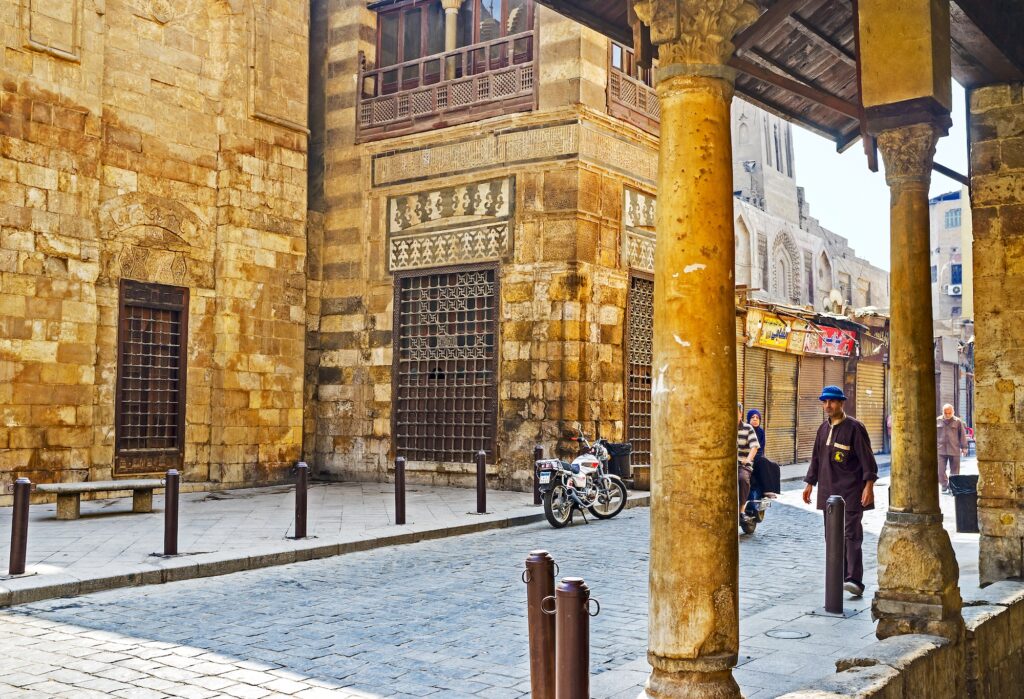
Marble panels feature intricate carving that demonstrates the highest level of medieval craftsmanship. Calligraphic inscriptions in elegant Kufic script interweave with flowing arabesque patterns, creating surfaces that reward close examination with increasingly complex details.
The Adjacent Mosque of Al-Nasir Muhammad
Adjacent to the original complex stands the royal mosque commissioned by Qalawun’s son, Sultan al-Nasir Muhammad, in 1318. This hypostyle mosque features granite columns and a distinctive minaret that complements the original complex’s skyline.
The mosque’s prayer hall accommodates large congregations for Friday prayers and religious festivals. Its architectural style reflects early 14th-century developments in Mamluk design, showing how the complex continued evolving after Qalawun’s death.
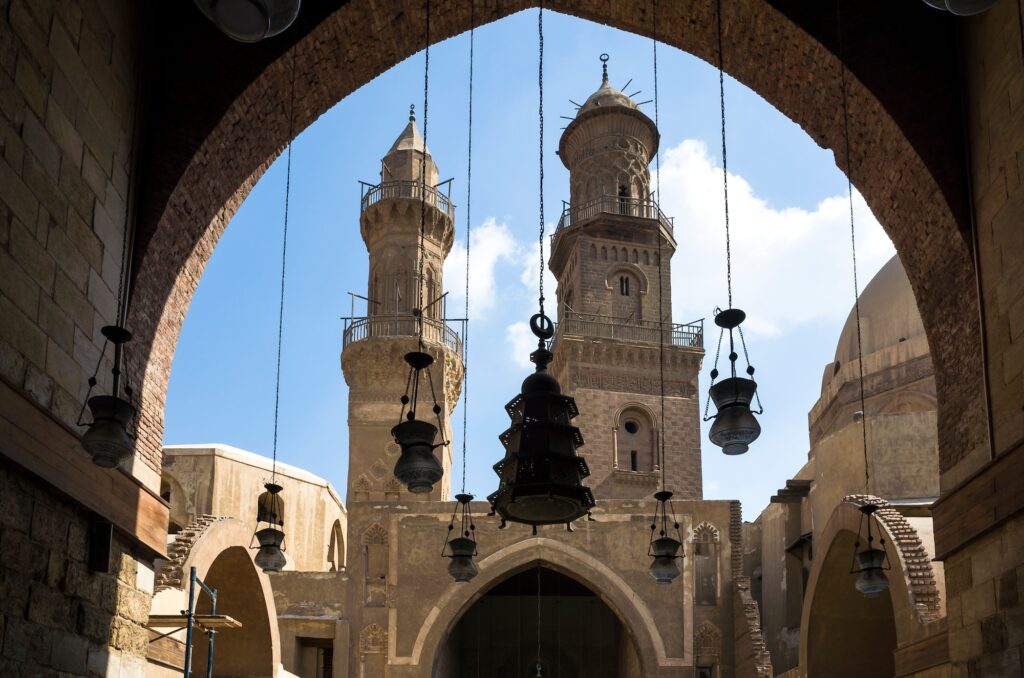
Together, these structures create an architectural ensemble that demonstrates the Mamluk dynasty’s commitment to religious, educational, and social welfare.
Visiting the Qalawun Complex Today
Modern visitors can explore this architectural masterpiece as part of Islamic Cairo’s UNESCO World Heritage area. The complex opens daily, though prayer times may restrict access to certain areas. We recommend early morning visits to avoid crowds and appreciate the natural lighting that illuminates the intricate decorations.
Professional guides enhance the experience by explaining architectural details and historical context that casual visitors might overlook. The complex’s location makes it easily accessible from other major attractions like Khan el-Khalili bazaar and al-Azhar Mosque.
Photography is permitted in most areas, allowing visitors to capture the stunning geometric patterns and architectural details. However, respectful behavior is essential, particularly in active prayer spaces and near the mausoleum.
Frequently Asked Questions
What are the Qalawun Complex opening hours?
Daily from 9:00 am to 5:00 pm (09:00-17:00), though Friday prayers may temporarily restrict access.
How much time should I spend visiting the complex?
Plan at least 1-2 hours to properly appreciate the architecture and historical significance.
Is photography allowed inside the buildings?
Yes, photography is permitted in most areas, but flash photography may be restricted near delicate decorations.
What’s the entry fee for international visitors?
Entry costs approximately 100 Egyptian pounds for foreign tourists, with student discounts available.
Can I visit during Ramadan or religious holidays?
The complex remains open but may have modified schedules during Islamic holidays and prayer times.
Is the complex wheelchair accessible?
Limited accessibility exists due to the medieval architecture, with stairs and narrow passages in some areas.
What other attractions are nearby?
Khan el-Khalili bazaar, al-Azhar Mosque, and the Citadel of Saladin are all within walking distance.
Should I hire a guide for the visit?
While not required, knowledgeable guides significantly enhance understanding of the complex’s historical and architectural significance.
What’s the best time of day to visit?
Early morning offers the best lighting conditions and fewer crowds for photography and contemplation.
Are there facilities for visitors like restrooms and cafes?
Basic facilities are available, though we recommend planning refreshment stops at nearby establishments.
How does the complex compare to other Islamic monuments in Cairo?
Many consider it the second most beautiful mausoleum worldwide after the Taj Mahal, highlighting its exceptional architectural significance.
What should I wear when visiting religious areas?
Modest clothing covering shoulders and knees is required, with head covering recommended for women in prayer areas.
Design Your Custom Tour
Explore Egypt your way by selecting only the attractions you want to visit