

Meidum Pyramid – An Example of Engineering Gone Wrong
Step into ancient Egypt’s most fascinating architectural experiment.
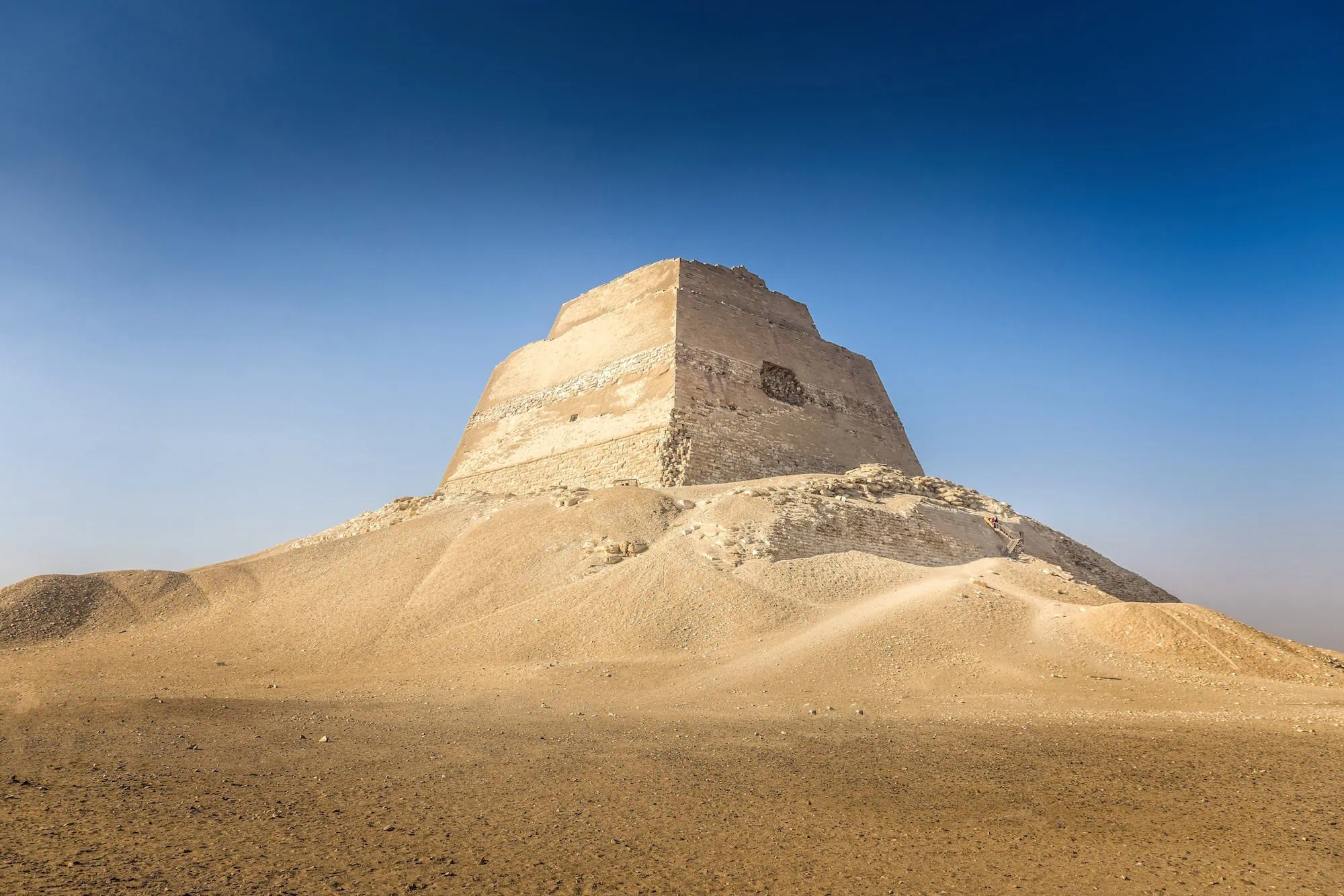
The Meidum Pyramid stands as a remarkable testament to ancient Egyptian ambition and innovation. Located 65 km (40 miles) south of Cairo, this partially collapsed monument represents pharaoh Sneferu’s bold attempt to create Egypt’s first true pyramid around 2600 BC. Unlike the stepped pyramids that came before, Meidum was designed with straight, angled sides – a revolutionary concept that would define pyramid construction for centuries.
The pyramid’s dramatic partial collapse in antiquity has left behind a haunting three-tiered tower that rises from a massive pile of rubble, creating one of Egypt’s most mysterious and photogenic ancient sites.
Today, this pyramid offers visitors an intimate glimpse into the trial-and-error process that led to the Great Pyramid of Giza. We’ve guided countless travelers through this extraordinary site, and each visit reveals new details about ancient Egyptian engineering prowess.
Table of Contents
The Revolutionary Architecture That Changed Egypt Forever
Sneferu’s architects broke new ground when they conceived the Meidum Pyramid. Previous pharaohs had built step pyramids, but Meidum was designed from the start as a true pyramid with smooth, angled sides rising at 51.8 degrees.
The Three-Phase Construction Mystery
Archaeological evidence reveals three distinct building phases, labeled E1, E2, and E3 by researchers. The first phase created a seven-step tower, followed by an eighth step in phase two. The final phase transformed the stepped structure into a smooth-sided pyramid by filling in the steps and adding an outer casing of fine limestone.
This ambitious transformation required innovative engineering solutions. The builders used a corbelled ceiling technique in the burial chamber, where stones were carefully arranged to distribute the enormous weight of the superstructure above. Small relieving chambers were built into the walls to prevent collapse.
Why It Partially Collapsed
The pyramid’s partial collapse wasn’t due to poor construction but rather the ambitious scale of the project. When builders filled in the steps to create smooth sides, they may not have properly bonded the new masonry to the original stepped core. Over centuries, this outer shell gradually gave way, leaving the stepped core visible as a three-tiered tower surrounded by limestone debris.
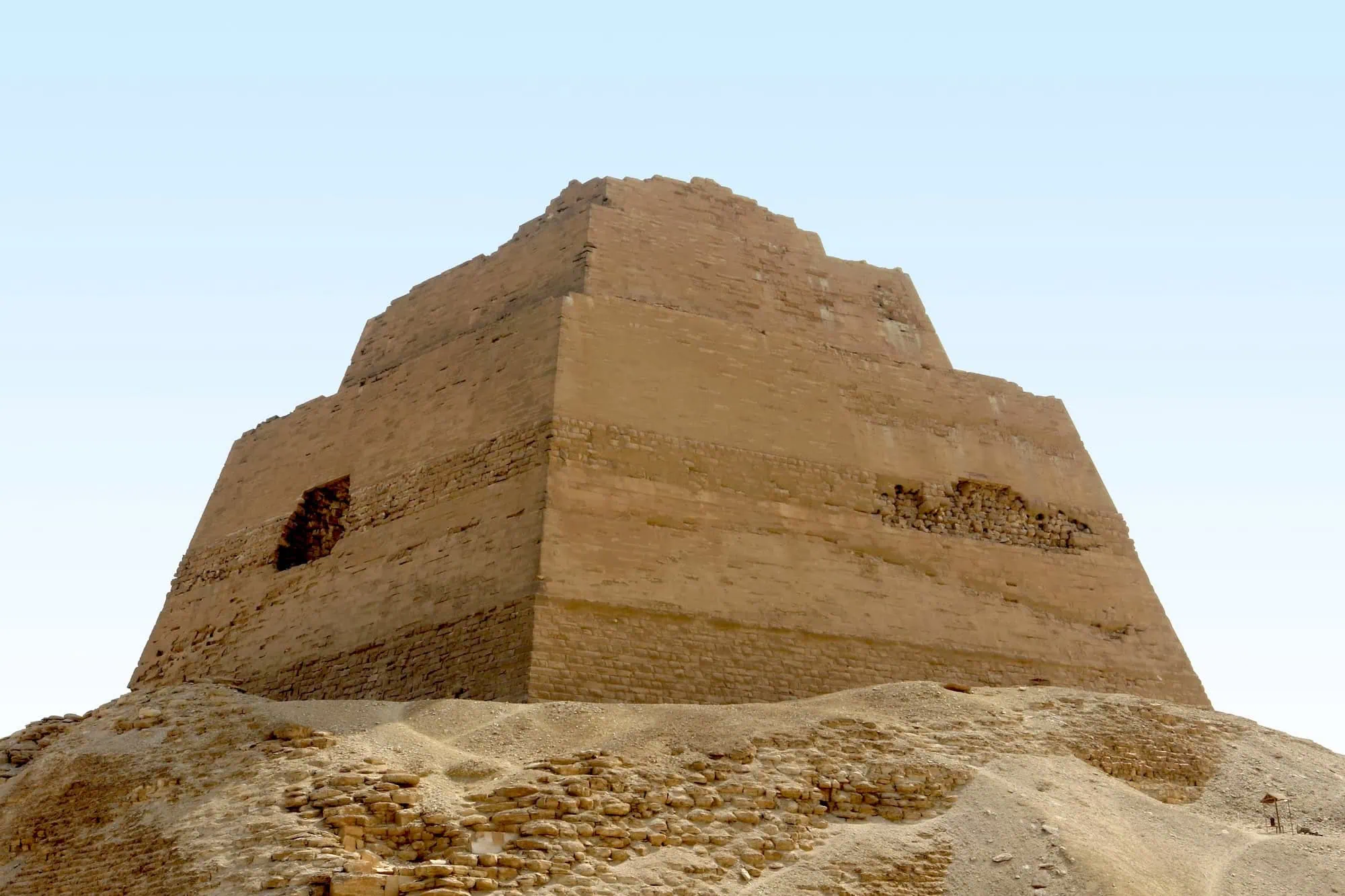
Inside the Pyramid Today
Visitors can enter through a passage on the north side that descends into the bedrock before rising again to reach the burial chamber. The chamber itself is a marvel of engineering, with its corbelled ceiling rising to a height of 5.05 meters (16.6 feet). Two small niches in the walls may have held canopic jars or other burial goods.
Sneferu’s Grand Pyramid Building Program
Sneferu didn’t stop with Meidum. This pyramid was just the beginning of the most ambitious building program in Egyptian history.
After learning from Meidum’s construction challenges, Sneferu moved north to Dahshur where he built two more pyramids. The Bent Pyramid, with its distinctive change in angle halfway up, reflects the lessons learned from Meidum’s structural issues. Finally, the Red Pyramid became Egypt’s first successfully completed true pyramid, paving the way for his son Khufu’s Great Pyramid at Giza.
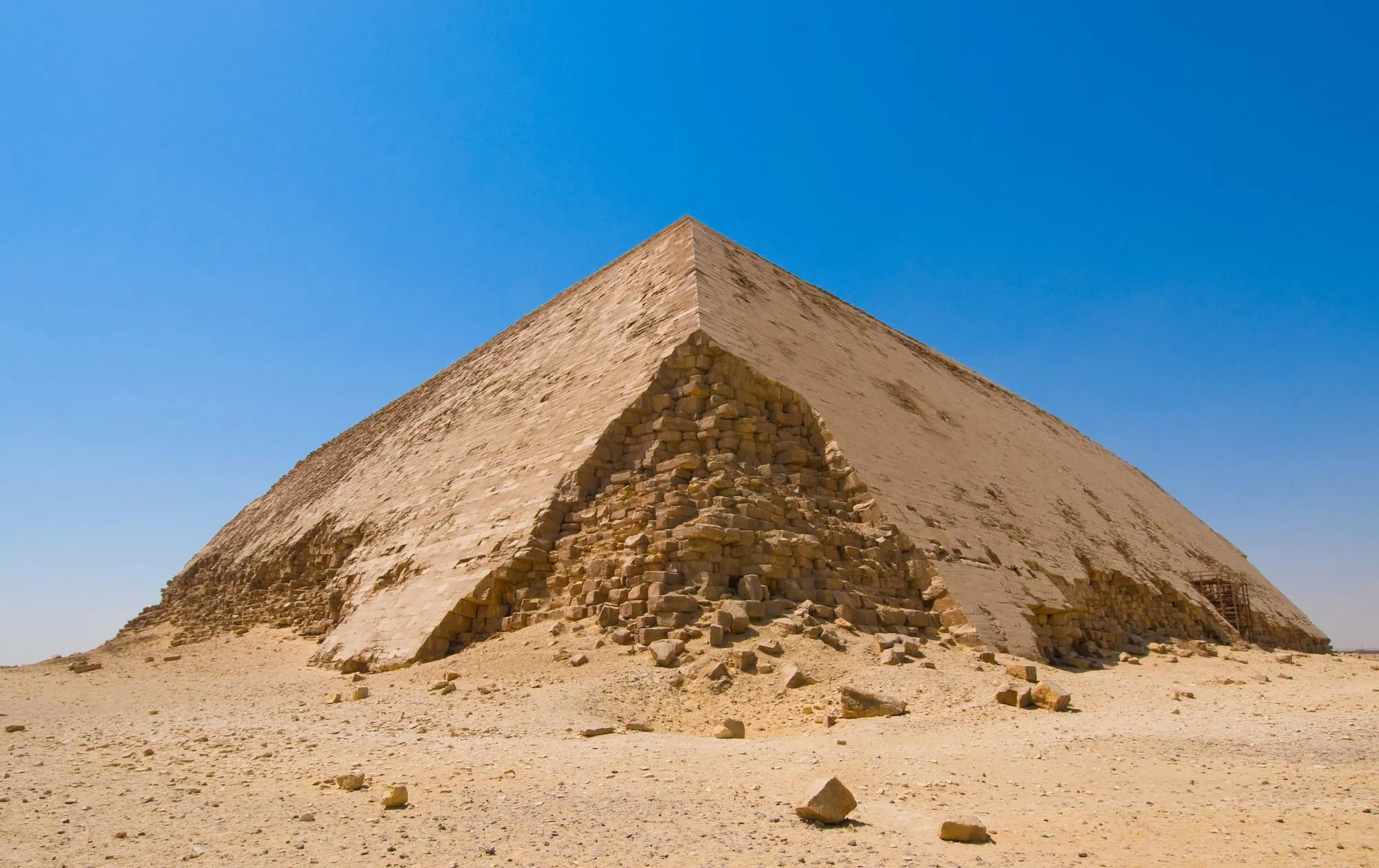
The technological knowledge gained from Meidum directly influenced pyramid construction for the next thousand years. Modern archaeologists have identified specific techniques first tested at Meidum that appear in later monuments throughout the Old Kingdom period.
The Mastabas and Royal Courtiers
The pyramid complex includes several fascinating mastaba tombs that housed members of Sneferu’s royal court. The most famous belongs to Ra-hotep and his wife Noferet, whose limestone statues are considered masterpieces of Old Kingdom art.
The Geese of Meidum
One mastaba yielded the famous “Geese of Meidum” painting, now displayed in the Egyptian Museum in Cairo. This vibrant fresco demonstrates the artistic sophistication of the 4th Dynasty and provides insight into daily life during Sneferu’s reign.
Accessing the Royal Tombs
Several mastabas remain open to visitors, though access requires special permission. The burial chambers contain original wall decorations and hieroglyphic inscriptions that name court officials and describe their roles in the royal administration.
Planning Your Visit to Meidum
We recommend visiting Meidum as part of a full-day excursion from Cairo, often combined with nearby Fayoum Oasis or the Bent Pyramid at Dahshur.
Practical Information
The site opens daily from 8:00 am (08:00) to 5:00 pm (17:00). The entrance tunnel can be challenging for those with mobility issues, as it involves crawling through narrow passages.
Getting There
Meidum lies approximately 100 km (62 miles) south of central Cairo along the road to Fayoum. The drive takes about 90 minutes in normal traffic. Most visitors arrive as part of organized tours, though independent travelers can hire a taxi for the day.
What to Bring
Comfortable shoes with good grip are essential for navigating the rocky terrain around the pyramid. A flashlight helps illuminate details inside the burial chamber, though some lighting is provided. Bring water and sun protection, as shade is limited at the site.
Combined Itineraries
Many travelers visit Meidum alongside Dahshur to explore Sneferu’s complete pyramid-building evolution, offering a clear contrast between his early experimental designs and later architectural achievements. The nearby Memphis region and the Saqqara Complex also pair seamlessly with Meidum, creating a well-rounded itinerary that highlights the most important Old Kingdom monuments in Egypt.
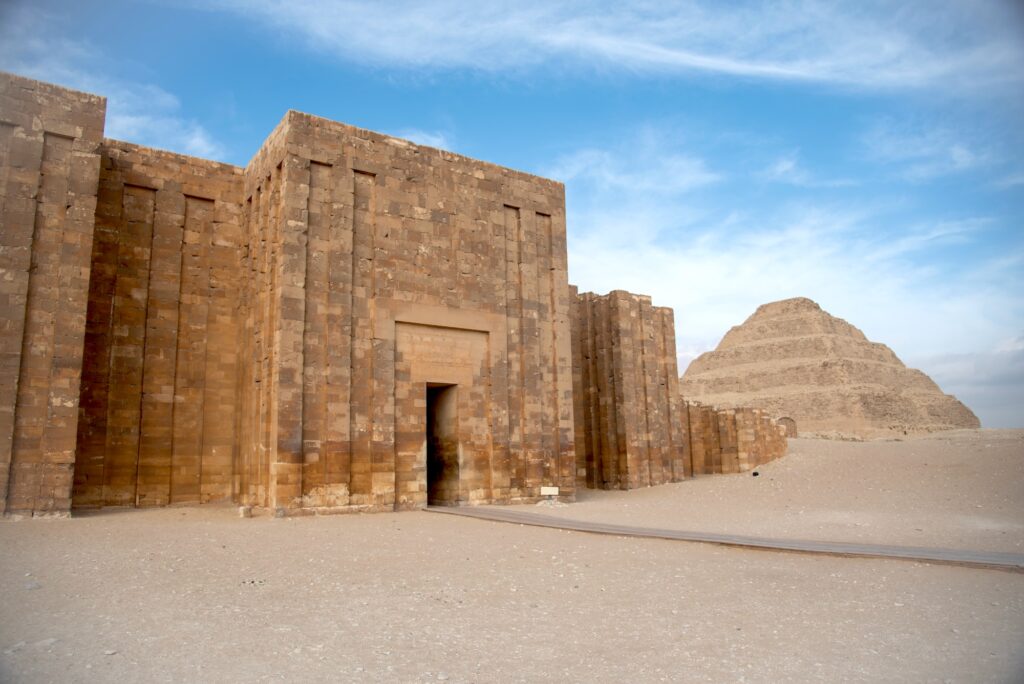
Our private tours include qualified Egyptologist guides who bring the archaeological evidence to life and provide deeper insight into the pyramid’s historical significance. With modern, air-conditioned vehicles and experienced drivers, we ensure a comfortable journey to this remote yet highly rewarding destination.
Archaeological Discoveries and Ongoing Research
British archaeologist Flinders Petrie conducted the first systematic excavation of Meidum in the 1890s, though earlier explorers like John Shae Perring and Karl Richard Lepsius had documented the site. Petrie’s work revealed the pyramid’s three construction phases and uncovered the spectacular artifacts now housed in museums worldwide.
Recent archaeological work has focused on understanding the collapse mechanism and dating the various construction phases more precisely. Ground-penetrating radar has revealed additional chambers and passages that may have been sealed since ancient times. French and Egyptian teams continue to study the site using advanced techniques including photogrammetry and 3D modeling to preserve digital records of this fragile monument.
The debate over whether Huni or Sneferu built the pyramid continues among Egyptologists, with most evidence pointing to Sneferu as the primary builder who may have completed a monument begun by his predecessor.
The Pyramid’s Place in Egyptian History
Meidum represents a crucial turning point in ancient Egyptian architecture. Before this pyramid, royal tombs were rectangular mastabas or step pyramids. The concept of a true pyramid – a monument reaching toward the sun god Ra with perfect geometric precision – began here in the desert south of Memphis.
The pyramid complex also reflects the growing power of the pharaoh during the early 4th Dynasty. The massive resources required to quarry, transport, and precisely place millions of limestone blocks demonstrate unprecedented royal authority. Workers came from across Egypt to participate in this grand project, creating a national building program that would define Egyptian civilization for millennia.
Understanding Meidum helps visitors appreciate the remarkable achievements at Giza. Without Sneferu’s experiments at Meidum and Dahshur, his son Khufu could never have built the Great Pyramid with such confidence and precision.
Discover The Origins Of Pyramid Building At Meidum
The Meidum Pyramid offers a rare look into the evolution of Egypt’s most iconic structures—standing quietly in the desert, rich in mystery and historical significance. With EgyptToursPlus, we seamlessly include this fascinating site in a private journey that connects early pyramid history with Egypt’s most celebrated landmarks.
You choose your travel dates, your pace, and the experiences that shape your route. From ancient wonders to cultural highlights and comfortable stays, we tailor every detail around your preferences—ensuring a smooth, refined, and deeply personal travel experience from start to finish.
Frequently Asked Questions
Meidum Pyramid is widely considered Egypt’s first true attempt at a smooth-sided pyramid, making it a critical architectural bridge between stepped pyramids and later monuments like the Great Pyramid of Giza. Built during the early 4th Dynasty around 2600 BC, the structure began as a step pyramid before being modified into a straight-sided form. Its partially collapsed outer casing reveals the inner stepped core, which gives archaeologists rare insight into early pyramid engineering experiments. Visitors interested in pyramid evolution often rank Meidum among Egypt’s most historically important sites.
Yes, visitors can enter the Meidum Pyramid through a north-facing entrance passage that leads to the burial chamber high inside the surviving core structure. The experience is more physically demanding than entering larger pyramids at Giza because the tunnels are narrow, steep, and occasionally require crouching or crawling. Interior temperatures can become warm and humid, especially between May and September. Travelers uncomfortable with confined spaces or steep inclines may prefer exploring the exterior and surrounding mastaba tombs instead.
Most Egyptologists attribute the Meidum Pyramid to Pharaoh Sneferu, who ruled during Egypt’s 4th Dynasty around 2613-2589 BC, although evidence suggests the project may have originated under his predecessor King Huni. Sneferu is also associated with the Bent Pyramid and Red Pyramid at Dahshur, which together document the rapid evolution of pyramid construction techniques in ancient Egypt. The architectural experimentation visible at Meidum helps explain how later pyramids achieved greater structural stability and scale.
The Meidum Pyramid likely collapsed gradually over many centuries rather than during a single catastrophic event, with major structural failures possibly beginning during the New Kingdom around 1500 BC. Ancient travelers already described the monument as partially ruined, suggesting the outer casing had been slipping away long before modern archaeological study began. Because the smooth limestone casing detached from the inner stepped core, the pyramid eventually developed its distinctive tower-like appearance. Today, only the central core and lower rubble mound remain intact.
Meidum Pyramid lies approximately 65 km (40 miles) south of Cairo, and the journey usually takes 90 minutes to 2 hours by private vehicle depending on traffic conditions. The site sits near the entrance to the Fayoum region, making it geographically convenient for combined excursions to Dahshur, Hawara, or the Fayoum Oasis. Because public transportation connections are limited and signage can be inconsistent, most international visitors reach the pyramid through organized tours or private drivers. Early departures help avoid Cairo’s morning traffic congestion.
The Meidum Pyramid partially collapsed because its outer limestone casing was built over a stepped core without sufficiently secure bonding between layers. Over time, gravity, shifting foundations, and erosion caused the smooth exterior stones to detach and slide downward, leaving the inner structure exposed. Archaeologists often compare Meidum with Sneferu’s Bent Pyramid at Dahshur because both monuments reflect the trial-and-error engineering process of early pyramid construction. The collapse ultimately provided valuable lessons for later Old Kingdom builders.
Yes, several important mastaba tombs surround the Meidum Pyramid, including those of Prince Ra-hotep and his wife Noferet, whose painted limestone statues are among the masterpieces of Old Kingdom Egyptian art. The original statues now reside in Cairo’s Egyptian Museum, but the surrounding necropolis still reveals how elite officials and royal relatives were buried near pyramid complexes around 2600 BC. Many visitors overlook these tombs despite their major archaeological significance. Allow extra time beyond the main pyramid to explore the wider site properly.
Early morning visits between 8:00 am and 10:00 am provide the best conditions for exploring Meidum Pyramid, especially during Egypt’s hotter months from May through September. Morning light enhances the texture of the exposed stone core and surrounding desert landscape while temperatures remain significantly cooler than midday highs that often exceed 35°C (95°F) in summer. The site also receives relatively few visitors compared with Giza, so early arrivals often enjoy near-empty views. Winter months from October through April offer the most comfortable overall conditions.
Yes, interior photography at Meidum Pyramid typically requires an additional camera ticket beyond the standard archaeological site admission fee for foreign visitors. Recent pricing has generally ranged around 300 EGP for photography permits and approximately 150 EGP for adult foreign entry tickets, although official rates can change without notice. Mobile phone photography outside the pyramid is usually more flexible than interior photography rules. Travelers planning professional photography or video work should confirm current regulations before arrival.
Most visitors should allow 2 to 3 hours for a complete Meidum Pyramid visit, including time to enter the pyramid, examine the collapsed outer structure, and explore nearby mastaba tombs. Travelers interested primarily in photography may spend less than 90 minutes, while archaeology enthusiasts often stay longer because the site offers unusually clear evidence of pyramid construction methods. The surrounding desert landscape also creates excellent panoramic viewpoints. Visiting early helps avoid midday heat and allows more comfortable exploration of exposed outdoor areas.
Yes, Meidum Pyramid is commonly combined with Dahshur’s Bent and Red Pyramids or with attractions in the Fayoum Oasis as part of a full-day excursion from Cairo. Because Meidum lies south of the capital along routes toward Fayoum, the logistics work well for travelers interested in lesser-visited pyramid fields beyond Giza and Saqqara. Combining multiple sites also helps visitors understand how pyramid design evolved during Egypt’s 4th Dynasty under Sneferu. Private transportation provides the most efficient scheduling flexibility.
Meidum Pyramid can be fascinating for children interested in ancient Egypt, but the interior passages are narrow, steep, and physically challenging for younger visitors. The climb through low tunnels may feel uncomfortable for children under 8 or anyone sensitive to confined spaces, although the dramatic exterior remains enjoyable for families of all ages. Unlike busier sites such as Giza, Meidum offers a quieter and more open environment for photography and exploration. Parents should bring water, hats, and sun protection because shaded areas are limited.
Design Your Custom Tour
Explore Egypt your way by selecting only the attractions you want to visit